Department of Pulmonary Medicine, Kyoto Prefectural University of Medicine, Kyoto, Japan.
Department of Pulmonary Medicine, Kyoto Chubu Medical Center, Kyoto, Japan.
Oncologist. 2019 Aug;24(8):1033-e617. doi: 10.1634/theoncologist.2019-0290. Epub 2019 Apr 30.
In terms of efficacy and safety, good results were obtained with S-1 and paclitaxel (PTX) combination therapy.The findings suggest that S-1 and PTX combination therapy is a feasible treatment option in patients with previously treated non-small cell lung cancer.
Although monotherapy with cytotoxic agents, including docetaxel and pemetrexed, is recommended for patients with previously treated advanced non-small cell lung cancer (NSCLC), its outcomes are unsatisfactory. S-1 is an oral fluoropyrimidine agent that consists of tegafur, 5- chloro-2, 4-dihydroxypyridine, and potassium oxonate. S-1 is approved for patients with gastric cancer in 7 Asian countries and 15 European countries. It is also approved for patients with eight type of cancers, including NSCLC, in Japan. We evaluated the efficacy and toxicity of S-1 and paclitaxel (PTX) combination therapy in patients with previously treated NSCLC.
Oral S-1 was administered thrice weekly on days 1-14 at 80, 100, and 120 mg/day in patients with body surface areas of <1.25, 1.25-1.5, and >1.5 m, respectively. PTX was administered at 80 mg/m on days 1 and 8. Primary endpoint was response rate, and secondary endpoints were progression-free survival (PFS), overall survival (OS), and safety.
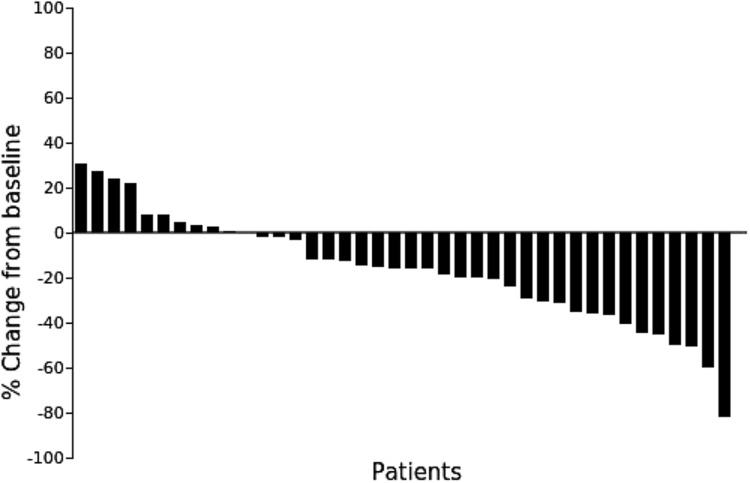
Forty patients were enrolled, with response and disease control rates of 27.5% and 75.0%, respectively (Fig. 1). Median PFS and OS were 6.5 and 20.7 months, respectively. Grade 3/4 anemia and thrombocytopenia were seen in five (12%) and one (2%) patients, respectively. Febrile neutropenia occurred in three patients (7%). Common grade 3/4 nonhematological toxicities were stomatitis (5% of patients), diarrhea (7% of patients), and interstitial lung disease (one patient). No treatment-related deaths were observed.
This S-1 and PTX cotherapy dose and schedule showed satisfactory efficacy, with mild toxicities, in patients with previously treated advanced NSCLC.
在疗效和安全性方面,S-1 联合紫杉醇(PTX)治疗取得了良好的效果。研究结果表明,S-1 联合 PTX 治疗是治疗既往治疗的非小细胞肺癌患者的一种可行的治疗选择。
尽管包括多西紫杉醇和培美曲塞在内的细胞毒药物的单药治疗被推荐用于既往治疗的晚期非小细胞肺癌(NSCLC)患者,但疗效并不令人满意。S-1 是一种口服氟嘧啶药物,由替加氟、5-氯-2,4-二羟基吡啶和氧嗪酸钾组成。S-1 在亚洲的 7 个国家和欧洲的 15 个国家被批准用于胃癌患者,在日本也被批准用于包括 NSCLC 在内的 8 种癌症患者。我们评估了 S-1 联合紫杉醇(PTX)治疗既往治疗的 NSCLC 患者的疗效和毒性。
对于体表面积<1.25、1.25-1.5 和>1.5 m 的患者,分别给予口服 S-1,每周 3 次,第 1-14 天,剂量分别为 80、100 和 120 mg/天。PTX 剂量为 80 mg/m,第 1 和 8 天给药。主要终点为缓解率,次要终点为无进展生存期(PFS)、总生存期(OS)和安全性。
共纳入 40 例患者,缓解率和疾病控制率分别为 27.5%和 75.0%(图 1)。中位 PFS 和 OS 分别为 6.5 和 20.7 个月。3/4 级贫血和血小板减少分别发生在 5(12%)和 1(2%)例患者中。3 例(7%)患者发生发热性中性粒细胞减少。常见的 3/4 级非血液学毒性为口腔炎(5%的患者)、腹泻(7%的患者)和间质性肺病(1 例)。无治疗相关死亡。
S-1 联合 PTX 治疗剂量和方案在既往治疗的晚期 NSCLC 患者中显示出良好的疗效,毒性轻微。