Department of Medical Oncology, Leiden University Medical Center, Leiden, The Netherlands
Department of Medical Oncology, Leiden University Medical Center, Leiden, The Netherlands.
Oncologist. 2019 Jul;24(7):889-e421. doi: 10.1634/theoncologist.2019-0280. Epub 2019 Apr 30.
Adjuvant treatment with zoledronic acid did not decrease the recurrence rate of giant cell tumor of bone (GCTB) in this study. The efficacy could not be determined because of the small sample size.GCTB recurrences, even in the denosumab era, are still an issue; therefore, a randomized study exploring the efficacy of zoledronic acid in the adjuvant setting in GCTB is still valid.
Bisphosphonates are assumed to inhibit giant cell tumor of bone (GCTB)-associated osteoclast activity and have an apoptotic effect on the neoplastic mononuclear cell population. The primary objective of this study was to determine the 2-year recurrence rate of high-risk GCTB after adjuvant zoledronic acid versus standard care.
In this multicenter randomized open-label phase II trial, patients with high-risk GCTB were included (December 2008 to October 2013). Recruitment was stopped because of low accrual after the introduction of denosumab. In the intervention group, patients received adjuvant zoledronic acid (4 mg) intravenously at 1, 2, 3, 6, 9, and 12 months after surgery.
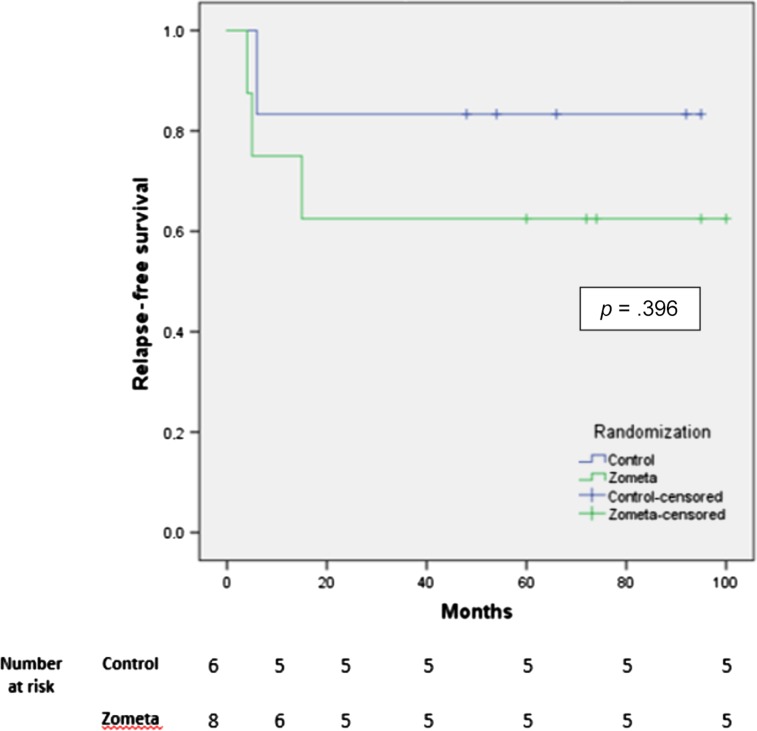
Fourteen patients were included (intervention = 8, controls = 6). Median follow-up was long: 93.5 months (range, 48-111). Overall 2-year recurrence rate was 38% (3/8) in the intervention versus 17% (1/6) in the control group ( = .58). All recurrences were seen within the first 15 months after surgery.
Adjuvant treatment with zoledronic acid did not decrease the recurrence rate of GCTB in this study. The efficacy could not be determined because of the small sample size. Because recurrences, even in the denosumab era, are still an issue, a randomized study exploring the efficacy of zoledronic acid in the adjuvant setting in GCTB is still valid.
在这项研究中,唑来膦酸辅助治疗并未降低骨巨细胞瘤(GCTB)的复发率。由于样本量小,无法确定疗效。即使在地舒单抗时代,GCTB 的复发仍然是一个问题;因此,一项探索唑来膦酸在 GCTB 辅助治疗中的疗效的随机研究仍然有效。
双膦酸盐被认为可以抑制骨巨细胞瘤(GCTB)相关破骨细胞活性,并对肿瘤单核细胞群具有凋亡作用。本研究的主要目的是确定高危 GCTB 患者在接受唑来膦酸辅助治疗与标准治疗后的 2 年复发率。
在这项多中心随机开放标签 II 期试验中,纳入了高危 GCTB 患者(2008 年 12 月至 2013 年 10 月)。在引入地舒单抗后,由于入组人数较少,试验停止。在干预组中,患者在手术后 1、2、3、6、9 和 12 个月时接受静脉注射唑来膦酸(4 mg)。
共纳入 14 例患者(干预组 8 例,对照组 6 例)。中位随访时间长:93.5 个月(范围,48-111)。干预组的 2 年总体复发率为 38%(3/8),对照组为 17%(1/6)( =.58)。所有复发均发生在手术后的前 15 个月内。
在这项研究中,唑来膦酸辅助治疗并未降低 GCTB 的复发率。由于样本量小,无法确定疗效。由于即使在地舒单抗时代,复发仍然是一个问题,因此一项探索唑来膦酸在 GCTB 辅助治疗中的疗效的随机研究仍然有效。