Pogge von Strandmann Philip A E, Burton Kevin W, Snæbjörnsdóttir Sandra O, Sigfússon Bergur, Aradóttir Edda S, Gunnarsson Ingvi, Alfredsson Helgi A, Mesfin Kiflom G, Oelkers Eric H, Gislason Sigurður R
LOGIC, Institute of Earth and Planetary Sciences, University College London and Birkbeck, University of London, Gower Street, London, WC1E 6BT, UK.
Department of Earth Sciences, University of Durham, Durham, DH1 3LE, UK.
Nat Commun. 2019 Apr 30;10(1):1983. doi: 10.1038/s41467-019-10003-8.
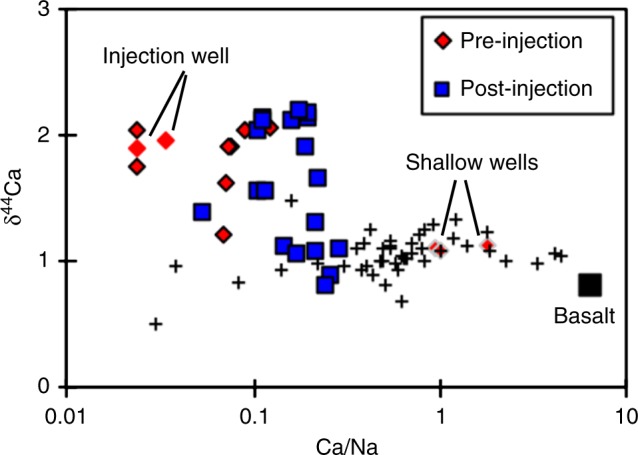
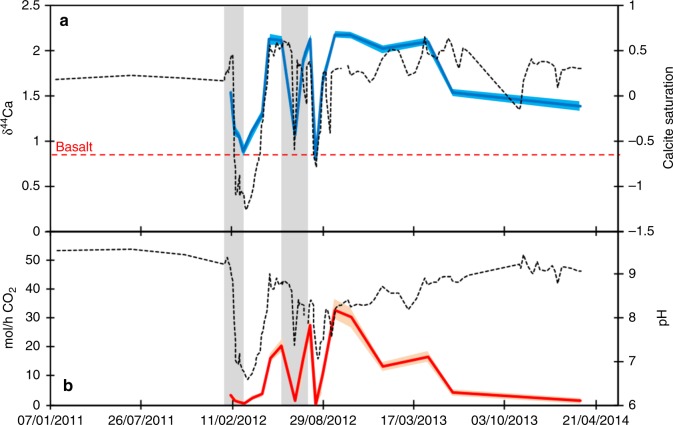
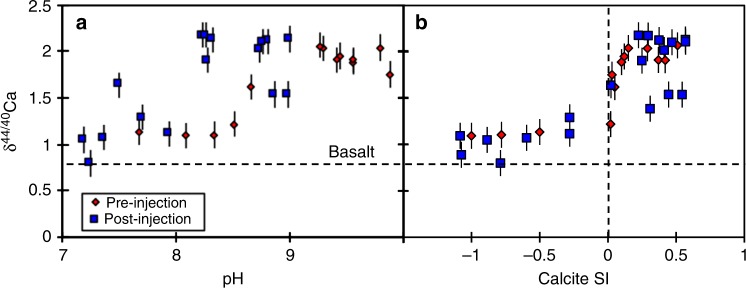
The engineered removal of atmospheric CO is now considered a key component of mitigating climate warming below 1.5 °C. Mineral carbonation is a potential negative emissions technique that, in the case of Iceland's CarbFix experiment, precipitates dissolved CO as carbonate minerals in basaltic groundwater settings. Here we use calcium (Ca) isotopes in both pre- and post-CO injection waters to quantify the amount of carbonate precipitated, and hence CO stored. Ca isotope ratios rapidly increase with the pH and calcite saturation state, indicating calcite precipitation. Calculations suggest that up to 93% of dissolved Ca is removed into calcite during certain phases of injection. In total, our results suggest that 165 ± 8.3 t CO were precipitated into calcite, an overall carbon storage efficiency of 72 ± 5%. The success of this approach opens the potential for quantification of similar mineral carbonation efforts where drawdown rates cannot be estimated by other means.
工程化去除大气中的二氧化碳(CO)现在被认为是将气候变暖控制在1.5°C以下的关键组成部分。矿物碳酸化是一种潜在的负排放技术,就冰岛的CarbFix实验而言,它能在玄武岩地下水环境中将溶解的CO沉淀为碳酸盐矿物。在这里,我们使用注入CO前后的水中的钙(Ca)同位素来量化沉淀的碳酸盐量,从而确定储存的CO量。Ca同位素比值随着pH值和方解石饱和状态迅速增加,表明方解石沉淀。计算表明,在注入的某些阶段,高达93%的溶解Ca被去除到方解石中。总体而言,我们的结果表明,有165±8.3吨CO沉淀为方解石,整体碳储存效率为72±5%。这种方法的成功为量化类似的矿物碳酸化努力开辟了潜力,在这些努力中,其他方法无法估计减排速率。