Fathala Ahmed, Aboulkheir Mervat, Bukhari Salwa, Shoukri Mohamed M, Abouzied Moheieldin M
Department of Radiology Nuclear Medicine and Cardiovascular Imaging, King Faisal Specialist Hospital and Research Centre, Riyadh, Saudi Arabia.
Department of Radiology, Taibah University Madina, Saudi Arabia.
World J Nucl Med. 2019 Apr-Jun;18(2):149-153. doi: 10.4103/wjnm.WJNM_34_18.
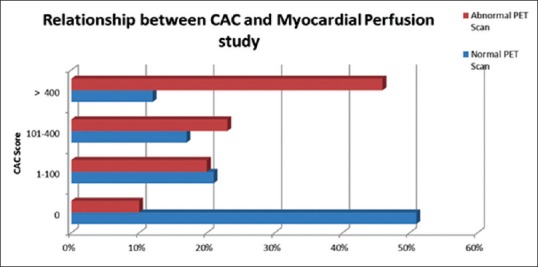
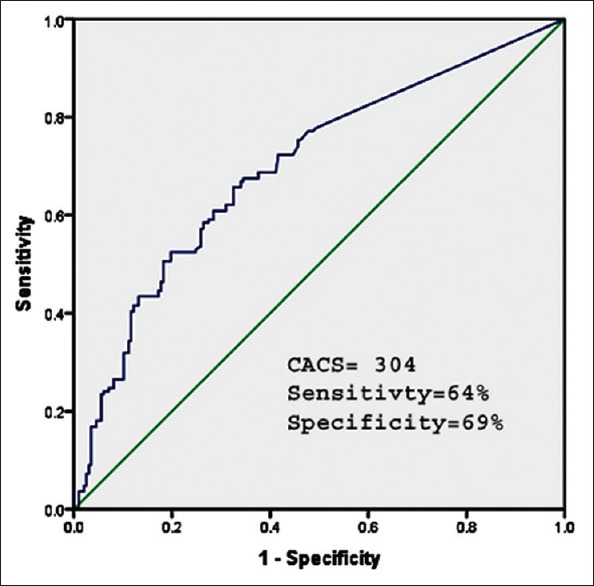
There have been little and conflicting data regarding the relationship between coronary artery calcification score (CACS) and myocardial ischemia on positron emission tomography myocardial perfusion imaging (PET MPI). The aims of this study were to investigate the relationship between myocardial ischemia on PET MPI and CACS, the frequency and severity of CACS in patients with normal PET MPI, and to determine the optimal CACS cutoff point for abnormal PET. This retrospective study included 363 patients who underwent same-setting stress PET perfusion imaging and CACS scan because of clinically suspected coronary artery disease (CAD). Fifty-five (55%) of the 363 patients had abnormal PET perfusion. There was an association between sex, diabetes mellitus (DM), smoking, and CACS and PET perfusion abnormities with = 0.003, 0.05, 0.005, and 0.001, respectively. However, there was no association between PET perfusion abnormalities with age, body mass index, hypertension, and hypercholesterolemia. There was association between CACS and age, sex, and DM with = 0.000, 0.014, and 0.052, respectively, and stepwise increase in the frequency of myocardial ischemia and CACS groups. Receiver-operating characteristic analysis showed that a CACS ≥304 is the optimal cutoff for predicting perfusion abnormalities with sensitivity of 64% and specificity of 69%. In conclusion, the frequency of CAC in patients with normal PET MPI is 49%, it is highly recommended to combine CACS with PET MPI in patients without a history of CAD. PET MPI identifies myocardial ischemia and defines the need for coronary revascularization, but CAC reflects the anatomic burden of coronary atherosclerosis. Combining CACS to PET MPI allows better risk stratification and identifies high-risk patients with PET, and it may change future follow-up recommendations. CACS scan is readily available and easily acquired with modern PET-computed tomography (CT) and single-photon emission CT (SPECT)-CT with modest radiation exposure.
关于冠状动脉钙化评分(CACS)与正电子发射断层扫描心肌灌注成像(PET MPI)中的心肌缺血之间的关系,目前的数据较少且相互矛盾。本研究的目的是探讨PET MPI上的心肌缺血与CACS之间的关系、PET MPI正常患者中CACS的频率和严重程度,并确定PET异常的最佳CACS截断点。这项回顾性研究纳入了363例因临床怀疑冠心病(CAD)而接受同期负荷PET灌注成像和CACS扫描的患者。363例患者中有55例(55%)PET灌注异常。性别、糖尿病(DM)、吸烟与CACS以及PET灌注异常之间存在关联,P值分别为0.003、0.05、0.005和0.001。然而,PET灌注异常与年龄、体重指数、高血压和高胆固醇血症之间没有关联。CACS与年龄、性别和DM之间存在关联,P值分别为0.000、0.014和0.052,并且心肌缺血频率和CACS组呈逐步增加。受试者操作特征分析表明,CACS≥304是预测灌注异常的最佳截断点,敏感性为64%,特异性为69%。总之,PET MPI正常患者中CAC的频率为49%,强烈建议在无CAD病史的患者中将CACS与PET MPI相结合。PET MPI可识别心肌缺血并确定冠状动脉血运重建的必要性,但CAC反映冠状动脉粥样硬化的解剖学负担。将CACS与PET MPI相结合可实现更好的风险分层,并识别出PET高危患者,这可能会改变未来的随访建议。通过现代PET计算机断层扫描(CT)和单光子发射CT(SPECT)-CT,CACS扫描很容易获得,且辐射暴露适度。