Aydin Nuri, Karaismailoglu Bedri, Harbiyeli Emir, Ozsahin Mahmut Kursat
Istanbul University - Cerrahpasa, Cerrahpasa Medical Faculty, Orthopaedics and Traumatology Department, Fatih, Istanbul, Turkey.
Sinop Ayancik State Hospital, Orthopaedics and Traumatology Clinic, Sinop, Turkey.
Acta Orthop Traumatol Turc. 2019 Jul;53(4):266-271. doi: 10.1016/j.aott.2019.04.003. Epub 2019 Apr 30.
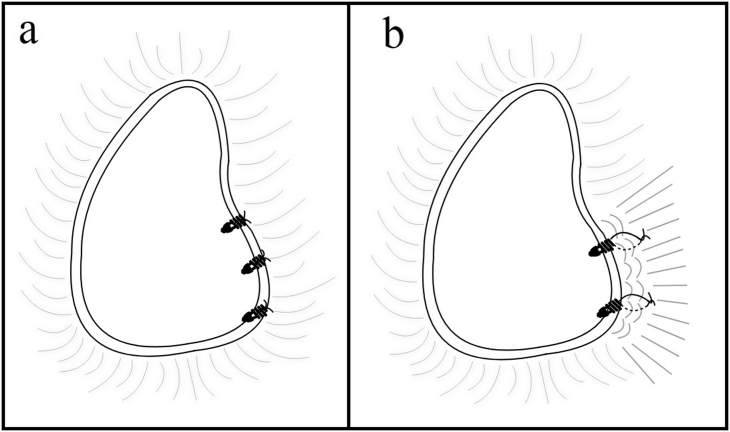
The aim of this study was to compare the complication rates and clinical results of labral repair with two suture anchors and capsular plication, and labral repair with three suture anchor fixation in artroscopic Bankart surgery.
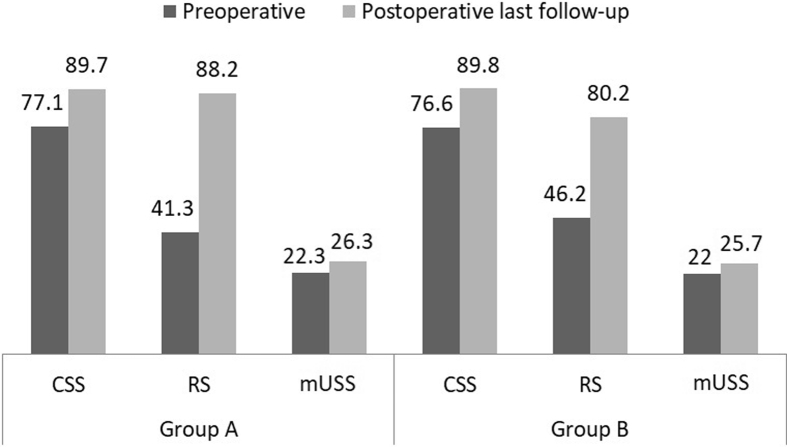
Sixty-nine patients (60 males, 9 females; mean age: 28.2 ± 7.8 years (range: 16-50)) who had undergone arthroscopic repair of a labral Bankart lesion were evaluated. Group A underwent an arthroscopic Bankart repair with three knotless suture anchors, while group B underwent a modified arthroscopic Bankart repair with two knotless suture anchors and an additional capsular plication procedure. The mean follow-up was 52.5 months. Constant Shoulder Score (CSS), Rowe Score (RS), modified UCLA Shoulder Score (mUSS) and range of motion (ROM) were used as outcome measures.
In both groups, a significant improvement was detected in functional outcomes at postoperative last follow-up compared to the preoperative period. No statistically significant difference was found (p > 0.05) in clinical scores (CSS; Group A: 89.7, Group B: 80.2) (RS; Group A: 88.2, Group B: 80.2) (mUSS; Group A: 26.3, Group B: 25.7) external rotation loss (At neutral; Group A: 4.5°, Group B: 5.2°. At abduction; Group A: 4.3°, Group B: 5.7°) and recurrence rates (Group A: 13.3%, Group B: 20.8%). Although the difference was not statistically significant, the recurrence rate was higher in group B (20.8%), compared to group A (13.3%), despite the shorter average follow-up time of group B (p = 0.417).
Arthroscopic repair of labral Bankart lesions with both techniques showed good functional outcomes and stability at the latest follow-up. Higher recurrence rate despite the shorter average follow-up of group B suggests that two anchor usage might not be sufficient for Bankart repair in terms of better stability and less recurrence risk.
Level III, Therapeutic Study.
本研究旨在比较在关节镜下Bankart手术中,使用两个缝合锚钉并进行关节囊折叠术的盂唇修复与使用三个缝合锚钉固定的盂唇修复的并发症发生率和临床结果。
对69例行关节镜下盂唇Bankart损伤修复术的患者(60例男性,9例女性;平均年龄:28.2±7.8岁(范围:16 - 50岁))进行评估。A组采用三个无结缝合锚钉进行关节镜下Bankart修复,而B组采用两个无结缝合锚钉及额外的关节囊折叠术进行改良关节镜下Bankart修复。平均随访时间为52.5个月。采用Constant肩关节评分(CSS)、Rowe评分(RS)、改良UCLA肩关节评分(mUSS)和活动范围(ROM)作为疗效指标。
与术前相比,两组在术后最后一次随访时的功能结果均有显著改善。临床评分(CSS;A组:89.7,B组:80.2)(RS;A组:88.2,B组:80.2)(mUSS;A组:26.3,B组:25.7)、外旋丧失(中立位时;A组:4.5°,B组:5.2°。外展时;A组:4.3°,B组:5.7°)和复发率(A组:13.3%,B组:20.8%)方面均未发现统计学上的显著差异。尽管差异无统计学意义,但B组的复发率(20.8%)高于A组(13.3%),尽管B组的平均随访时间较短(p = 0.417)。
两种技术进行关节镜下盂唇Bankart损伤修复在最新随访时均显示出良好的功能结果和稳定性。B组平均随访时间较短但复发率较高,这表明就更好的稳定性和更低的复发风险而言,使用两个锚钉可能不足以进行Bankart修复。
III级,治疗性研究。