Department of Physiology and Pharmacology, Schulich School of Medicine and Dentistry, The University of Western Ontario, Ontario, Canada.
Division of Nephrology, Department of Medicine, Schulich School of Medicine and Dentistry, The University of Western Ontario, Ontario, Canada.
Sci Rep. 2019 May 2;9(1):6831. doi: 10.1038/s41598-019-42992-3.
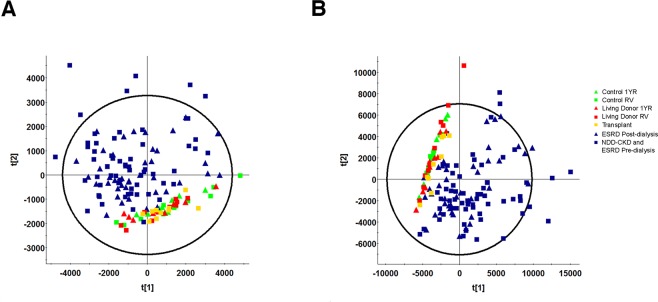
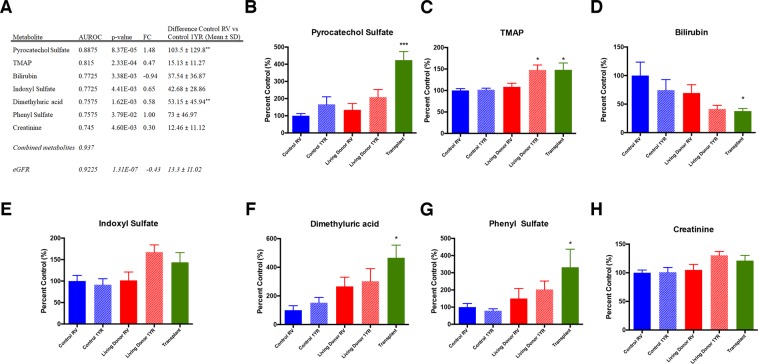
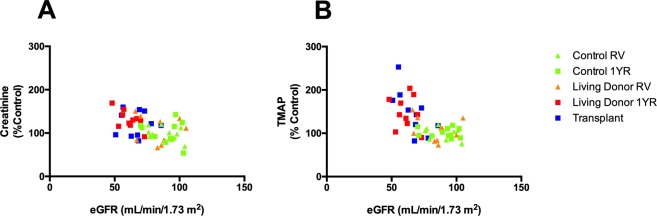
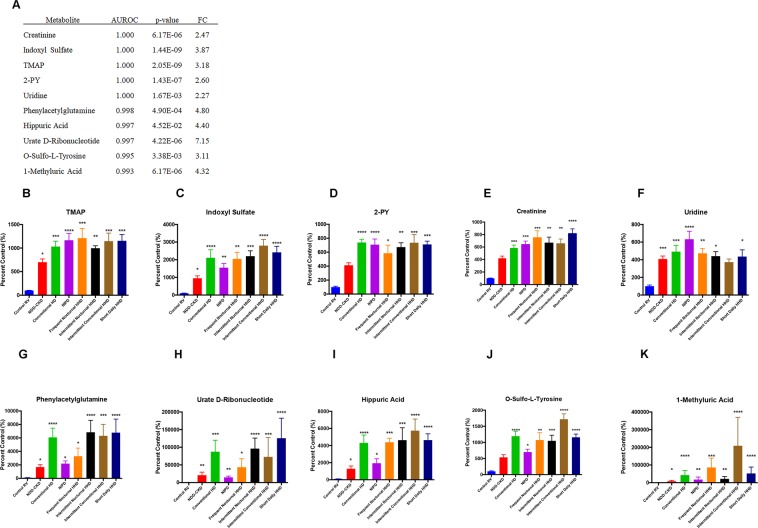
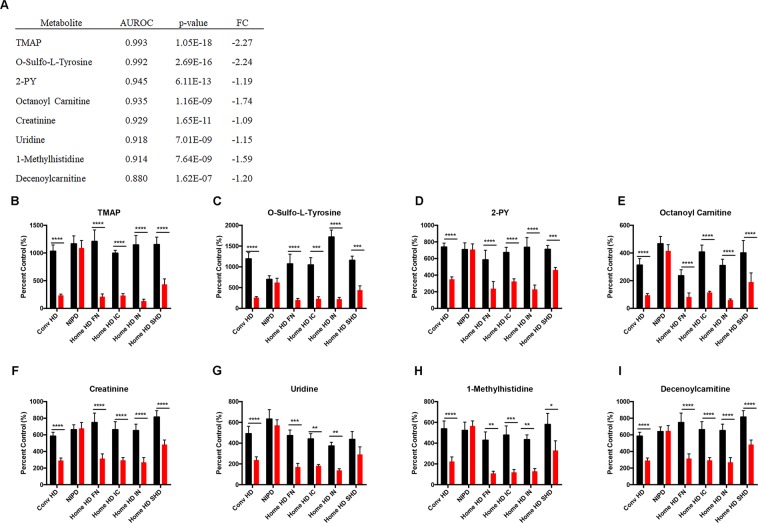
The diagnosis and prognosis of chronic kidney disease (CKD) currently relies on very few circulating small molecules, which can vary by factors unrelated to kidney function. In end-stage renal disease (ESRD), these same small molecules are used to determine dialysis dose and dialytic clearance. Therefore, we aimed to identify novel plasma biomarkers to estimate kidney function in CKD and dialytic clearance in ESRD. Untargeted metabolomics was performed on plasma samples from patients with a single kidney, non-dialysis CKD, ESRD and healthy controls. For ESRD patients, pre- and post-dialysis plasma samples were obtained from several dialysis modalities. Metabolomics analysis revealed over 400 significantly different features in non-dialysis CKD and ESRD plasma compared to controls while less than 35 features were significantly altered in patients with a single kidney. N,N,N-trimethyl-L-alanyl-L-proline betaine (TMAP, AUROC = 0.815) and pyrocatechol sulfate (AUROC = 0.888) outperformed creatinine (AUROC = 0.745) in accurately identifying patients with a single kidney. Several metabolites accurately predicted ESRD; however, when comparing pre-and post-hemodialysis, TMAP was the most robust biomarker of dialytic clearance for all modalities (AUROC = 0.993). This study describes TMAP as a novel potential biomarker of kidney function and dialytic clearance across several hemodialysis modalities.
目前,慢性肾脏病 (CKD) 的诊断和预后主要依赖于少数几种循环中的小分子物质,而这些小分子物质的水平会受到与肾功能无关的因素影响。在终末期肾病 (ESRD) 中,这些相同的小分子物质用于确定透析剂量和透析清除率。因此,我们旨在确定新的血浆生物标志物,以估计 CKD 患者的肾功能和 ESRD 患者的透析清除率。对单侧肾脏、非透析性 CKD、ESRD 和健康对照者的血浆样本进行了非靶向代谢组学分析。对于 ESRD 患者,从几种透析方式中获得了透析前和透析后的血浆样本。代谢组学分析显示,与对照组相比,非透析性 CKD 和 ESRD 患者的血浆中有 400 多种特征明显不同,而单侧肾脏患者的特征仅有不到 35 种明显改变。N,N,N-三甲基-L-丙氨酰-L-脯氨酸甜菜碱 (TMAP,AUROC=0.815) 和焦儿茶酚硫酸盐 (AUROC=0.888) 在准确识别单侧肾脏患者方面优于肌酐 (AUROC=0.745)。有几种代谢物能准确预测 ESRD;然而,在比较血液透析前后时,TMAP 是所有方式中透析清除率最稳健的生物标志物 (AUROC=0.993)。这项研究描述了 TMAP 是一种新的潜在的肾功能和几种血液透析方式透析清除率的生物标志物。