Hollerbach Brittany S, Jahnke Sara A, Poston Walker S C, Harms Craig A, Heinrich Katie M
1Department of Kinesiology, Kansas State University, Natatorium 8, 920 Denison Ave., Manhattan, Kansas, 66506 USA.
2Center for Fire, Rescue, and EMS Health Research, National Development & Research Institutes, 1920 143rd Street, Suite 120, Leawood, KS 66224-7813 USA.
J Occup Med Toxicol. 2019 Apr 23;14:12. doi: 10.1186/s12995-019-0232-2. eCollection 2019.
Firefighting is a dangerous occupation with high rates of injuries and fatalities, with the majority of line of duty fatalities due to cardiovascular events. Additionally, firefighters struggle with poor health/low levels of fitness, including high (> 80%) rates of overweight and obesity. Limited resources exist for fire departments that are tailored to the culture and work requirements of these "tactical athletes". Though there has been increasing interest in high intensity functional training (HIFT) programs, research data are lacking among firefighters and few studies have focused on training recruits. The purpose of this pilot investigation was to examine a novel HIFT program (TF20) on fire academy recruits' health, fitness, and performance as determined by a simulated fire ground test (SFGT), as well as determining the program's acceptability and feasibility.
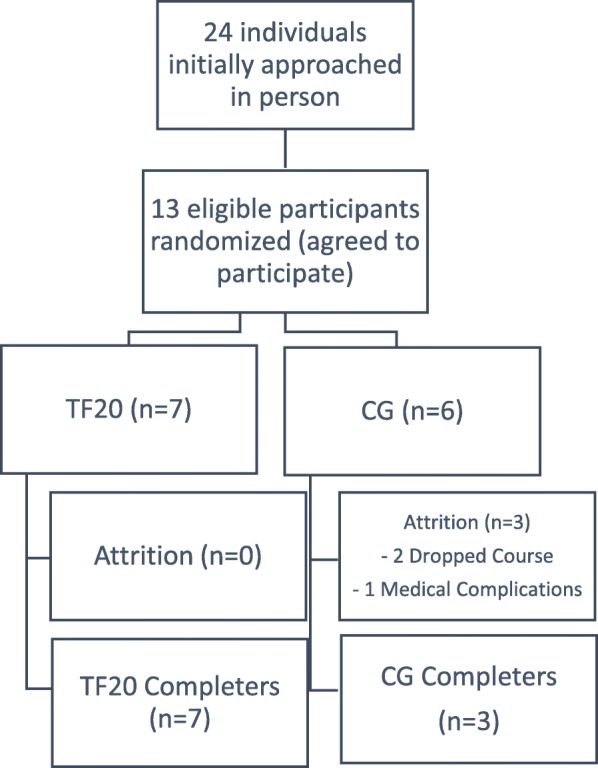
Thirteen participants were recruited from an entry level fire academy and were randomly assigned to the control (CG, = 6) or HIFT group (TF20, = 7). The CG was asked to continue current exercise habits. TF20 was provided a 10-week online based training program that included periodized workouts, nutritional information, and mental readiness education. Due to attrition within the first two weeks of the study, 10 male fire recruits (23 ± 3 years) completed the study (CG, = 3, TF20, = 7). All 10 participants completed baseline and follow-up assessments.
The TF20 group showed improvement on numerous outcome measures including SFGT (40% passing at baseline, 86% passing post-intervention). TF20 participants significantly increased estimated VO2max ( = 0.028), improved body composition (p = 0.028), and improved grip strength ( = 0.018). The CG did not experience any significant changes. The TF20 group completed approximately 75% of the assigned workouts.
While TF20 participants showed significant fitness gains, the small sample size limited direct comparisons to the CG. TF20 was well-received although there may be a better way to implement the intervention to increase participation. This investigation provides promising outcomes, useful information about implementation, feasibility, and acceptability for the TF20 HIFT program among firefighter recruits. IRB #8063 APPROVED 01/04/2016.
NCT03319394. Registered 28 September 2014. Retrospectively registered.
消防工作是一项危险职业,伤亡率很高,大多数因公殉职是由心血管事件导致的。此外,消防员健康状况不佳/体能水平较低,超重和肥胖率很高(超过80%)。针对这些“战术运动员”的文化和工作要求量身定制的消防部门资源有限。尽管人们对高强度功能训练(HIFT)项目的兴趣日益浓厚,但消防员群体中缺乏相关研究数据,且很少有研究关注新入职人员的训练。这项初步调查的目的是通过模拟火场测试(SFGT)来检验一种新型HIFT项目(TF20)对消防学院新入职人员的健康、体能和表现的影响,并确定该项目的可接受性和可行性。
从一所初级消防学院招募了13名参与者,并将他们随机分配到对照组(CG,n = 6)或HIFT组(TF20,n = 7)。要求CG组继续保持当前的锻炼习惯。为TF20组提供了一个为期10周的在线训练项目,包括阶段性训练、营养信息和心理准备教育。由于在研究的前两周内出现人员流失,10名男性消防新入职人员(23±3岁)完成了研究(CG组,n = 3;TF20组,n = 7)。所有10名参与者都完成了基线和随访评估。
TF20组在多项结果指标上都有改善,包括SFGT(基线时通过率为40%,干预后通过率为86%)。TF20组的参与者显著提高了估计的最大摄氧量(p = 0.028),改善了身体成分(p = 0.028),并提高了握力(p = 0.018)。CG组没有出现任何显著变化。TF20组完成了大约75%的指定训练。
虽然TF20组的参与者体能有显著提升,但样本量较小限制了与CG组的直接比较。TF20项目很受欢迎,不过可能有更好的方式来实施干预以提高参与度。这项调查为TF20 HIFT项目在消防员新入职人员中的实施、可行性和可接受性提供了有前景的结果和有用信息。机构审查委员会编号8063于2016年1月4日批准。
NCT03319394。于2014年9月28日注册。追溯注册。