Hemostasis Branch, Division of Plasma Protein Therapeutics, Office of Tissues and Advanced Therapeutics, Center for Biologics Evaluation and Research, US Food and Drug Administration, Silver Spring, MD.
Department of Laboratory Medicine and Pathology, University of North Carolina at Chapel Hill, Chapel Hill, NC.
Blood Adv. 2019 May 14;3(9):1429-1440. doi: 10.1182/bloodadvances.2018030452.
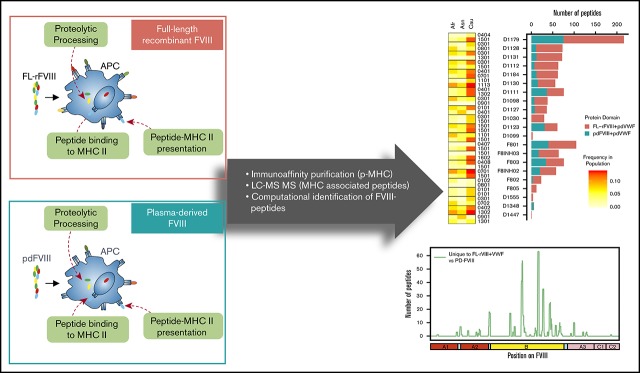
The immunogenicity of protein therapeutics is an important safety and efficacy concern during drug development and regulation. Strategies to identify individuals and subpopulations at risk for an undesirable immune response represent an important unmet need. The major histocompatibility complex (MHC)-associated peptide proteomics (MAPPs) assay directly identifies the presence of peptides derived from a specific protein therapeutic on a donor's MHC class II (MHC-II) proteins. We applied this technique to address several questions related to the use of factor VIII (FVIII) replacement therapy in the treatment of hemophilia A (HA). Although >12 FVIII therapeutics are marketed, most fall into 3 categories: (i) human plasma-derived FVIII (pdFVIII), (ii) full-length (FL)-recombinant FVIII (rFVIII; FL-rFVIII), and (iii) B-domain-deleted rFVIII. Here, we investigated whether there are differences between the FVIII peptides found on the MHC-II proteins of the same individual when incubated with these 3 classes. Based on several observational studies and a prospective, randomized, clinical trial showing that the originally approved rFVIII products may be more immunogenic than the pdFVIII products containing von Willebrand factor (VWF) in molar excess, it has been hypothesized that the pdFVIII molecules yield/present fewer peptides (ie, potential T-cell epitopes). We have experimentally tested this hypothesis and found that dendritic cells from HA patients and healthy donors present fewer FVIII peptides when administered pdFVIII vs FL-rFVIII, despite both containing the same molar VWF excess. Our results support the hypothesis that synthesis of pdFVIII under physiological conditions could result in reduced heterogeneity and/or subtle differences in structure/conformation which, in turn, may result in reduced FVIII proteolytic processing relative to FL-rFVIII.
蛋白治疗药物的免疫原性是药物开发和监管过程中一个重要的安全性和疗效关注点。寻找特定蛋白治疗药物引起不良免疫反应的个体和亚群的策略是一个重要的未满足需求。主要组织相容性复合体(MHC)相关肽蛋白质组学(MAPPs)检测直接鉴定供体 MHC Ⅱ类(MHC-II)蛋白上源自特定蛋白治疗药物的肽的存在。我们应用该技术来解决与因子 VIII(FVIII)替代疗法治疗血友病 A(HA)相关的几个问题。尽管有超过 12 种 FVIII 治疗药物上市,但大多数属于以下 3 类:(i)人血浆衍生的 FVIII(pdFVIII),(ii)全长(FL)-重组 FVIII(rFVIII;FL-rFVIII),和(iii)B 结构域缺失的 rFVIII。在这里,我们研究了在与这 3 类药物孵育时,同一个体的 MHC-II 蛋白上发现的 FVIII 肽之间是否存在差异。基于几项观察性研究和一项前瞻性、随机、临床试验表明,最初批准的 rFVIII 产品可能比含有摩尔过量 von Willebrand 因子(VWF)的 pdFVIII 产品更具免疫原性,因此有人假设 pdFVIII 分子产生/呈现的肽较少(即潜在的 T 细胞表位)。我们通过实验验证了这一假设,发现与 FL-rFVIII 相比,HA 患者和健康供体的树突状细胞在给予 pdFVIII 时呈现的 FVIII 肽较少,尽管两者都含有相同摩尔的 VWF 过量。我们的结果支持以下假设:在生理条件下合成 pdFVIII 可能导致结构/构象的异质性和/或细微差异减少,从而导致相对于 FL-rFVIII 的 FVIII 蛋白水解加工减少。