Abbott Christopher C, Miller Jeremy, Lloyd Megan, Tohen Mauricio
Department of Psychiatry & Behavioral Sciences, University of New Mexico Health Sciences Center, University of New Mexico School of Medicine, Albuquerque, NM, 87131, USA.
Int J Bipolar Disord. 2019 May 4;7(1):11. doi: 10.1186/s40345-019-0146-z.
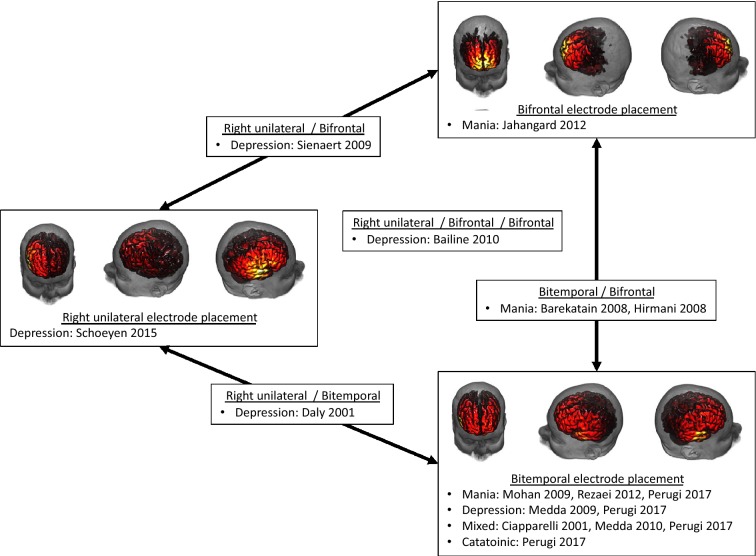
Electroconvulsive therapy (ECT) is an effective treatment for all bipolar states. However, ECT remains underutilized, likely stemming from stigma and the risk of neurocognitive impairment. Neuroimaging research has identified state-specific areas of aberrant brain activity that may serve as targets for therapeutic brain stimulation. Electrode placement determines the geometry of the electric field and can be either non-focal (bitemporal) or more focal (right unilateral or bifrontal). Previous research has shown that electrode placement can impact clinical and cognitive outcomes independent of seizure activity. This review critically examines the evidence that focal (unilateral or bifrontal) electrode placements target specific aberrant circuitry in specific bipolar states to optimize clinical outcomes. We hypothesize that optimal target engagement for a bipolar state will be associated with equivalent efficacy relative to bitemporal non-focal stimulation with less neurocognitive impairment.
We performed a literature search in the PubMed database. Inclusion criteria included prospective, longitudinal investigations during the ECT series with specific electrode placements within a bipolar state from 2000 to 2018.
We identified investigations that met our inclusion criteria with bipolar mania (n = 6), depression (n = 6), mixed (n = 3) and catatonia (n = 1) states. These studies included clinical outcomes and several included cognitive outcomes, which were discussed separately.
While the heterogeneity of the studies makes comparisons difficult, important patterns included the reduced cognitive side effects, faster rate of response, and equivalent efficacy rates of the focal electrode placements (right unilateral and bifrontal) when compared to non-focal (bitemporal) placement. Further avenues for research include more robust cognitive assessments to separate procedure-related and state-related impairment. In addition, future studies could investigate novel electrode configurations with more specific target engagement for different bipolar states.
电休克治疗(ECT)是治疗所有双相情感障碍状态的有效方法。然而,ECT的使用仍未得到充分利用,这可能源于污名化以及神经认知障碍的风险。神经影像学研究已经确定了大脑异常活动的特定状态区域,这些区域可能成为治疗性脑刺激的靶点。电极放置决定了电场的几何形状,可以是非聚焦的(双侧颞部)或更聚焦的(右侧单侧或双侧额叶)。先前的研究表明,电极放置可独立于癫痫发作活动影响临床和认知结果。本综述批判性地审视了以下证据:聚焦(单侧或双侧额叶)电极放置针对特定双相情感障碍状态下的特定异常神经回路,以优化临床结果。我们假设,相对于双侧颞部非聚焦刺激,双相情感障碍状态下的最佳靶点参与将与同等疗效相关,且神经认知损害更少。
我们在PubMed数据库中进行了文献检索。纳入标准包括2000年至2018年ECT系列期间对双相情感障碍状态下特定电极放置进行的前瞻性纵向研究。
我们确定了符合纳入标准的双相躁狂(n = 6)、抑郁(n = 6)、混合(n = 3)和紧张症(n = 1)状态的研究。这些研究包括临床结果,有几项还包括认知结果,将分别进行讨论。
虽然研究的异质性使得比较困难,但重要的模式包括与非聚焦(双侧颞部)放置相比,聚焦电极放置(右侧单侧和双侧额叶)的认知副作用减少、反应速度更快以及疗效相当。进一步的研究途径包括更有力的认知评估,以区分与治疗过程相关和与疾病状态相关的损害。此外,未来的研究可以调查针对不同双相情感障碍状态具有更特定靶点参与的新型电极配置。