Department of Nephrology, Chinese PLA General Hospital, Medical School of Chinese PLA, Chinese PLA Institute of Nephrology, State Key Laboratory of Kidney Diseases, National Clinical Research Center for Kidney Diseases, Beijing, China.
Mol Genet Genomic Med. 2019 Jun;7(6):e720. doi: 10.1002/mgg3.720. Epub 2019 May 6.
Polycystic kidney disease (PKD) is the most common hereditary kidney disease. The main mutational genes causing autosomal dominant polycystic kidney disease (ADPKD) are PKD1 and PKD2 as well as some rare pathogenic genes. Unilateral PKD is rare in clinics, and its association with gene mutations is unclear.
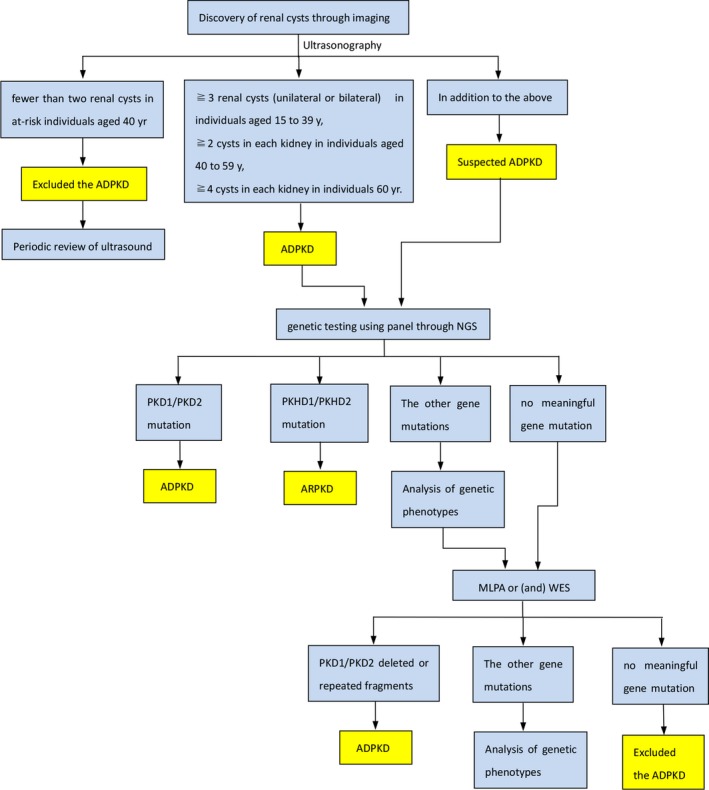
Targeted next-generation sequencing (NGS) was performed to detect the renal ciliopathy-associated genes (targeted NGS panel including 63 genes) in PKD patients.
Forty-eight PKD1 and PKD2 mutation sites were detected in 44 bilateral PKD patients, of which 48 were PKD1 mutation sites (87.5%) and six were PKD2 mutation sites (12.5%). All of which exhibited typical ADPKD. Furthermore, we detected HNF1B heterozygous mutations in three families. Although these three patients showed HNF1B heterozygous mutations, their clinical characteristics differed and showed phenotypic heterogeneity.
Targeted NGS panel was helpful in detecting typical ADPKD patients and even in non-typical PKD patients. Macromutation in HNF1B may lead to bilateral PKD. The 16 novel PKD gene mutation sites and two novel PKD2 gene mutation sites discovered in this study have some significance in genetic counseling for ADPKD patients, and increase the number of studied families and expand the mutation database of ADPKD.
多囊肾病(PKD)是最常见的遗传性肾病。导致常染色体显性多囊肾病(ADPKD)的主要突变基因是 PKD1 和 PKD2 以及一些罕见的致病基因。临床上单侧 PKD 较为少见,其与基因突变的关系尚不清楚。
对 PKD 患者进行靶向下一代测序(NGS)检测肾纤毛病相关基因(靶向 NGS panel 包括 63 个基因)。
在 44 例双侧 PKD 患者中检测到 48 个 PKD1 和 PKD2 突变位点,其中 48 个为 PKD1 突变位点(87.5%),6 个为 PKD2 突变位点(12.5%)。所有这些均表现为典型的 ADPKD。此外,我们在三个家庭中检测到 HNF1B 杂合突变。虽然这三个患者均表现出 HNF1B 杂合突变,但他们的临床特征不同,表现出表型异质性。
靶向 NGS panel 有助于检测典型的 ADPKD 患者,甚至非典型 PKD 患者。HNF1B 的大片段突变可能导致双侧 PKD。本研究发现的 16 个新的 PKD 基因突变位点和 2 个新的 PKD2 基因突变位点在 ADPKD 患者的遗传咨询中具有一定意义,并增加了研究的家系数量,扩展了 ADPKD 的突变数据库。