Scarfò Irene, Frigault Matthew J, Maus Marcela V
Cellular Immunotherapy Program, Massachusetts General Hospital Cancer Center, Charlestown, MA, United States.
Harvard Medical School, Boston, MA, United States.
Front Oncol. 2019 Apr 16;9:259. doi: 10.3389/fonc.2019.00259. eCollection 2019.
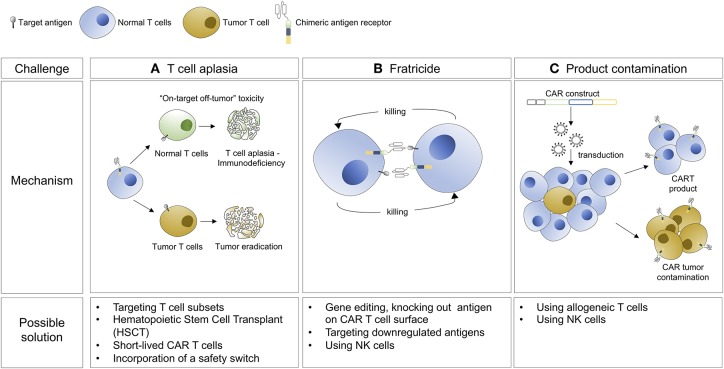
Cutaneous T cell lymphomas (CTCL) are a heterogeneous group of malignancies characterized by the expansion of a malignant T cell clone. Chimeric Antigen Receptor (CAR) T cell therapy has shown impressive results for the treatment of B-cell tumors, but several challenges have prevented this approach in the context of T cell lymphoma. These challenges include the possibilities of fratricide due to shared T-cell antigens, T cell immunodeficiency, and CAR transduction of malignant cells if CAR T are manufactured in the autologous setting. In this review, we discuss these and other challenges in detail and summarize the approaches currently in development to overcome these challenges and offer cellular targeting of T cell lymphomas.
皮肤T细胞淋巴瘤(CTCL)是一组异质性恶性肿瘤,其特征是恶性T细胞克隆扩增。嵌合抗原受体(CAR)T细胞疗法在治疗B细胞肿瘤方面已显示出令人瞩目的效果,但在T细胞淋巴瘤的治疗中,一些挑战阻碍了这种方法的应用。这些挑战包括由于共享T细胞抗原导致的自相残杀、T细胞免疫缺陷,以及如果在自体环境中制造CAR T细胞,恶性细胞的CAR转导。在本综述中,我们详细讨论了这些及其他挑战,并总结了目前正在开发的克服这些挑战并实现T细胞淋巴瘤细胞靶向治疗的方法。