Department of Public Health and Clinical Medicine, Östersund, Umeå University, Umeå, Sweden.
PLoS One. 2019 May 6;14(5):e0216404. doi: 10.1371/journal.pone.0216404. eCollection 2019.
Previous ischemic stroke is a predictor of recurrent ischemic stroke after an acute myocardial infarction (AMI). Dual antiplatelet therapy, including a P2Y12-inhibitor, is important in secondary prevention after AMI. Ticagrelor, a P2Y12-inhibitor, is more potent than the commonly used clopidogrel. Here, we evaluated the impact of ticagrelor on the risk of ischemic stroke following AMI in patients with previous ischemic stroke.
Data for patients with AMI that had a previous ischemic stroke were obtained from the Swedish Registry of Information and Knowledge about Swedish Heart Intensive Care Admissions. Patients were assigned to early and late cohorts, each covering a two-year time period before and after, respectively, the introduction of ticagrelor prescriptions (20 Dec 2011). Patients in the early cohort (n = 1633) were treated with clopidogrel (100%); those in the late cohort (n = 1642) were treated with either clopidogrel (66.3%) or ticagrelor (33.7%). We assessed the risk of ischemic stroke and intracranial bleeding over time with Kaplan-Meier analyses. We identified predictors of ischemic stroke with multivariable Cox regression analyses.
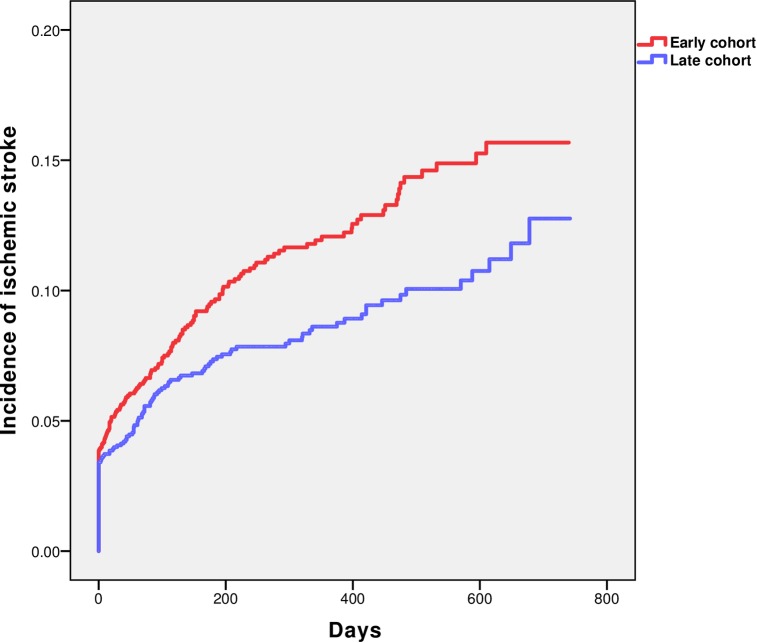
Of 3275 patients, 311 experienced ischemic stroke after AMI. Cumulative Kaplan-Meier incidence estimates of ischemic stroke within one year after AMI were 12.1% versus 8.6% for the early and late cohorts, respectively (p<0.01). Intracranial bleeding incidences (1.2% versus 1.5%) were similar between the two cohorts.
Ticagrelor introduction was associated with a lower rate of ischemic stroke, with no increase in intracranial bleeding, in an AMI population with a history of ischemic stroke.
既往缺血性卒中是急性心肌梗死(AMI)后再次发生缺血性卒中的预测因素。在 AMI 后二级预防中,双联抗血小板治疗(包括 P2Y12 抑制剂)非常重要。替格瑞洛是一种比常用的氯吡格雷更为有效的 P2Y12 抑制剂。在此,我们评估了既往有缺血性卒中的 AMI 患者使用替格瑞洛对 AMI 后缺血性卒中风险的影响。
从瑞典心脏重症监护登记处获取既往有缺血性卒中的 AMI 患者的数据。患者被分配到早期和晚期队列,分别涵盖替格瑞洛处方引入前和引入后的两年时间段(2011 年 12 月 20 日)。早期队列(n=1633)的患者接受氯吡格雷(100%)治疗;晚期队列(n=1642)的患者接受氯吡格雷(66.3%)或替格瑞洛(33.7%)治疗。我们通过 Kaplan-Meier 分析评估随时间推移的缺血性卒中和颅内出血风险。我们通过多变量 Cox 回归分析确定缺血性卒中的预测因素。
在 3275 例患者中,311 例在 AMI 后发生缺血性卒中。AMI 后一年内缺血性卒中的累积 Kaplan-Meier 发生率估计值分别为早期队列的 12.1%和晚期队列的 8.6%(p<0.01)。两个队列的颅内出血发生率(1.2%比 1.5%)相似。
在既往有缺血性卒中的 AMI 人群中,替格瑞洛的引入与缺血性卒中发生率降低相关,颅内出血发生率无增加。