Department of Emergency Medicine, University of Massachusetts Medical School, Worcester, Massachusetts, USA
Department of Microbiology and Physiological Systems, University of Massachusetts Medical School, Worcester, Massachusetts, USA.
mBio. 2019 May 7;10(3):e00632-19. doi: 10.1128/mBio.00632-19.
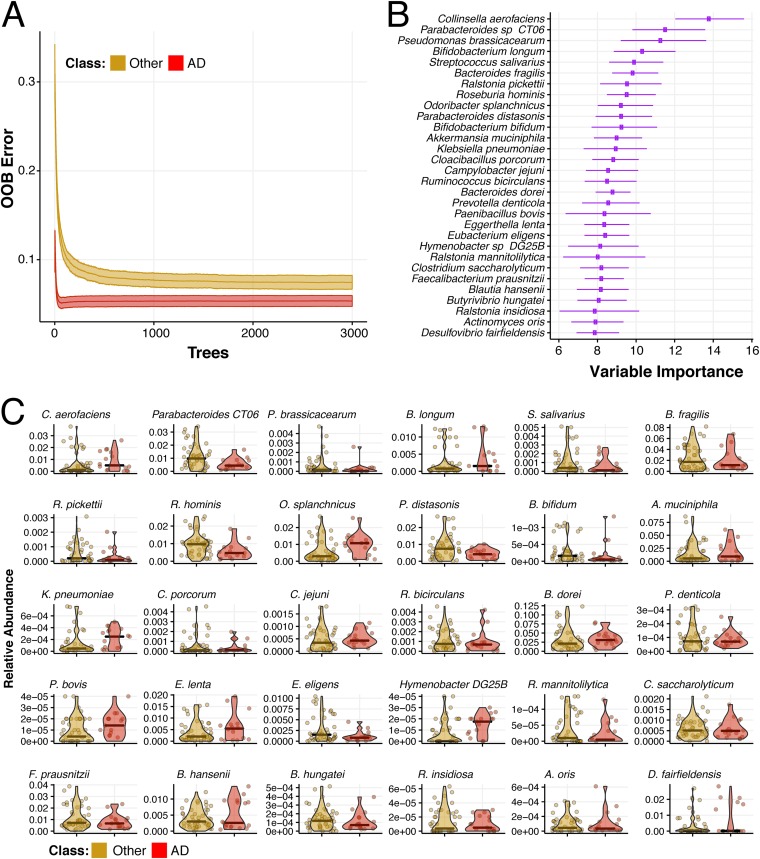
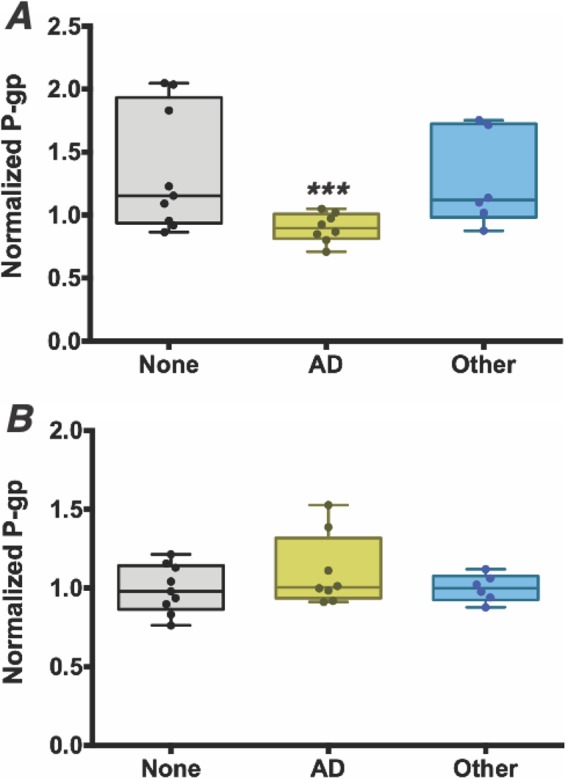
The microbiota-gut-brain axis is a bidirectional communication system that is poorly understood. Alzheimer's disease (AD), the most common cause of dementia, has long been associated with bacterial infections and inflammation-causing immunosenescence. Recent studies examining the intestinal microbiota of AD patients revealed that their microbiome differs from that of subjects without dementia. In this work, we prospectively enrolled 108 nursing home elders and followed each for up to 5 months, collecting longitudinal stool samples from which we performed metagenomic sequencing and T84 intestinal epithelial cell functional assays for P-glycoprotein (P-gp) expression, a critical mediator of intestinal homeostasis. Our analysis identified clinical parameters as well as numerous microbial taxa and functional genes that act as predictors of AD dementia in comparison to elders without dementia or with other dementia types. We further demonstrate that stool samples from elders with AD can induce lower P-gp expression levels those samples from elders without dementia or with other dementia types. We also paired functional studies with machine learning approaches to identify bacterial species differentiating the microbiome of AD elders from that of elders without dementia, which in turn are accurate predictors of the loss of dysregulation of the P-gp pathway. We observed that the microbiome of AD elders shows a lower proportion and prevalence of bacteria with the potential to synthesize butyrate, as well as higher abundances of taxa that are known to cause proinflammatory states. Therefore, a potential nexus between the intestinal microbiome and AD is the modulation of intestinal homeostasis by increases in inflammatory, and decreases in anti-inflammatory, microbial metabolism. Studies of the intestinal microbiome and AD have demonstrated associations with microbiome composition at the genus level among matched cohorts. We move this body of literature forward by more deeply investigating microbiome composition via metagenomics and by comparing AD patients against those without dementia and with other dementia types. We also exploit machine learning approaches that combine both metagenomic and clinical data. Finally, our functional studies using stool samples from elders demonstrate how the c microbiome of AD elders can affect intestinal health via dysregulation of the P-glycoprotein pathway. P-glycoprotein dysregulation contributes directly to inflammatory disorders of the intestine. Since AD has been long thought to be linked to chronic bacterial infections as a possible etiology, our findings therefore fill a gap in knowledge in the field of AD research by identifying a nexus between the microbiome, loss of intestinal homeostasis, and inflammation that may underlie this neurodegenerative disorder.
肠道微生物群-肠道-大脑轴是一个双向通讯系统,目前人们对此了解甚少。阿尔茨海默病(AD)是最常见的痴呆症,长期以来一直与细菌感染和导致免疫衰老的炎症有关。最近研究 AD 患者的肠道微生物群发现,他们的微生物组与没有痴呆的受试者不同。在这项工作中,我们前瞻性地招募了 108 名养老院的老年人,并对他们进行了长达 5 个月的随访,收集纵向粪便样本,我们对这些样本进行了宏基因组测序和 T84 肠上皮细胞功能测定,以检测 P-糖蛋白(P-gp)的表达,这是肠道内稳态的关键介质。我们的分析确定了临床参数以及许多微生物类群和功能基因,这些参数和基因可作为 AD 痴呆与无痴呆或其他类型痴呆老年人相比的预测因子。我们进一步证明,AD 老年人的粪便样本可诱导较低的 P-gp 表达水平,而无痴呆或其他类型痴呆老年人的粪便样本则不会。我们还将功能研究与机器学习方法相结合,以识别区分 AD 老年人和无痴呆老年人微生物组的细菌物种,这些细菌物种反过来又可以准确预测 P-gp 通路失调的丧失。我们观察到,AD 老年人的微生物组显示出具有合成丁酸潜力的细菌的比例和流行率较低,而已知会引起促炎状态的细菌丰度较高。因此,肠道微生物组与 AD 之间的潜在联系是通过增加炎症和减少抗炎微生物代谢来调节肠道内稳态。肠道微生物组和 AD 的研究已经证明了在匹配队列中属水平的微生物组组成存在关联。我们通过通过宏基因组学更深入地研究微生物组组成,并将 AD 患者与无痴呆和其他痴呆类型的患者进行比较,从而将这一文献推向前进。我们还利用结合了宏基因组学和临床数据的机器学习方法。最后,我们使用老年人的粪便样本进行的功能研究表明,AD 老年人的微生物组如何通过 P-糖蛋白途径的失调影响肠道健康。P-糖蛋白失调直接导致肠道炎症性疾病。由于 AD 长期以来一直被认为与慢性细菌感染有关,因此作为一种可能的病因,我们的发现填补了 AD 研究领域知识空白,确定了微生物组、肠道内稳态丧失和炎症之间的联系,这可能是这种神经退行性疾病的基础。