Du Kang, Zhao Can, Wang Li, Wang Yue, Zhang Kang-Zhen, Shen Xi-Yu, Sun Hui-Xian, Gao Wei, Lu Xiang
Department of Geriatrics, Sir Run Run Hospital, Nanjing Medical University, Nanjing, Jiangsu Province 211166, China.
Key Laboratory for Aging and Disease, Nanjing Medical University, Nanjing, Jiangsu Province 211166, China.
Aging (Albany NY). 2019 May 7;11(9):2762-2786. doi: 10.18632/aging.101948.
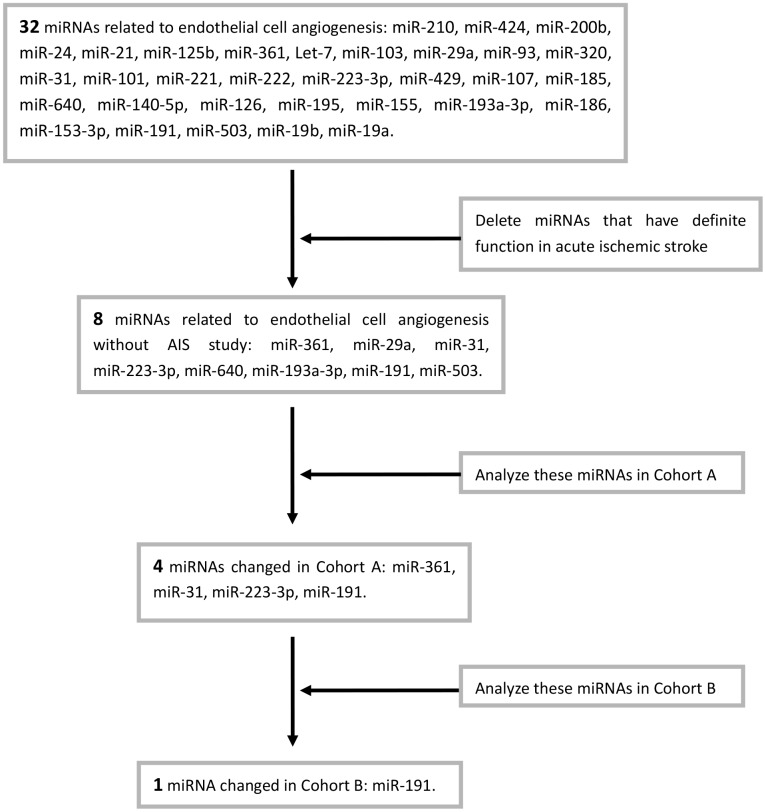
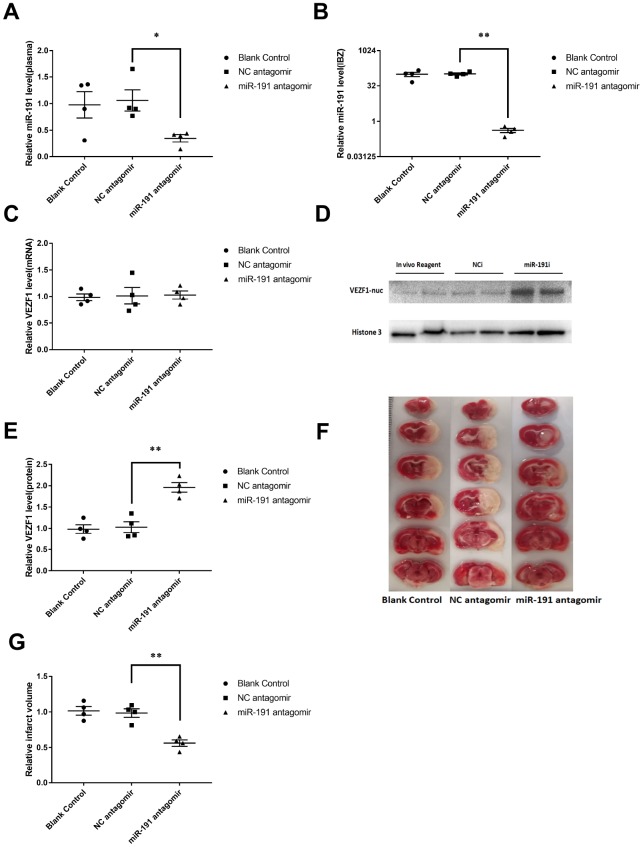
Acute ischemic stroke (AIS) is a major public health problem in China. Impaired angiogenesis plays crucial roles in the development of ischemic cerebral injury. Recent studies have identified that microRNAs (miRNAs) are important regulators of angiogenesis, but little is known the exact effects of angiogenesis-associated miRNAs in AIS. In the present study, we detected the expression levels of angiogenesis-associated miRNAs in AIS patients, middle cerebral artery occlusion (MCAO) rats, and oxygen-glucose deprivation/reoxygenation (OGD/R) human umbilical vein endothelial cells (HUVECs). MiR-191 was increased in the plasma of AIS patients, OGD/R HUVECs, and the plasma and brain of MCAO rats. Over-expression of miR-191 promoted apoptosis, but reduced the proliferation, migration, tube-forming and spheroid sprouting activity in HUVECs OGD/R model. Mechanically, vascular endothelial zinc finger 1 (VEZF1) was identified as the direct target of miR-191, and could be regulated by miR-191 at post-translational level. In vivo studies applying miR-191 antagomir demonstrated that inhibition of miR-191 reduced infarction volume in MCAO rats. In conclusion, our data reveal a novel role of miR-191 in promoting ischemic brain injury through inhibiting angiogenesis via targeting VEZF1. Therefore, miR-191 may serve as a biomarker or a therapeutic target for AIS.
急性缺血性卒中(AIS)是中国一个主要的公共卫生问题。血管生成受损在缺血性脑损伤的发展过程中起关键作用。最近的研究已经确定,微小RNA(miRNA)是血管生成的重要调节因子,但血管生成相关miRNA在AIS中的具体作用尚不清楚。在本研究中,我们检测了AIS患者、大脑中动脉闭塞(MCAO)大鼠以及氧糖剥夺/复氧(OGD/R)人脐静脉内皮细胞(HUVECs)中血管生成相关miRNA的表达水平。MiR-191在AIS患者的血浆、OGD/R HUVECs以及MCAO大鼠的血浆和脑组织中表达增加。MiR-191的过表达促进了细胞凋亡,但降低了OGD/R模型中HUVECs的增殖、迁移、成管和球状体发芽活性。机制上,血管内皮锌指1(VEZF1)被确定为miR-191的直接靶点,并且可以在翻译后水平受到miR-191的调控。应用miR-191拮抗剂的体内研究表明,抑制miR-191可减少MCAO大鼠的梗死体积。总之,我们的数据揭示了miR-191通过靶向VEZF1抑制血管生成从而促进缺血性脑损伤的新作用。因此,miR-191可能作为AIS的生物标志物或治疗靶点。