Salvati Kathryn, Beenhakker Mark
Epilepsy Curr. 2019 May-Jun;19(3):196-198. doi: 10.1177/1535759719844267. Epub 2019 May 8.
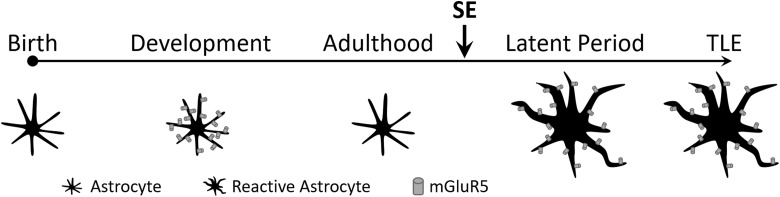
Conditional Knockout of mGluR5 From Astrocytes During Epilepsy Development Impairs High-Frequency Glutamate Uptake Umpierre AD, West PJ, White JA, et al. J Neurosci. 2019;39(4):727-742. doi:10.1523/JNEUROSCI.1148-18.2018 Astrocyte expression of metabotropic glutamate receptor 5 (mGluR5) is consistently observed in resected tissue from patients with epilepsy and is equally prevalent in animal models of epilepsy. However, little is known about the functional signaling properties or downstream consequences of astrocyte mGluR5 activation during epilepsy development. In the rodent brain, astrocyte mGluR5 expression is developmentally regulated and confined in expression/function to the first weeks of life, with similar observations made in human control tissue. Herein, we demonstrate that mGluR5 expression and function dramatically increase in a mouse model of temporal lobe epilepsy. Interestingly, in both male and female mice, mGluR5 function persists in the astrocyte throughout the process of epileptogenesis following status epilepticus. However, mGluR5 expression and function are transient in animals that do not develop epilepsy over an equivalent time period, suggesting that patterns of mGluR5expression may signify continuing epilepsy development or its resolution. We demonstrate that, during epileptogenesis, astrocytes reacquire mGluR5-dependent calcium transients following agonist application or synaptic glutamate release, a feature of astrocyte-neuron communication absent since early development. Finally, we find that the selective and conditional knockout of mGluR5 signaling from astrocytes during epilepsy development slows the rate of glutamate clearance through astrocyte glutamate transporters under high-frequency stimulation conditions, a feature that suggests astrocyte mGluR5 expression during epileptogenesis may recapitulate earlier developmental roles in regulating glutamate transporter function.
癫痫发生过程中星形胶质细胞mGluR5的条件性敲除损害高频谷氨酸摄取
昂皮埃尔·A·D、韦斯特·P·J、怀特·J·A等。《神经科学杂志》。2019年;39(4):727 - 742。doi:10.1523/JNEUROSCI.1148 - 18.2018
在癫痫患者切除的组织中持续观察到代谢型谷氨酸受体5(mGluR5)在星形胶质细胞中的表达,并且在癫痫动物模型中同样普遍存在。然而,关于癫痫发生过程中星形胶质细胞mGluR5激活的功能信号特性或下游后果知之甚少。在啮齿动物大脑中,星形胶质细胞mGluR5的表达受发育调控,且在出生后的头几周内表达/功能受限,在人类对照组织中也有类似观察结果。在此,我们证明在颞叶癫痫小鼠模型中mGluR5的表达和功能显著增加。有趣的是,在雄性和雌性小鼠中,癫痫持续状态后癫痫发生过程中星形胶质细胞中的mGluR5功能持续存在。然而,在相同时间段内未发生癫痫的动物中,mGluR5的表达和功能是短暂的,这表明mGluR5的表达模式可能预示着癫痫的持续发展或缓解。我们证明,在癫痫发生过程中,星形胶质细胞在应用激动剂或突触谷氨酸释放后重新获得mGluR5依赖性钙瞬变,这是自早期发育以来星形胶质细胞 - 神经元通讯所缺乏的一个特征。最后,我们发现癫痫发生过程中从星形胶质细胞中选择性和条件性敲除mGluR5信号会减缓高频刺激条件下通过星形胶质细胞谷氨酸转运体清除谷氨酸的速率,这一特征表明癫痫发生过程中星形胶质细胞mGluR5的表达可能重现了其在调节谷氨酸转运体功能方面早期的发育作用。