Pregnancy Loss Research Group, The Irish Centre for Fetal and Neonatal Translational Research University College Cork, Cork, Ireland.
National Perinatal Epidemiology Centre, Department of Obstetrics and Gynaecology, University College Cork, Cork University Maternity Hospital, 5th floor, Postgraduate Study Room, 5S-30, Wilton, Cork, T12 YE02, Ireland.
Reprod Health. 2019 May 9;16(1):51. doi: 10.1186/s12978-019-0720-y.
Early miscarriage is one of the most common obstetric causes of maternal morbidity early in pregnancy. However, data concerning non-fatal complications among hospitalisations for early miscarriage are lacking. The aim of this study was to determine whether there were changes in the incidence, management and outcomes of early miscarriage hospitalisations between 2005 and 2016.
This is a nationwide population-based study of 50,538 hospitalisations with a diagnosis of early miscarriage of all acute maternity hospitals in Ireland. Electronic health records were retrieved using the Hospital In-Patient Enquiry database. Main outcomes include the incidence rates of hospitalisations and management for early miscarriage, and rates of blood transfusion and length of stay over 2 days.
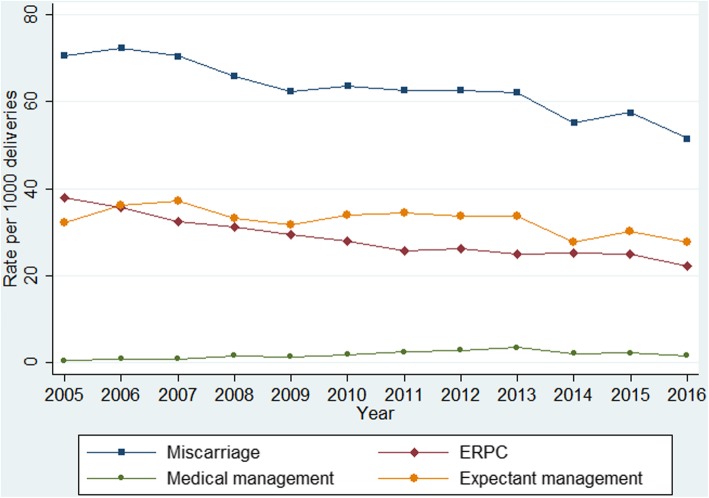
Overall, 50,538 hospitalisations for early miscarriage were identified from 2005 to 2016. The risk of hospitalisation decreased from 70.6 per 1000 deliveries (95% CI 68.4 to 72.8) in 2005 to 49.7 per 1000 deliveries (95% CI 49.7 to 53.3) in 2016; however, the risk of blood transfusion increased over time (ratio: 2.0; 95% CI 1.6 to 2.4). Women of advanced maternal age had a higher risk of hospitalisations. There were less blood transfusions among women who undertook medical treatment (ratio: 0.3; 95% CI 0.1 to 0.5), but they had an increased risk of staying over 2 days at the hospital (ratio: 1.5; 95% CI 1.2 to 1.9) compared to evacuation of retained products of conception.
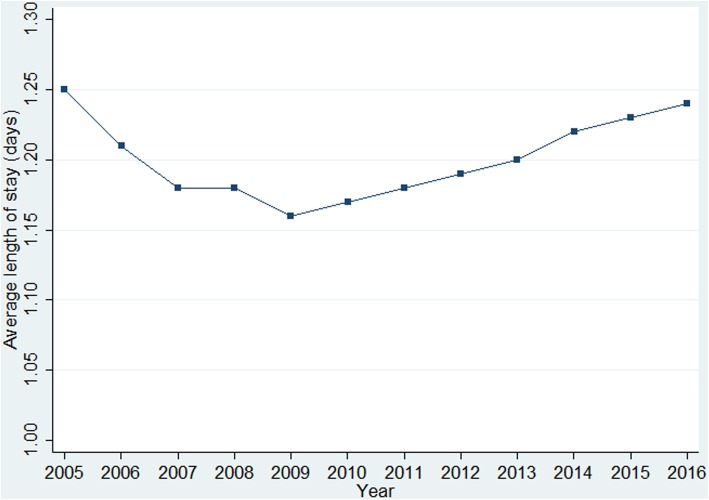
Hospitalisation rates for early miscarriage decreased over time with an increase in risk of blood transfusion and an extended length of stay at the hospital. Women who underwent medical management did not have as many blood transfusions as those undergoing surgical management. However, they had an increased risk of an extended stay. Research is needed to explore both outpatient and inpatient settings in order to improve the management and care provided.
早期流产是妊娠早期产妇发病率最高的产科原因之一。然而,关于早期流产住院的非致命性并发症的数据尚缺乏。本研究旨在确定 2005 年至 2016 年期间,早期流产住院的发生率、管理和结局是否发生变化。
这是一项对爱尔兰所有急性产科医院的 50538 例早期流产住院患者的全国性基于人群的研究。使用医院住院病人查询数据库检索电子健康记录。主要结局包括早期流产住院和管理的发生率、输血率和住院时间超过 2 天的比例。
2005 年至 2016 年共确定了 50538 例早期流产住院患者。住院风险从 2005 年的每 1000 例分娩 70.6 例(95%可信区间 68.4 至 72.8)下降到 2016 年的每 1000 例分娩 49.7 例(95%可信区间 49.7 至 53.3);然而,输血风险随时间增加(比值:2.0;95%可信区间 1.6 至 2.4)。高龄产妇的住院风险更高。接受药物治疗的女性输血较少(比值:0.3;95%可信区间 0.1 至 0.5),但住院时间延长超过 2 天的风险增加(比值:1.5;95%可信区间 1.2 至 1.9),与清除残留妊娠组织相比。
随着输血风险的增加和住院时间的延长,早期流产的住院率呈下降趋势。接受药物治疗的女性输血量不如接受手术治疗的女性多,但她们的住院时间延长风险增加。需要研究门诊和住院环境,以改善提供的管理和护理。