Demir Salih, Boldrin Elena, Sun Qian, Hampp Stephanie, Tausch Eugen, Eckert Cornelia, Ebinger Martin, Handgretinger Rupert, Kronnie Geertruy Te, Wiesmüller Lisa, Stilgenbauer Stephan, Selivanova Galina, Debatin Klaus-Michael, Meyer Lüder Hinrich
Department of Pediatrics and Adolescent Medicine, Ulm University Medical Center, Ulm, Germany.
International Graduate School of Molecular Medicine, Ulm University, Ulm, Germany.
Haematologica. 2020 Jan;105(1):170-181. doi: 10.3324/haematol.2018.199364. Epub 2019 May 9.
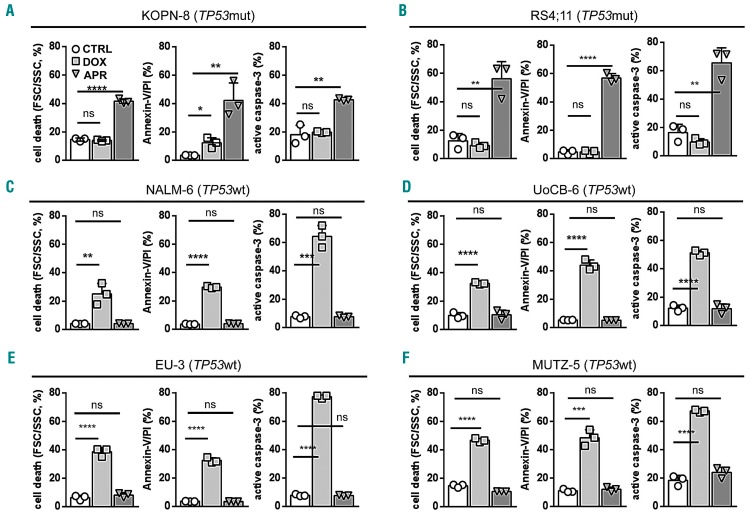
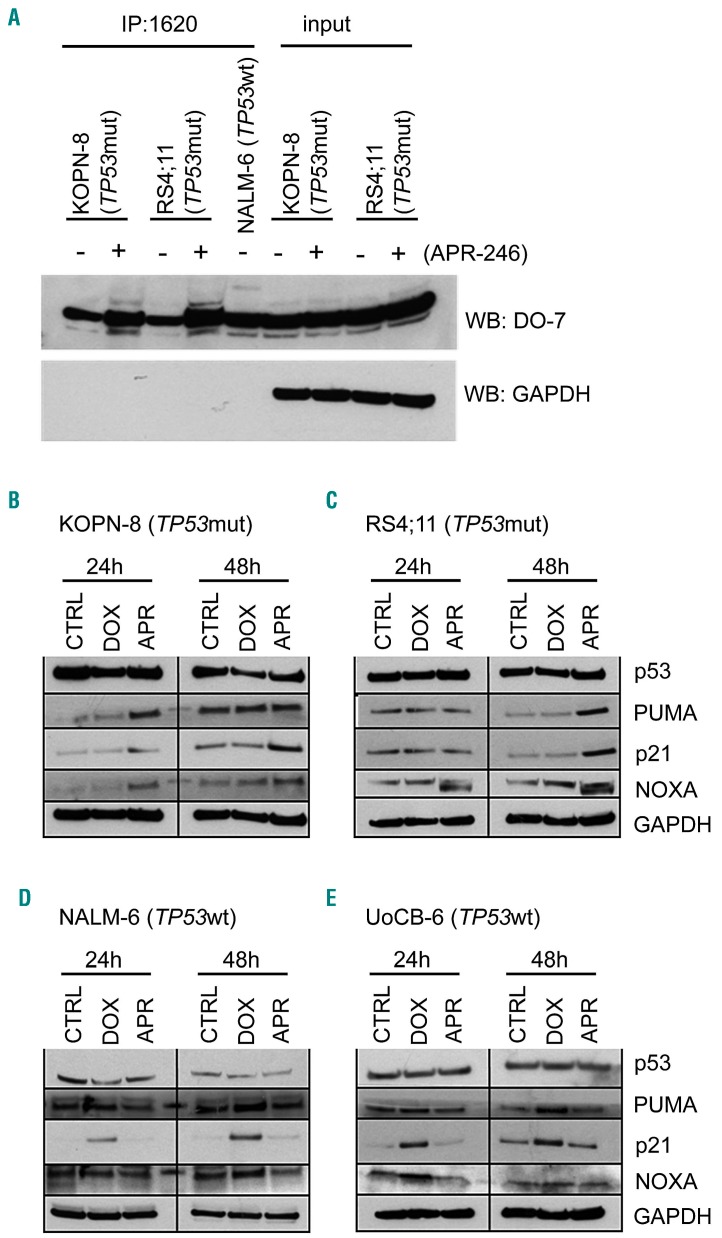
Alterations of the tumor suppressor gene are found in different cancers, in particular in carcinomas of adults. In pediatric acute lymphoblastic leukemia (ALL), mutations are infrequent but enriched at relapse. As in most cancers, mainly DNA-binding domain missense mutations are found, resulting in accumulation of mutant p53, poor therapy response, and inferior outcome. Different strategies to target mutant p53 have been developed including reactivation of p53's wildtype function by the small molecule APR-246. We investigated mutations in cell lines and 62 B-cell precursor ALL samples and evaluated the activity of APR-246 in -mutated or wildtype ALL. We identified cases with missense mutations, high (mutant) p53 expression and insensitivity to the DNA-damaging agent doxorubicin. In -mutated ALL, APR-246 induced apoptosis showing strong anti-leukemia activity. APR-246 restored mutant p53 to its wildtype conformation, leading to pathway activation with induction of transcriptional targets and re-sensitization to genotoxic therapy and In addition, induction of oxidative stress contributed to APR-246-mediated cell death. In a preclinical model of patient-derived -mutant ALL, APR-246 reduced leukemia burden and synergized strongly with the genotoxic agent doxorubicin, leading to superior leukemia-free survival Thus, targeting mutant p53 by APR-246, restoring its tumor suppressive function, seems to be an effective therapeutic strategy for this high-risk group of -mutant ALL.
肿瘤抑制基因的改变在不同癌症中均有发现,尤其是在成人癌症中。在儿童急性淋巴细胞白血病(ALL)中,该基因突变并不常见,但在复发时有所富集。与大多数癌症一样,主要发现的是DNA结合域错义突变,导致突变型p53积累、治疗反应不佳和预后较差。已经开发了多种针对突变型p53的策略,包括通过小分子APR-246重新激活p53的野生型功能。我们研究了细胞系和62例B细胞前体ALL样本中的该基因突变,并评估了APR-246在该基因突变或野生型ALL中的活性。我们鉴定出了具有该错义突变、高(突变型)p53表达且对DNA损伤剂阿霉素不敏感的病例。在该基因突变的ALL中,APR-246诱导凋亡,显示出强大的抗白血病活性。APR-246将突变型p53恢复到其野生型构象,导致通路激活,诱导转录靶点并重新对基因毒性治疗敏感。此外,氧化应激的诱导也促成了APR-246介导的细胞死亡。在患者来源的该基因突变ALL的临床前模型中,APR-246降低了白血病负担,并与基因毒性剂阿霉素强烈协同作用,导致无白血病生存期延长。因此,通过APR-246靶向突变型p53,恢复其肿瘤抑制功能,似乎是针对这一高危的该基因突变ALL群体的有效治疗策略。