Sundström Patrik, Szeponik Louis, Ahlmanner Filip, Sundquist Malin, Wong Justin S B, Lindskog Elinor Bexe, Gustafsson Bengt, Quiding-Järbrink Marianne
Department of Microbiology and Immunology, Sahlgrenska Academy at University of Gothenburg, Göteborg, Sweden.
Department of Pathology, National University Hospital, Singapore and Department of Microbiology, National, University of Singapore, Singapore.
Oncotarget. 2019 Apr 19;10(29):2810-2823. doi: 10.18632/oncotarget.26866.
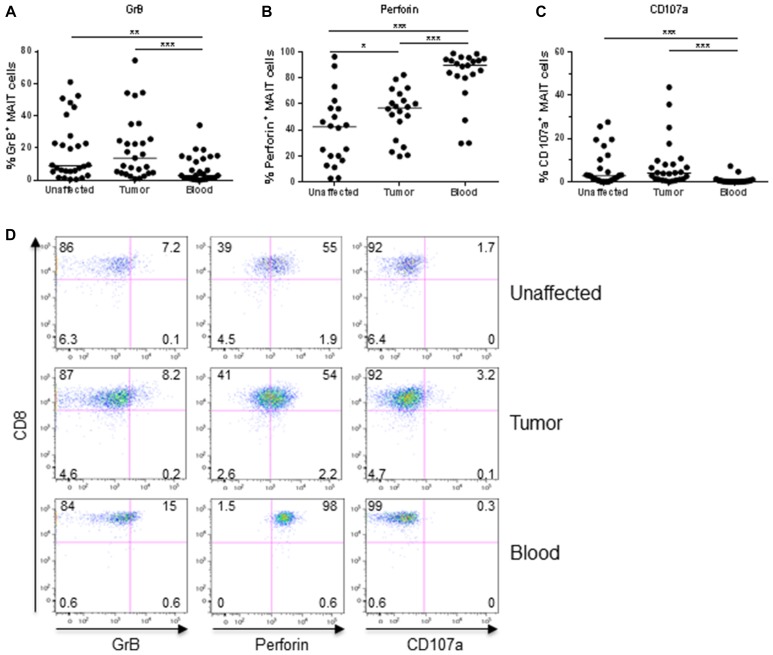
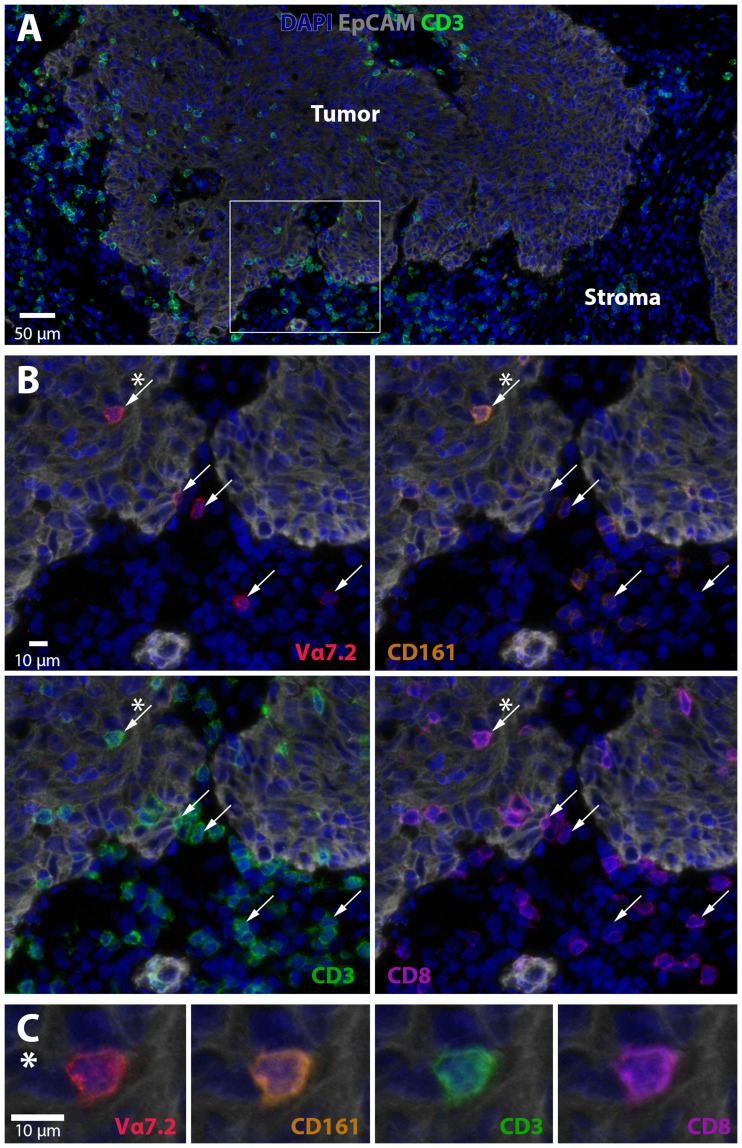
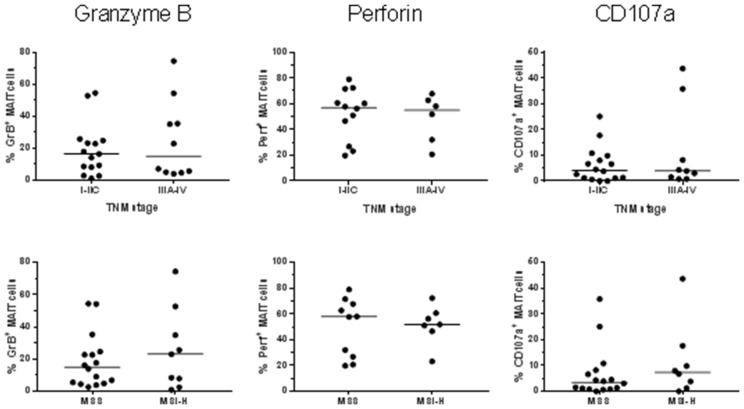
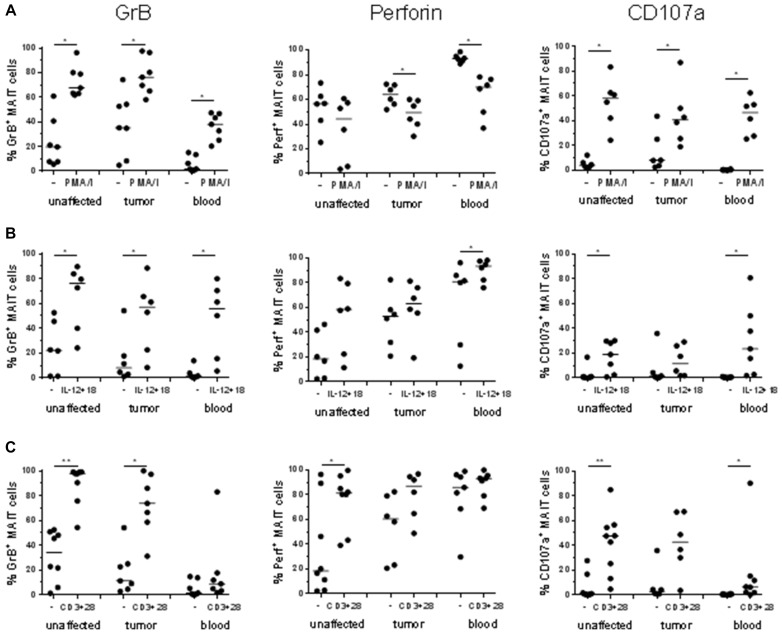
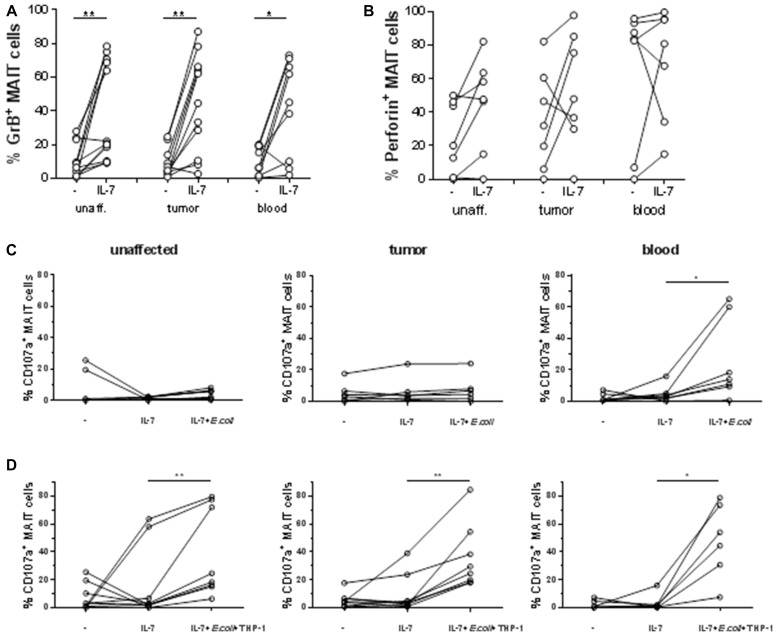
Mucosal-associated invariant T (MAIT) cells all express a semi-invariable T cell receptor recognizing microbial metabolites presented on the MHC class I-like molecule MR1. Upon activation, they rapidly secrete cytokines and increase their cytotoxic potential. We showed recently that MAIT cells with Th1 phenotype accumulate in human colon adenocarcinomas. Here, we investigated the cytotoxic potential of tumor-infiltrating MAIT cells in colon adenocarcinomas, and to what extent it may be affected by the tumor microenvironment. Activation of MAIT cells from tumors induced increased Granzyme B, and to a lesser extent, perforin expression. Degranulation was assessed by surface expression of CD107a, and was also seen in response to cognate antigen recognition. The cytotoxic potential of tumor-associated MAIT cells was very similar to that of MAIT cells from unaffected colon. MAIT cells were also identified by immunofluorescence in direct contact with tumor cells in sections from colon cancer specimens. To summarize, tumor-associated MAIT cells from colon tumors have strong cytotoxic potential and are not compromised in this regard compared to MAIT cells from the unaffected colon. We conclude that MAIT cells may contribute significantly to the protective immune response to tumors, both by secretion of Th1-associated cytokines and by direct killing of tumor cells.
黏膜相关恒定T(MAIT)细胞均表达一种半恒定的T细胞受体,该受体可识别在类MHC I 分子MR1上呈递的微生物代谢产物。激活后,它们会迅速分泌细胞因子并增强其细胞毒性潜能。我们最近发现,具有Th1表型的MAIT细胞在人类结肠腺癌中积聚。在此,我们研究了结肠腺癌中肿瘤浸润性MAIT细胞的细胞毒性潜能,以及它在多大程度上可能受到肿瘤微环境的影响。肿瘤来源的MAIT细胞激活后,颗粒酶B表达增加,穿孔素表达也有一定程度增加。通过CD107a的表面表达评估脱颗粒情况,在对同源抗原识别的反应中也观察到了脱颗粒现象。肿瘤相关MAIT细胞的细胞毒性潜能与未受影响结肠中的MAIT细胞非常相似。在结肠癌标本切片中,通过免疫荧光也鉴定出与肿瘤细胞直接接触的MAIT细胞。总之,结肠肿瘤中肿瘤相关MAIT细胞具有很强的细胞毒性潜能,在这方面与未受影响结肠中的MAIT细胞相比并未受损。我们得出结论,MAIT细胞可能通过分泌Th1相关细胞因子和直接杀伤肿瘤细胞,对肿瘤的保护性免疫反应做出重大贡献。