Division of Pediatric Neurology, Department of Pediatrics, Boston Medical Center, Boston, MA.
Department of Radiology, Boston University School of Medicine, Boston, MA.
J Pediatr. 2019 Jul;210:81-90.e3. doi: 10.1016/j.jpeds.2019.03.018. Epub 2019 May 7.
To examine elevated neonatal inflammatory and neurotrophic proteins from children born extremely preterm in relation to later childhood brain Magnetic Resonance Imaging volumes and cognition.
We measured circulating inflammation-related proteins and neurotrophic proteins on postnatal days 1, 7, and 14 in 166 children at 10 years of age (73 males; 93 females). Top quartile levels on ≥2 days for ≥3 inflammation-related proteins and for ≥4 neurotrophic proteins defined exposure. We examined associations among protein levels, brain Magnetic Resonance Imaging volumes, and cognition with multiple linear and logistic regressions.
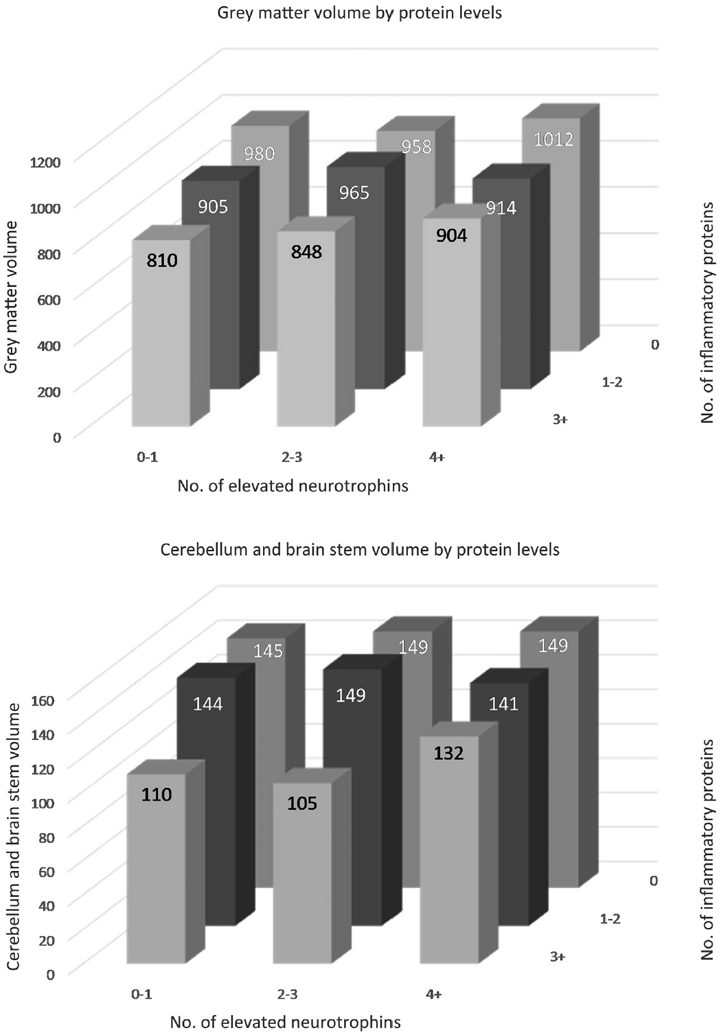
Analyses were adjusted for gestational age at birth and sex. Children with ≥3 elevated inflammation-related proteins had smaller grey matter, brain stem/cerebellar, and total brain volumes than those without elevated inflammation-related proteins, adjusted for neurotrophic proteins. When adjusted for inflammation-related proteins, children with ≥4 neurotrophic proteins, compared with children with no neurotrophic proteins, had larger grey matter and total brain volumes. Higher grey matter, white matter, and cerebellum and brainstem volumes were significantly correlated with higher IQ. Grey and white matter volumes were correlated with each other (r = -0.18; P = .021), and cerebellum and brainstem was highly correlated with grey matter (r = 0.55; P < .001) and white matter (r = 0.29; P < .001). Adjusting for other brain compartments, cerebellum and brainstem was associated with IQ (P = .016), but the association with white matter was marginally significant (P = .051). Grey matter was not associated with IQ. After adjusting for brain volumes, elevated inflammation-related proteins remained significantly associated with a lower IQ, and elevated neurotrophic proteins remained associated with a higher IQ.
Newborn inflammatory and neurotrophin protein levels are associated with later brain volumes and cognition, but their effects on cognition are not entirely explained by altered brain volumes.
研究极早产儿出生后第 1、7 和 14 天循环中升高的新生儿炎症和神经营养蛋白与儿童后期大脑磁共振成像体积和认知之间的关系。
我们在 10 岁时测量了 166 名儿童(73 名男性;93 名女性)的 166 名儿童的循环炎症相关蛋白和神经营养蛋白。≥2 天≥3 种炎症相关蛋白和≥4 种神经营养蛋白的四分位水平定义为暴露。我们使用多元线性和逻辑回归检查了蛋白水平、大脑磁共振成像体积和认知之间的关联。
分析调整了出生时的胎龄和性别。与无炎症相关蛋白升高的儿童相比,≥3 种炎症相关蛋白升高的儿童的灰质、脑干/小脑和全脑体积较小,而与神经营养蛋白相比。当调整为炎症相关蛋白时,与无神经营养蛋白的儿童相比,≥4 种神经营养蛋白的儿童的灰质和全脑体积较大。较高的灰质、白质和小脑及脑干体积与较高的智商显著相关。灰质、白质和小脑及脑干体积之间存在显著相关性(r= -0.18;P=0.021),小脑及脑干与灰质(r=0.55;P<0.001)和白质(r=0.29;P<0.001)高度相关。调整其他脑区后,小脑及脑干与智商相关(P=0.016),但与白质相关具有边缘显著性(P=0.051)。灰质与智商无关。在调整脑体积后,炎症相关蛋白升高仍与智商较低显著相关,神经营养蛋白升高仍与智商较高相关。
新生儿炎症和神经生长因子蛋白水平与后期脑体积和认知相关,但它们对认知的影响不能完全用改变的脑体积来解释。