Department of Hematology, Cancer Center Amsterdam.
Lymphoma and Myeloma Center Amsterdam, and.
Blood. 2019 Jul 4;134(1):44-58. doi: 10.1182/blood.2018885863. Epub 2019 May 10.
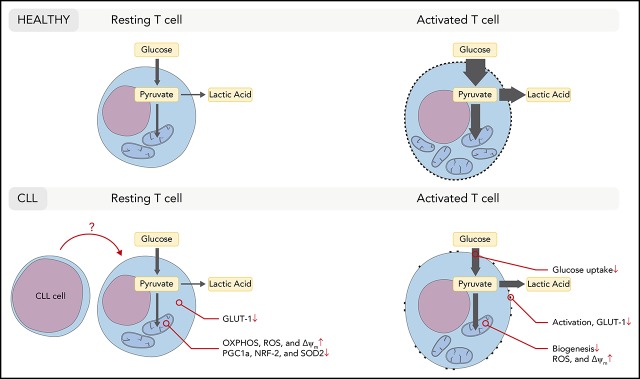
In chronic lymphocytic leukemia (CLL), acquired T-cell dysfunction impedes development of effective immunotherapeutic strategies, through as-yet unresolved mechanisms. We have previously shown that CD8 T cells in CLL exhibit impaired activation and reduced glucose uptake after stimulation. CD8 T cells in CLL patients are chronically exposed to leukemic B cells, which potentially impacts metabolic homeostasis resulting in aberrant metabolic reprogramming upon stimulation. Here, we report that resting CD8 T cells in CLL have reduced intracellular glucose transporter 1 (GLUT1) reserves, and have an altered mitochondrial metabolic profile as displayed by increased mitochondrial respiration, membrane potential, and levels of reactive oxygen species. This coincided with decreased levels of peroxisome proliferator-activated receptor γ coactivator 1-α, and in line with that, CLL-derived CD8 T cells showed impaired mitochondrial biogenesis upon stimulation. In search of a therapeutic correlate of these findings, we analyzed mitochondrial biogenesis in CD19-directed chimeric antigen receptor (CAR) CD8 T cells prior to infusion in CLL patients (who were enrolled in NCT01747486 and NCT01029366 [https://clinicaltrials.gov]). Interestingly, in cases with a subsequent complete response, the infused CD8 CAR T cells had increased mitochondrial mass compared with nonresponders, which positively correlated with the expansion and persistence of CAR T cells. Our findings demonstrate that GLUT1 reserves and mitochondrial fitness of CD8 T cells are impaired in CLL. Therefore, boosting mitochondrial biogenesis in CAR T cells might improve the efficacy of CAR T-cell therapy and other emerging cellular immunotherapies.
在慢性淋巴细胞白血病 (CLL) 中,获得性 T 细胞功能障碍通过尚未解决的机制阻碍了有效免疫治疗策略的发展。我们之前已经表明,CLL 中的 CD8 T 细胞在刺激后表现出激活受损和葡萄糖摄取减少。CLL 患者的 CD8 T 细胞长期受到白血病 B 细胞的影响,这可能会影响代谢稳态,导致刺激后异常的代谢重编程。在这里,我们报告 CLL 中的静止 CD8 T 细胞的细胞内葡萄糖转运蛋白 1 (GLUT1) 储备减少,并且线粒体代谢特征发生改变,表现为线粒体呼吸、膜电位和活性氧水平增加。这与过氧化物酶体增殖物激活受体 γ 共激活因子 1-α 的水平降低相一致,并且与 CLL 衍生的 CD8 T 细胞在刺激下表现出受损的线粒体生物发生一致。为了寻找这些发现的治疗相关性,我们分析了在输注到 CLL 患者(他们被纳入 NCT01747486 和 NCT01029366 [https://clinicaltrials.gov])之前,针对 CD19 的嵌合抗原受体 (CAR) CD8 T 细胞中的线粒体生物发生。有趣的是,在随后出现完全缓解的情况下,输注的 CD8 CAR T 细胞的线粒体质量与无反应者相比增加,这与 CAR T 细胞的扩增和持续存在呈正相关。我们的研究结果表明,CLL 中 CD8 T 细胞的 GLUT1 储备和线粒体功能受损。因此,在 CAR T 细胞中增强线粒体生物发生可能会提高 CAR T 细胞疗法和其他新兴细胞免疫疗法的疗效。