Institute for Virology and Research Center for Immunotherapy (FZI), University Medical Center of the Johannes Gutenberg-University Mainz, Obere Zahlbacher Strasse 67, Hochhaus am Augustusplatz, 55131, Mainz, Germany.
Med Microbiol Immunol. 2019 Aug;208(3-4):469-473. doi: 10.1007/s00430-019-00610-z. Epub 2019 May 10.
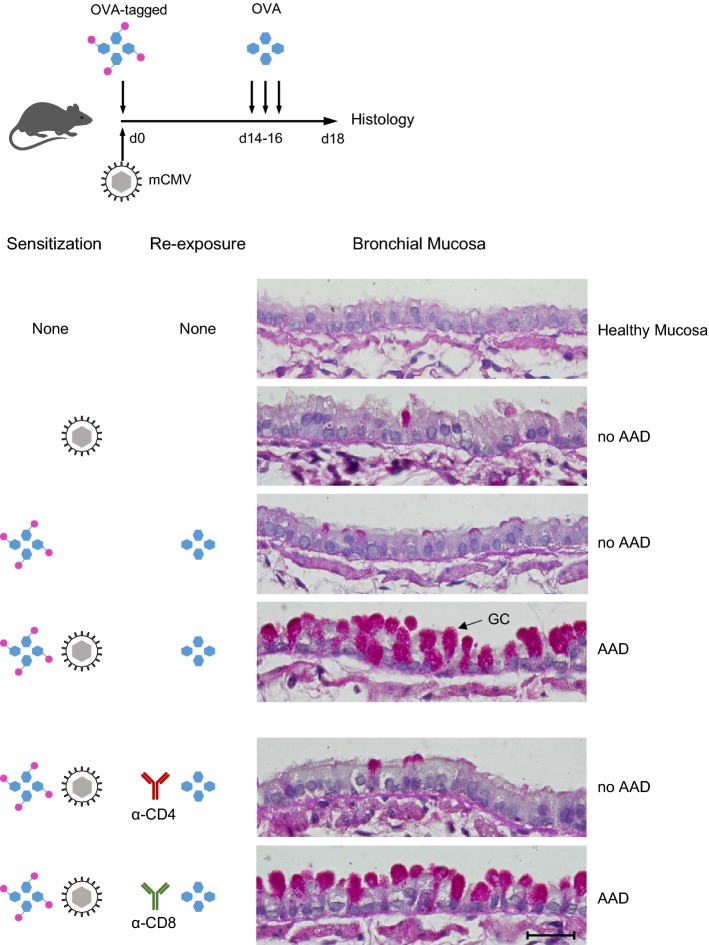
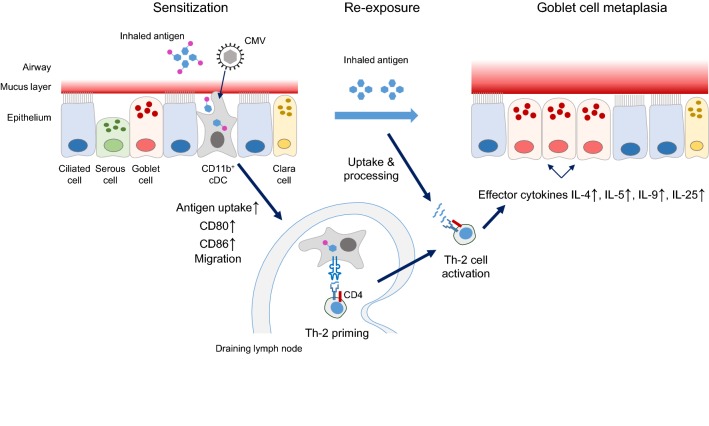
Cytomegalovirus (CMV) infection has a profound impact on the host's immune system. Immunological imprinting by CMV is not restricted to immunity against CMV itself, but can affect immunity against other viral or non-viral infectious agents and also immunopathological responses. One category is heterologous immunity based on molecular mimicry, where antigen recognition receptors specific for a CMV antigen with broad avidity distribution also bind with some avidity to unrelated antigens and exert effector functions against target structures other than those linked to CMV. Another category is induction of cytokines by CMV infection that inhibit or drive immune responses to bystander antigens unrelated to CMV, and a third category is the activation of antigen-presenting cells by CMV from which unrelated antigens profit as "stowaways". A striking example of the "stowaway" category, actually one that is of medical importance, has been published recently and will be discussed here for the more general reader. Specifically, in a murine model, CMV airway infection and inhaled environmental antigen of poor intrinsic allergenic potential were found to sensitize for allergic airway disease (AAD) only when combined. As to the mechanism, viral activation of CD11b conventional dendritic cells (CD11b cDC) that localize to airway mucosa facilitates uptake and processing of inhaled antigen. Thus, CMV serves as a "door opener" for otherwise harmless environmental antigens that have no intrinsic property to activate DC. Antigen-laden CD11b cDC migrate selectively to the airway draining lymph nodes, where they prime type-2 CD4 T helper (Th-2) cells. Upon airway re-exposure to the inhaled antigen, Th-2 cells secrete interleukins (IL-4, IL-5, IL-9, and IL-25) known to induce goblet cell metaplasia, the lead histopathological manifestation of AAD that is characterized by thickening of airway epithelia and increased numbers of mucus-producing goblet cells, resulting in enhanced mucus secretion and airflow obstruction.
巨细胞病毒 (CMV) 感染对宿主的免疫系统有深远影响。CMV 引起的免疫印迹不仅限于对 CMV 本身的免疫,还可以影响对其他病毒或非病毒传染性病原体的免疫以及免疫病理反应。一类是基于分子模拟的异源免疫,其中对 CMV 抗原具有广泛亲和力分布的抗原识别受体也以一定的亲和力与不相关的抗原结合,并对除与 CMV 相关的靶结构以外的靶结构发挥效应功能。另一类是 CMV 感染诱导细胞因子,抑制或驱动对与 CMV 无关的旁观者抗原的免疫反应,第三类是 CMV 激活抗原呈递细胞,无关抗原作为“偷渡客”从中受益。“偷渡客”类的一个引人注目的例子,实际上是一个具有医学重要性的例子,最近已经发表,并将在这里为更广泛的读者进行讨论。具体来说,在一个鼠模型中,发现 CMV 气道感染和吸入的低固有致敏潜能的环境抗原只有在联合时才会引起过敏性气道疾病 (AAD)。至于机制,病毒激活定位在气道黏膜的 CD11b 常规树突状细胞 (CD11b cDC) 促进吸入抗原的摄取和处理。因此,CMV 是一种“开门器”,可使原本无害的环境抗原发挥作用,这些抗原本身没有激活 DC 的特性。负载抗原的 CD11b cDC 选择性迁移到气道引流淋巴结,在那里它们激活 2 型 CD4 T 辅助 (Th-2) 细胞。当再次暴露于吸入的抗原时,Th-2 细胞分泌白细胞介素 (IL-4、IL-5、IL-9 和 IL-25),已知这些细胞因子可诱导杯状细胞化生,这是 AAD 的主要组织病理学表现,其特征是气道上皮增厚和粘液生成杯状细胞数量增加,导致粘液分泌增加和气流阻塞。