Cuneo Kyle C, Devasia Theresa, Sun Yilun, Schipper Matthew J, Karnak David, Davis Mary A, Owen Dawn, Feng Mary, El Naqa Issam, Bazzi Latifa, Ten Haken Randy, Lawrence Theodore S
Department of Radiation Oncology, University of Michigan Medical School, Ann Arbor, MI, USA.
Biostatistics, University of Michigan Medical School, Ann Arbor, MI, USA.
Transl Oncol. 2019 Jul;12(7):889-894. doi: 10.1016/j.tranon.2019.04.003. Epub 2019 May 9.
Declining liver function is a concerning side effect associated with radiation therapy. Biomarkers of liver toxicity would be useful in personalizing therapy.
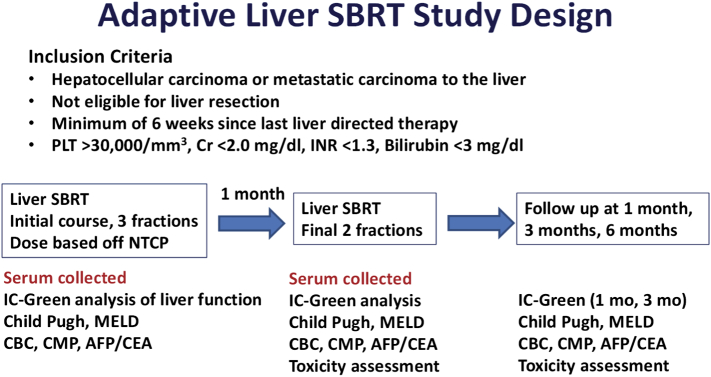
As part of two prospective clinical trials examining adaptive radiation therapy, we collected serum samples from patients receiving liver radiation. We performed a screen of 22 cytokines using a multiplex assay then used ELISA to quantify the cytokines of greatest interest. Subjects were split into screening and validation cohorts. Toxicity was defined as an increase in Child-Pugh score of 2 points or greater within 6 months. Logistic regression models were used to estimate the relationship between our toxicity endpoint and serum cytokine concentrations.
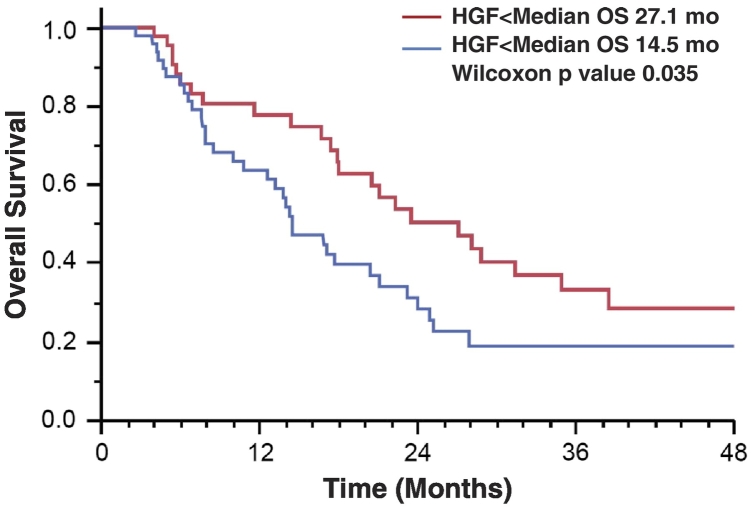
Our initial screen (46 subjects, 11 events) identified hepatocyte growth factor (HGF), CD40L (CD154), and eotaxin (CCL11) as potentially predictive of toxicity. We then tested these markers in an expanded patient cohort (104 subjects, 18 events) with a batch correction due to varying age of the samples which confirmed that high HGF and low CD40L were associated with a subsequent decline in liver function following radiation therapy. Multivariate analysis factoring in baseline Child-Pugh score and mean liver radiation dose demonstrated that HGF and CD40L were potentially predictive of toxicity (HGF OR 4.3, P = .009; CD40L OR 0.5 P = .06). Additionally, higher than median baseline HGF levels (1.4 ng/ml) were significantly associated with decreased survival following liver radiation (27.1 vs 14.5 months, P = .03).
Our study identifies high HGF and low CD40L as potential markers of liver toxicity following radiation therapy.
肝功能下降是放射治疗相关的一个令人担忧的副作用。肝毒性生物标志物有助于实现个体化治疗。
作为两项研究自适应放射治疗的前瞻性临床试验的一部分,我们收集了接受肝脏放射治疗患者的血清样本。我们使用多重检测法对22种细胞因子进行了筛查,然后用酶联免疫吸附测定法(ELISA)对最感兴趣的细胞因子进行定量。受试者被分为筛查队列和验证队列。毒性定义为6个月内Child-Pugh评分增加2分或更多。使用逻辑回归模型估计我们的毒性终点与血清细胞因子浓度之间的关系。
我们的初始筛查(46名受试者,11例事件)确定肝细胞生长因子(HGF)、CD40配体(CD154)和嗜酸性粒细胞趋化因子(CCL11)可能是毒性的预测指标。然后,我们在一个扩大的患者队列(104名受试者,18例事件)中对这些标志物进行了检测,由于样本年龄不同进行了批次校正,结果证实高HGF和低CD40L与放射治疗后肝功能的后续下降有关。纳入基线Child-Pugh评分和平均肝脏放射剂量的多变量分析表明,HGF和CD40L可能是毒性的预测指标(HGF比值比4.3,P = 0.009;CD40L比值比0.5,P = 0.06)。此外,高于基线HGF水平中位数(1.4 ng/ml)与肝脏放射治疗后生存率降低显著相关(27.1个月对14.5个月,P = 0.03)。
我们的研究确定高HGF和低CD40L是放射治疗后肝毒性的潜在标志物。