Wang Huan, Wang Yan, Deng Chun, Li Lei, Guo Chunbao
Department of Neonatology, Children's Hospital, Chongqing Medical University, Chongqing.
Ministry of Education Key Laboratory of Child Development and Disorders, Children's Hospital, Chongqing Medical University, Chongqing, P.R. China.
Medicine (Baltimore). 2019 May;98(19):e15568. doi: 10.1097/MD.0000000000015568.
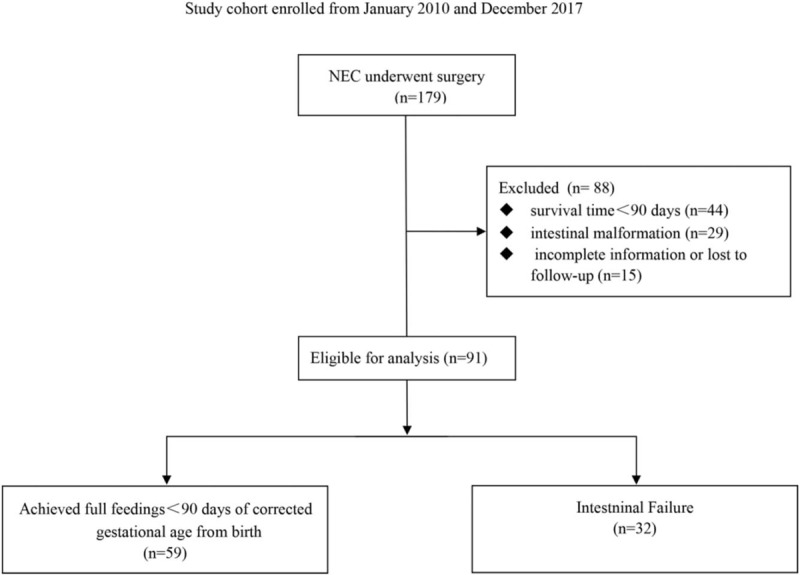
The aim of the present study was to identify risk factors for intestinal failure (IF) in infants who received surgery for necrotizing enterocolitis (NEC).A retrospective multicenter case-series study was conducted in a sample of 91 infants admitted to Children's Hospital of Chongqing Medical University between January 2010 and December 2017. The occurrence of IF was defined as the dependence on parenteral nutrition for ≥90 days. Logistic regression was used to investigate the predictors of IF.Of 179 patients reviewed, excluding those with intestinal malformation and inadequate information, 91 were included in the study, and of these cases, 32 (35.2%) developed IF. Controlling for other factors, multivariate analysis showed that birth weight (OR = 0.999; 95% CI, 0.998-1.000; P = .010), the length of the bowel resected (OR = 1.109; 95% CI, 1.048-1.173; P = .000), and the percentage of small bowel resected (OR = 1.305; 95% CI, 1.133-1.504; P = .000) were factors that increased the chances of IF occurrence.Our data demonstrated that variables characteristic of severe NEC, including lower birth weight, greater extent of bowel resection, and larger percentage of small bowel resection were associated with the incidence of IF.
本研究的目的是确定接受坏死性小肠结肠炎(NEC)手术的婴儿发生肠衰竭(IF)的危险因素。对2010年1月至2017年12月期间重庆医科大学附属儿童医院收治的91例婴儿进行了一项回顾性多中心病例系列研究。IF的发生定义为依赖肠外营养≥90天。采用逻辑回归分析IF的预测因素。在179例接受评估的患者中,排除肠道畸形和信息不完整的患者,91例纳入研究,其中32例(35.2%)发生IF。在控制其他因素后,多变量分析显示出生体重(OR = 0.999;95%CI,0.998 - 1.000;P = 0.010)、切除肠段长度(OR = 1.109;95%CI,1.048 - 1.173;P = 0.000)和小肠切除百分比(OR = 1.305;95%CI,1.133 - 1.504;P = 0.000)是增加IF发生几率的因素。我们的数据表明,严重NEC的特征变量,包括较低的出生体重、更大范围的肠切除和更高的小肠切除百分比,与IF的发生率相关。