Department of Pediatrics, Division of Newborn Medicine, Washington University School of Medicine, St. Louis, MO 63110, USA.
Department of Surgery, Division of Pediatric Surgery, Washington University School of Medicine, St. Louis, MO 63110, USA.
Nutrients. 2020 Feb 18;12(2):520. doi: 10.3390/nu12020520.
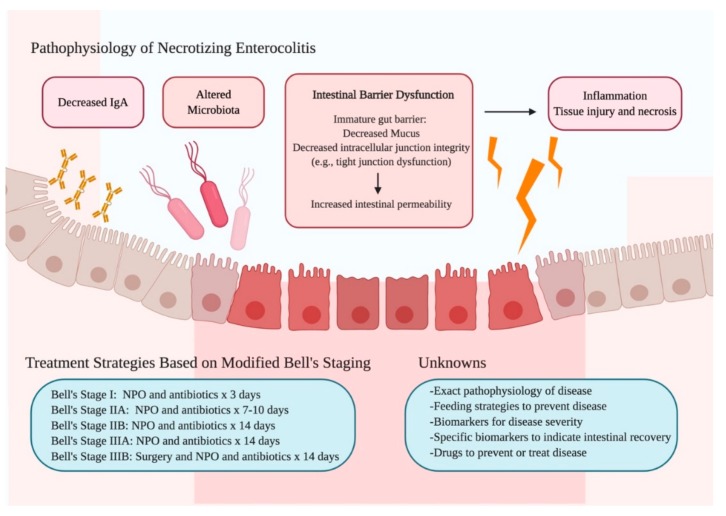
This review aims to discuss the role of nutrition and feeding practices in necrotizing enterocolitis (NEC), NEC prevention, and its complications, including surgical treatment. A thorough PubMed search was performed with a focus on meta-analyses and randomized controlled trials when available. There are several variables in nutrition and the feeding of preterm infants with the intention of preventing necrotizing enterocolitis (NEC). Starting feeds later rather than earlier, advancing feeds slowly and continuous feeds have not been shown to prevent NEC and breast milk remains the only effective prevention strategy. The lack of medical treatment options for NEC often leads to disease progression requiring surgical resection. Following resection, intestinal adaptation occurs, during which villi lengthen and crypts deepen to increase the functional capacity of remaining bowel. The effect of macronutrients on intestinal adaptation has been extensively studied in animal models. Clinically, the length and portion of intestine that is resected may lead to patients requiring parenteral nutrition, which is also reviewed here. There remain significant gaps in knowledge surrounding many of the nutritional aspects of NEC and more research is needed to determine optimal feeding approaches to prevent NEC, particularly in infants younger than 28 weeks and <1000 grams. Additional research is also needed to identify biomarkers reflecting intestinal recovery following NEC diagnosis individualize when feedings should be safely resumed for each patient.
本文旨在探讨营养和喂养实践在坏死性小肠结肠炎(NEC)中的作用,以及其预防和并发症,包括手术治疗。我们进行了全面的 PubMed 检索,重点关注荟萃分析和随机对照试验。对于早产儿,有多种营养和喂养变量,目的是预防坏死性小肠结肠炎(NEC)。与早期喂养相比,晚期开始喂养、缓慢增加喂养量和持续喂养并没有被证明可以预防 NEC,母乳仍然是唯一有效的预防策略。NEC 的治疗方法选择有限,往往导致疾病进展,需要进行手术切除。切除后,肠道会发生适应性变化,在此期间,绒毛变长,隐窝变深,从而增加剩余肠道的功能容量。大量营养素对肠道适应性的影响已在动物模型中得到广泛研究。临床上,切除的肠段长度和部分可能导致患者需要接受肠外营养,本文也对此进行了综述。在许多与 NEC 相关的营养方面仍存在知识空白,需要进一步研究以确定预防 NEC 的最佳喂养方法,特别是对于 28 周以下和体重不足 1000 克的婴儿。还需要进一步的研究来确定反映 NEC 诊断后肠道恢复的生物标志物,以便为每个患者个体化确定何时可以安全恢复喂养。