Sailaja K Baby, Mk Renuka
Department of Critical Care Medicine, Sriramachandra Medical College and Research Institute, Chennai, Tamil Nadu, India.
Department of Anaesthesiology, Sriramachandra Medical College and Research Institute, Chennai, Tamil Nadu, India, e-mail:
Indian J Crit Care Med. 2019 Feb;23(2):78-82. doi: 10.5005/jp-journals-10071-237121.
Critically ill obstetric patients represent a small proportion of intensive care unit (ICU) admissions. Physiological changes of pregnancy along with pregnancy specific diseases may lead to rapid deterioration of the health status of the parturient warranting ICU care. The present study aims to study the clinical profile and outcomes of the obstetric patients requiring ICU care.
Prospective observational study in the multidisciplinary ICU of a tertiary care teaching hospital conducted for a period of 2 years.
Demographic details, indication for ICU admission, severity of illness scores, interventions, complications and outcomes of the consecutive obstetric patients transferred to ICU were studied.
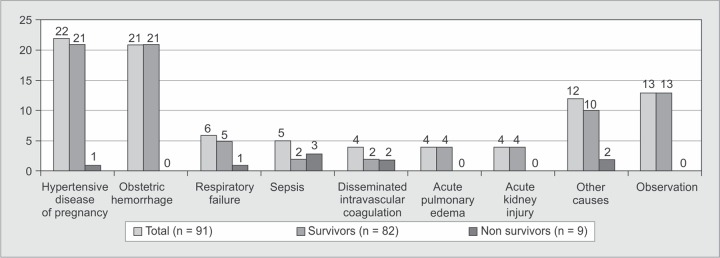
Ninety-one patients were admitted (26 per 1000 deliveries) to the ICU. Majority of them were postpartum (84.6%) and unbooked or referred (63.8%). Hypertensive disorders (24.2%) and obstetric hemorrhage (23.1%) were the major cause for admission to ICU. Forty three patients (47.3%) underwent cesarean delivery. Mechanical ventilation (54.9%), blood transfusion (46%), vasopressor therapy (22%) and dialysis (9.9%) were the various interventions provided in the ICU. Patients with sepsis had high mortality accounting for one third of ICU mortality. The ICU mortality rate was 9.9%.
The present study showed a clinical profile and outcomes similar to the current scenario of critically ill obstetric patients nationwide. Further studies with a larger sample size may provide a better insight in this population.
Sailaja B, Renuka MK, . Critically Ill Obstetric Admissions to an Intensive Care Unit: A Prospective Analysis from a Tertiary Care University Hospital in South India. Indian J of Crit Care Med 2019;23(2):78-82.
危重症产科患者占重症监护病房(ICU)收治患者的比例较小。妊娠期间的生理变化以及妊娠特有的疾病可能导致产妇健康状况迅速恶化,从而需要入住ICU治疗。本研究旨在探讨需要ICU治疗的产科患者的临床特征及治疗结果。
在一家三级护理教学医院的多学科ICU进行了为期2年的前瞻性观察研究。
对转入ICU的连续产科患者的人口统计学细节、入住ICU的指征、疾病严重程度评分、干预措施、并发症及治疗结果进行了研究。
91例患者入住ICU(每1000例分娩中有26例)。其中大多数为产后患者(84.6%),且未进行产前登记或为转诊患者(63.8%)。高血压疾病(24.2%)和产科出血(23.1%)是入住ICU的主要原因。43例患者(47.3%)接受了剖宫产。ICU提供的各种干预措施包括机械通气(54.9%)、输血(46%)、血管活性药物治疗(22%)和透析(9.9%)。脓毒症患者的死亡率较高,占ICU死亡人数的三分之一。ICU死亡率为9.9%。
本研究显示的临床特征和治疗结果与全国危重症产科患者的当前情况相似。进一步开展更大样本量的研究可能会对这一人群有更深入的了解。
Sailaja B, Renuka MK, 。重症监护病房收治的危重症产科患者:来自印度南部一家三级护理大学医院的前瞻性分析。《印度危重症医学杂志》2019;23(2):78 - 82。