Aix Marseille Université, CNRS, BIP UMR 7281, IMM, Marseille, France.
Aix Marseille Université, CNRS, BIP UMR 7281, IMM, Marseille, France
mBio. 2019 May 14;10(3):e00269-19. doi: 10.1128/mBio.00269-19.
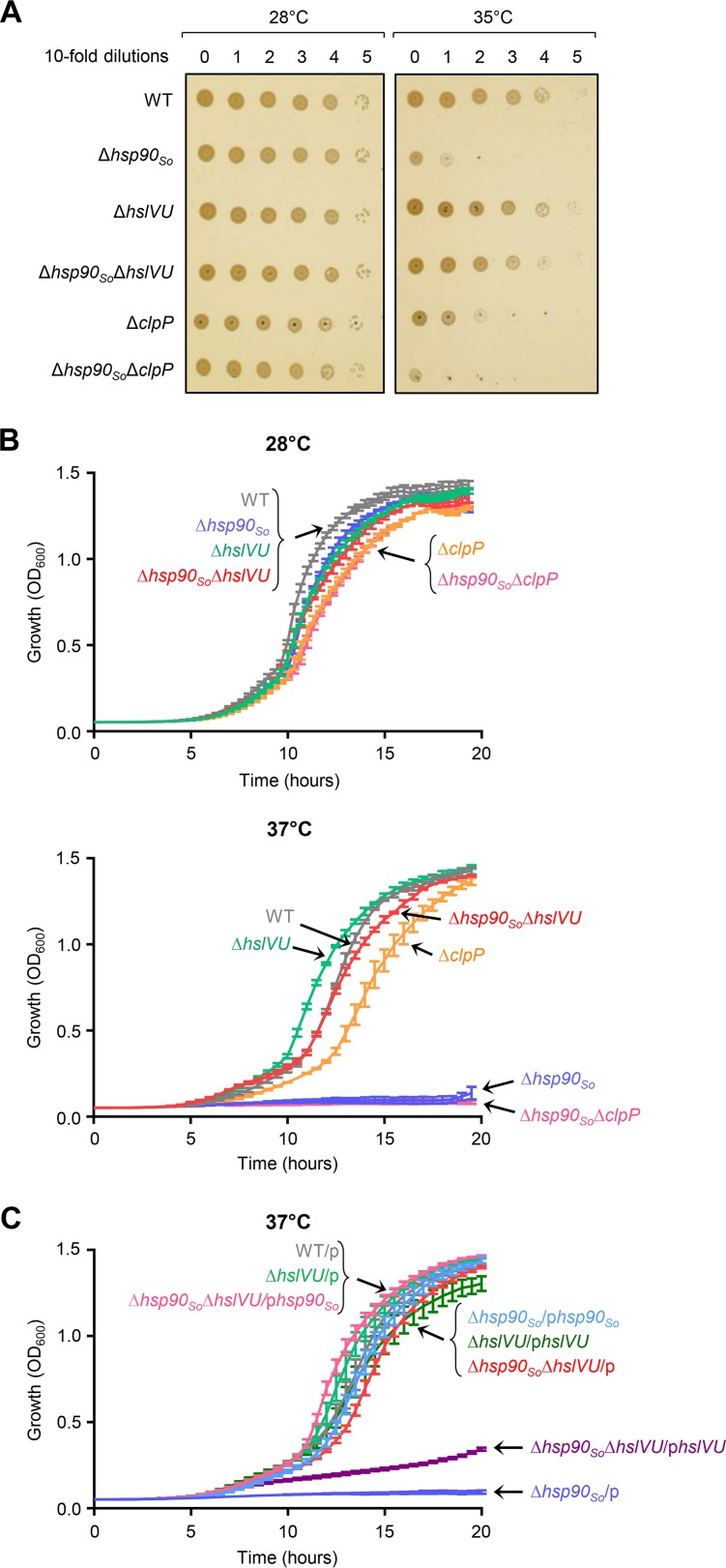
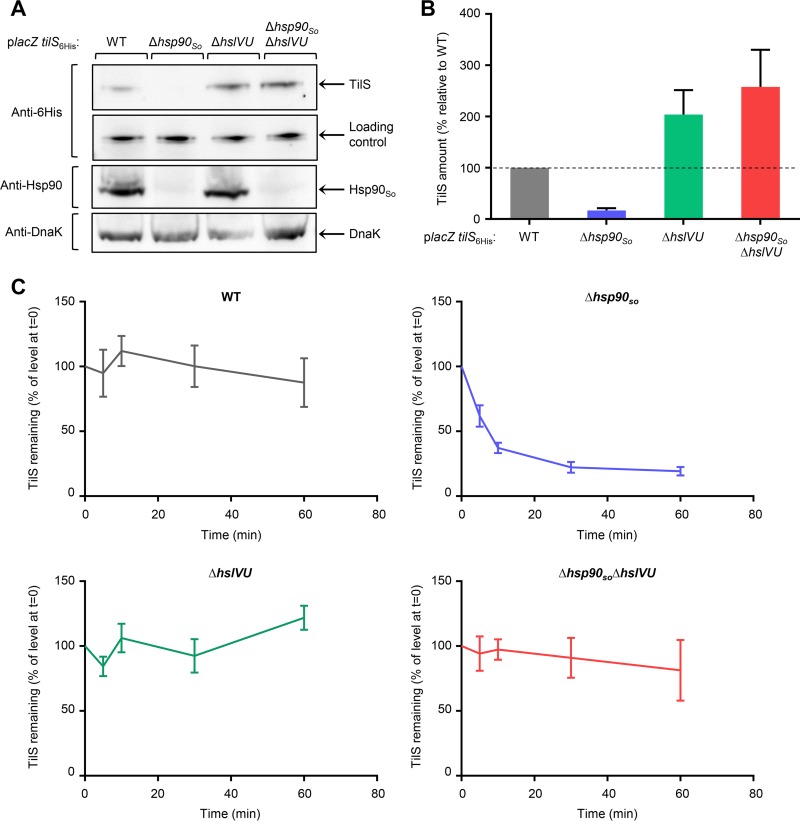
Protein synthesis, folding, and degradation are an accurately regulated process occurring in every organism and called proteostasis. This process is essential to maintain a healthy proteome since proteostasis dysregulation is responsible for devastating cellular issues. Proteostasis is controlled by a complex network of molecular chaperones and proteases. Among them, eukaryotic Hsp90, assisted by many cochaperones and the Hsp70 chaperone system, plays a major role in activating hundreds of client proteins, and Hsp90 inhibition usually leads to proteasomal degradation of these clients. In bacteria, however, the precise function of Hsp90 remains quite unclear, and only a few clients are known. Recently, we have shown that Hsp90 is essential at elevated temperature in the aquatic model bacterium , and we have identified a client of Hsp90, TilS, involved in tRNA modification. Here we found that two members of the proteostasis network with antagonist activities, the Hsp90 chaperone and the HslVU protease, which is considered the proteasome ancestor, together regulate the level of TilS. In particular, we show that deletion of the genes coding for the HslVU protease suppresses the growth defect of an strain with deleted, by increasing the cellular level of the essential TilS protein. These results open up new avenues for understanding how proteostasis is controlled in bacteria, and new Hsp90 clients are much needed now to confirm the interplay between Hsp90 and proteases. Maintaining a healthy proteome is essential in every living cell from bacteria to humans. For example, proteostasis (protein homeostasis) imbalance in humans leads to devastating diseases, including neurodegenerative diseases and cancers. Therefore, proteins need to be assisted from their synthesis to their native folding and ultimately to their degradation. To ensure efficient protein turnover, cells possess an intricate network of molecular chaperones and proteases for protein folding and degradation. However, these networks need to be better defined and understood. Here, using the aquatic bacterium as a model organism, we demonstrate interplay between two proteins with antagonist activities, the Hsp90 chaperone and the HslVU protease, to finely regulate the level of an essential client of Hsp90. Therefore, this work provides a new bacterial model to better study protein regulation and turnover, and it sheds light on how proteostasis by Hsp90 and proteases could be controlled in bacteria.
蛋白质的合成、折叠和降解是一个精确调节的过程,发生在每个生物体中,被称为蛋白质稳态。这个过程对于维持健康的蛋白质组至关重要,因为蛋白质稳态的失调是导致毁灭性细胞问题的原因。蛋白质稳态由一个复杂的分子伴侣和蛋白酶网络控制。其中,真核细胞的 Hsp90 在许多共伴侣和 Hsp70 伴侣系统的协助下,在激活数百种客户蛋白方面发挥着重要作用,而 Hsp90 的抑制通常会导致这些客户蛋白的蛋白酶体降解。然而,在细菌中,Hsp90 的精确功能仍然相当不清楚,并且只知道少数几个客户。最近,我们已经表明 Hsp90 在水生模式细菌 中高温时是必需的,并且我们已经鉴定出一个 Hsp90 的客户蛋白,TilS,参与 tRNA 修饰。在这里,我们发现两个具有拮抗活性的蛋白质稳态网络成员,Hsp90 伴侣和 HslVU 蛋白酶,被认为是蛋白酶体的前身,共同调节 TilS 的水平。特别是,我们表明,删除编码 HslVU 蛋白酶的基因可以通过增加必需的 TilS 蛋白的细胞水平来抑制 缺失的 菌株的生长缺陷。这些结果为理解细菌中蛋白质稳态的控制开辟了新的途径,现在非常需要新的 Hsp90 客户蛋白来确认 Hsp90 和蛋白酶之间的相互作用。维持健康的蛋白质组对于从细菌到人类的每个活细胞都是至关重要的。例如,人类的蛋白质稳态(蛋白质平衡)失衡会导致毁灭性的疾病,包括神经退行性疾病和癌症。因此,蛋白质需要从合成到天然折叠再到最终降解都得到辅助。为了确保有效的蛋白质周转,细胞拥有一个复杂的分子伴侣和蛋白酶网络来进行蛋白质折叠和降解。然而,这些网络需要更好地定义和理解。在这里,我们使用水生细菌 作为模型生物,证明了两种具有拮抗活性的蛋白质,Hsp90 伴侣和 HslVU 蛋白酶之间的相互作用,以精细调节 Hsp90 的一个必需客户蛋白的水平。因此,这项工作提供了一个新的细菌模型,以更好地研究蛋白质调节和周转,并揭示了 Hsp90 和蛋白酶如何控制细菌中的蛋白质稳态。