Shanghai Key Laboratory of Orthopaedic Implants, Department of Orthopaedic Surgery, Shanghai Ninth People's Hospital, Shanghai Jiao Tong University School of Medicine, 639 Zhizaoju Road, Shanghai, China.
Department of Radiology, Shanghai Ninth People's Hospital, Shanghai Jiao Tong University School of Medicine, 639 Zhizaoju Road, Shanghai, China.
J Orthop Surg Res. 2019 May 15;14(1):134. doi: 10.1186/s13018-019-1191-0.
We evaluated the compensatory change in ankle alignment due to knee malalignment and its relationship with varus knee deformities, as well as sex differences in compensation.
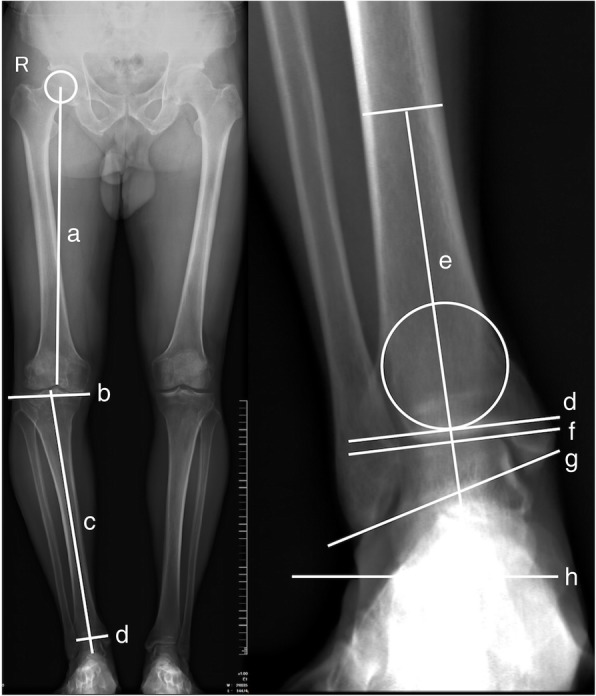
From October 2016 to September 2017, 103 patients with end-stage knee osteoarthritis underwent primary total knee arthroplasty (TKA). Ninety-five knees (78 patients) were included. The hip-knee-ankle angle (HKA) and ankle alignment and tilt were evaluated with full-leg standing anteroposterior radiographs. The ankle alignment was estimated according to the tibiotalar angle, tibial anterior surface angle (TAS), and lateral distal tibial angle. The talar tilt angle (TT), anatomical talocrural angle, angle between the tibial plateau and distal tibial plafond, angles between the ground and distal tibial plafond, and angles between the ground and upper talus were measured to evaluate ankle tilt. The patients were separated into two sex-based groups; correlations between the HKA and ankle parameters were estimated.
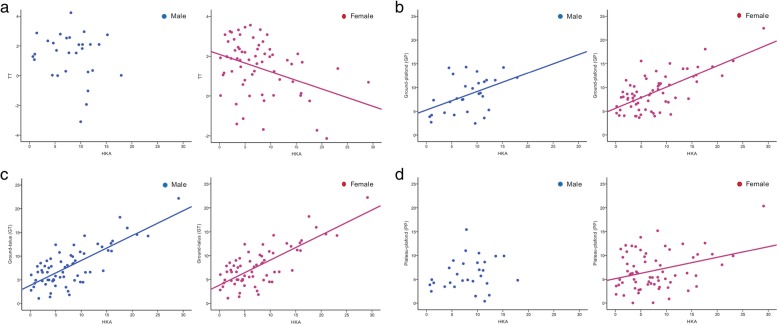
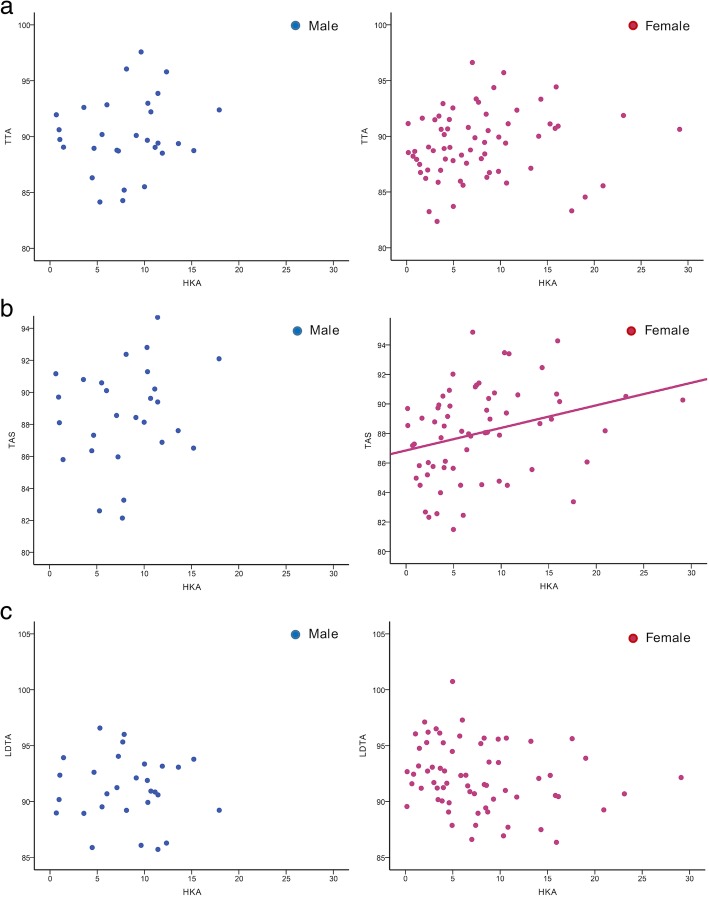
The mean HKA in men and women was 8.16 ± 4.36° and 7.69 ± 5.93°, respectively. The relative tilt of the talus and distal tibia plafond to the ground was increased when varus knee deformities progressed. In women, there was a positive correlation between the knee alignment and TAS (r = - 0.295, p = 0.016). As the knee mechanical axis became more varus, the distal tibia plafond became more valgus. In women, a negative correlation was observed between the HKA and TT (r = - 0.359, p = 0.003). Compensatory changes in the ankle alignment and TT to knee alignment were not observed in men.
Compensatory ankle changes should be considered before TKA.
我们评估了由于膝关节对线不良导致的踝关节对线的代偿性变化及其与内翻膝畸形的关系,以及补偿的性别差异。
从 2016 年 10 月至 2017 年 9 月,103 例终末期膝骨关节炎患者接受初次全膝关节置换术(TKA)。95 膝(78 例)纳入研究。通过下肢全长站立前后位 X 线片评估髋膝踝角(HKA)和踝关节对线及倾斜。踝关节对线根据胫距角、胫骨前表面角(TAS)和外侧远端胫骨角来评估。测量距骨倾斜角(TT)、解剖距下关节角、胫骨平台与远端胫骨平台之间的角度、距骨与远端胫骨平台之间的角度、距骨与上距骨之间的角度来评估踝关节倾斜。将患者分为两组;估计 HKA 与踝关节参数之间的相关性。
男性和女性的平均 HKA 分别为 8.16±4.36°和 7.69±5.93°。当内翻膝畸形进展时,距骨和远端胫骨平台相对于地面的相对倾斜增加。在女性中,膝关节对线与 TAS 呈正相关(r=-0.295,p=0.016)。随着膝关节机械轴向内侧偏移,远端胫骨平台变得更加外翻。在女性中,HKA 与 TT 呈负相关(r=-0.359,p=0.003)。男性膝关节对线变化时,踝关节对线和 TT 无代偿性变化。
TKA 前应考虑踝关节的代偿性变化。