Department of Radiation Oncology, MacKay Memorial Hospital, Taipei, Taiwan.
Department of Medicine, MacKay Medical College, Taipei, Taiwan.
J Cachexia Sarcopenia Muscle. 2019 Aug;10(4):814-826. doi: 10.1002/jcsm.12440. Epub 2019 May 15.
Treatment-related toxicities and decreased levels of patient performance during cancer therapy might contribute to body composition changes and thereby impact outcomes. However, the effect of longitudinal body composition changes on outcomes in patients with advanced endometrial cancer is unknown. This study investigated the association between body composition changes during staging surgery and adjuvant chemoradiotherapy and outcomes in patients with stage III endometrial cancer.
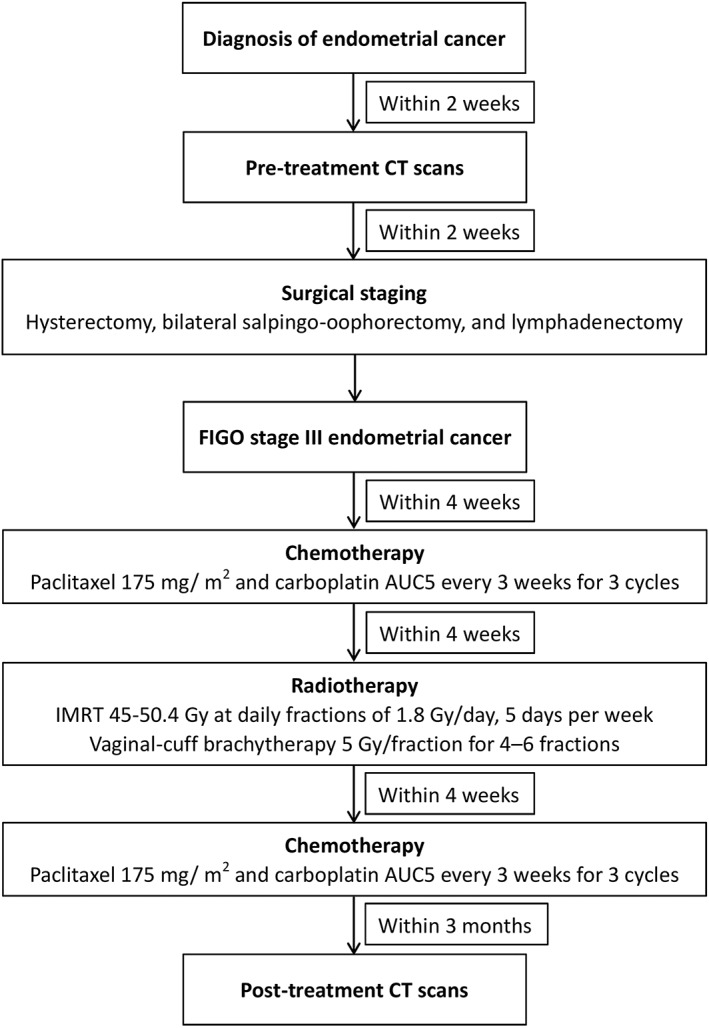
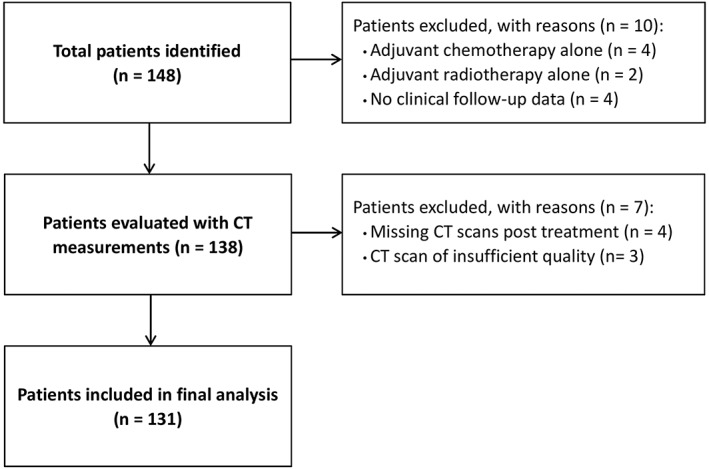
Pretreatment and post-treatment computed tomography (CT) images of 131 patients with stage III endometrial cancer who were treated between 2008 and 2016 were analysed. All CT images were contrast enhanced and acquired according to the standardized protocol. The skeletal muscle index (SMI), skeletal muscle radiodensity (SMD), and total adipose tissue index were measured from two sets of CT images obtained at the level of the third lumbar vertebra. The skeletal muscle gauge was calculated by multiplying SMI by SMD (SMI × SMD). Predictors of overall survival and progression-free survival were identified using Cox regression models.
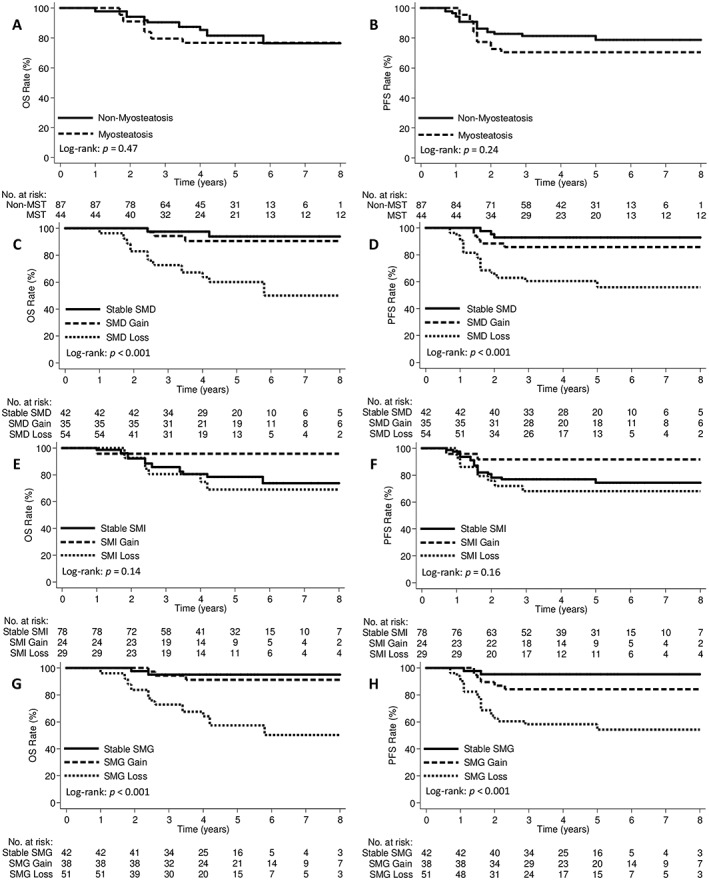
The median follow-up was 50.6 (range 12.1-117.0) months. Overall, body mass index (BMI) changes during treatment were 0.4% per 210 days (95% confidence interval: -0.6 to 1.4; P = 0.41), and patients experienced an average SMD loss of 2.1% per 210 days (95% confidence interval: -4.0 to -0.2; P = 0.03). Weight loss and SMD loss ≥5% were observed in 23 (17.6%) and 54 (41.2%) patients, respectively. The changes in SMD did not correlate with those in BMI (Spearman's ρ for SMD, -0.13; P = 0.13). SMD change (per 1 Hounsfield unit/210 days decrease) was independently associated with poorer overall survival (hazard ratio: 1.32, 95% confidence interval: 1.14-1.52; P < 0.001) and progression-free survival (hazard ratio: 1.28, 95% confidence interval: 1.12-1.43; P < 0.001). Our results did not show association between survival and pretreatment myosteatosis and sarcopenia or changes in SMI and total adipose tissue index during treatment. The pretreatment skeletal muscle gauge was associated with treatment modifications such as delays, dose reductions, and discontinuation of chemotherapy.
Skeletal muscle radiodensity decreased significantly during treatment and was independently associated with poorer survival in patients with stage III endometrial cancer who underwent staging surgery and adjuvant chemoradiotherapy. SMD loss was occult and occurred independently of BMI change.
癌症治疗过程中的治疗相关毒性和患者体能下降可能导致身体成分发生变化,从而影响治疗结局。然而,目前尚不清楚晚期子宫内膜癌患者的身体成分纵向变化对结局的影响。本研究旨在调查Ⅲ期子宫内膜癌患者分期手术和辅助放化疗期间的身体成分变化与结局之间的关系。
对 2008 年至 2016 年间接受治疗的 131 例Ⅲ期子宫内膜癌患者的术前和术后 CT 图像进行分析。所有 CT 图像均为增强对比图像,并按照标准化方案采集。通过第三腰椎水平的两组 CT 图像测量骨骼肌指数(SMI)、骨骼肌衰减值(SMD)和总脂肪组织指数。通过将 SMI 乘以 SMD(SMI×SMD)计算骨骼肌计量。使用 Cox 回归模型确定总生存期和无进展生存期的预测因子。
中位随访时间为 50.6(12.1-117.0)个月。总的来说,治疗期间 BMI 的变化为 0.4%/210 天(95%置信区间:-0.6 至 1.4;P=0.41),患者的 SMD 平均损失为 2.1%/210 天(95%置信区间:-4.0 至-0.2;P=0.03)。23 例(17.6%)和 54 例(41.2%)患者分别出现体重减轻和 SMD 损失≥5%的情况。SMD 的变化与 BMI 的变化不相关(SMD 的 Spearman ρ,-0.13;P=0.13)。SMD 变化(每 1 亨斯菲尔德单位/210 天下降)与总体生存率较差独立相关(风险比:1.32,95%置信区间:1.14-1.52;P<0.001)和无进展生存率较差独立相关(风险比:1.28,95%置信区间:1.12-1.43;P<0.001)。我们的结果显示,治疗前肌少症和肌减少症与生存无关,治疗期间 SMI 和总脂肪组织指数的变化也与生存无关。治疗前的骨骼肌计量与治疗方案的改变有关,如延迟、剂量减少和化疗停止。
在接受分期手术和辅助放化疗的Ⅲ期子宫内膜癌患者中,治疗期间骨骼肌衰减值显著下降,且与生存率较差独立相关。SMD 的丢失是隐匿的,且独立于 BMI 变化。