Google Inc., Pittsburgh, PA, United States of America.
Department of Electrical and Computer Engineering, University of California San Diego, La Jolla, CA, United States of America.
PLoS One. 2019 May 16;14(5):e0211765. doi: 10.1371/journal.pone.0211765. eCollection 2019.
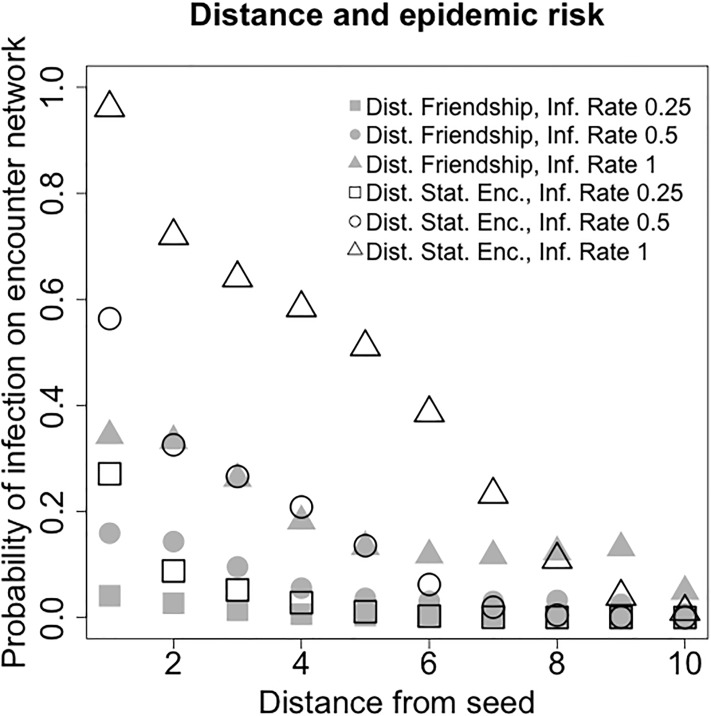
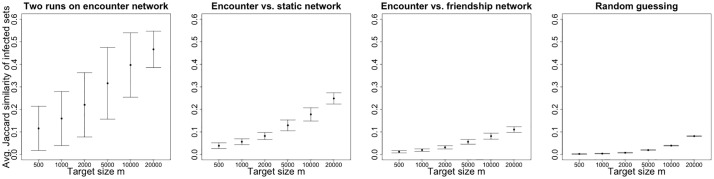
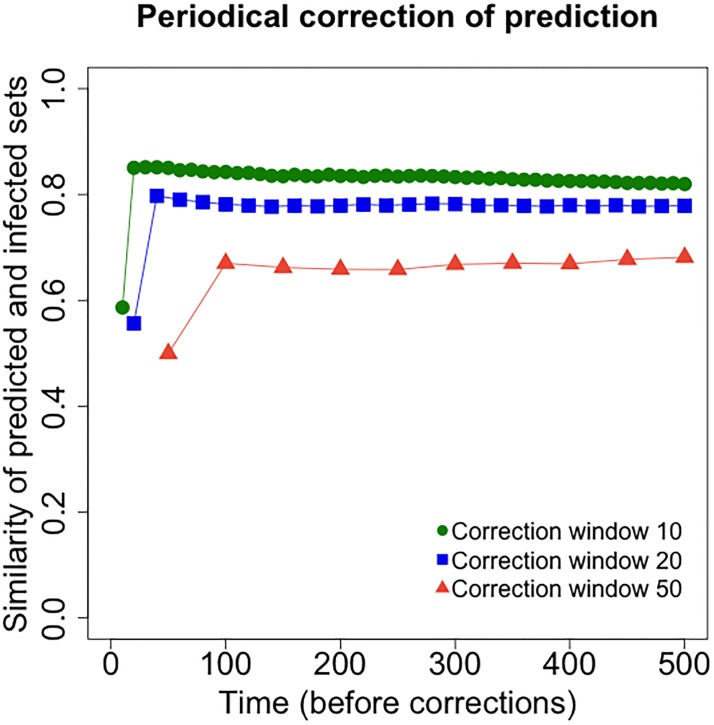
To what extent can online social networks predict who is at risk of an infection? Many infections are transmitted through physical encounter between humans, but collecting detailed information about it can be expensive, might invade privacy, or might not even be possible. In this paper, we ask whether online social networks help predict and contain epidemic risk. Using a dataset from a popular online review service which includes over 100 thousand users and spans 4 years of activity, we build a time-varying network that is a proxy of physical encounter between its users (the encounter network) and a static network based on their reported online friendship (the friendship With computer simulations, we compare stochastic infection processes on the two networks, considering infections on the encounter network as the benchmark. First, we show that the friendship network is useful to identify the individuals at risk of infection, despite providing lower accuracy than the ideal case in which the encounters are known. This limited prediction accuracy is not only due to the static nature of the friendship network because a static version of the encounter network provides more accurate prediction of risk than the friendship network. Then, we show that periodical monitoring of the infection spreading on the encounter network allows to correct the infection predicted by a process spreading on the friendly staff ndship network, and achieves high prediction accuracy. Finally, we show that the friendship network contains valuable information to effectively contain epidemic outbreaks even when a limited budget is available for immunization. In particular, a strategy that immunizes random friends of random individuals achieves the same performance as knowing individuals' encounters at a small additional cost, even if the infection spreads on the encounter network.
在线社交网络在多大程度上可以预测哪些人有感染风险?许多传染病是通过人与人之间的身体接触传播的,但收集关于这些接触的详细信息可能成本高昂、侵犯隐私,甚至是不可能的。在本文中,我们探讨了在线社交网络是否有助于预测和控制传染病风险。我们使用了一个来自流行在线评论服务的数据集合,其中包含超过 10 万名用户,涵盖了 4 年的活动记录。我们构建了一个时变网络,作为用户之间身体接触的代理(接触网络),以及一个基于他们报告的在线友谊的静态网络(友谊网络)。通过计算机模拟,我们比较了两种网络上的随机感染过程,将接触网络上的感染作为基准。首先,我们表明友谊网络有助于识别感染风险较高的个体,尽管其准确性低于已知接触情况的理想情况。这种有限的预测准确性不仅是由于友谊网络的静态性质造成的,因为接触网络的静态版本比友谊网络更能准确地预测风险。然后,我们表明定期监测接触网络上的感染传播可以纠正在友谊网络上传播的感染过程的预测,并实现高预测准确性。最后,我们表明即使免疫接种预算有限,友谊网络也包含有价值的信息,可以有效地控制传染病爆发。具体来说,对随机个体的随机朋友进行免疫接种的策略与仅知道个体接触情况的策略相比,只需额外付出较小的成本,就可以达到相同的效果。