Cristiani Cinzia, Iannicelli-Zubiani Elena Maria, Dotelli Giovanni, Finocchio Elisabetta, Gallo Stampino Paola, Licchelli Maurizio
Politecnico di Milano, Dipartimento di Chimica, Materiali e Ingegneria Chimica "Giulio Natta," Piazza Leonardo Da Vinci 32, 20133 Milano, Italy.
Università di Genova, Dipartimento di Ingegneria Civile, Chimica e Ambientale, Via all'Opera Pia 15, 16145 Genova, Italy.
Polymers (Basel). 2019 May 16;11(5):897. doi: 10.3390/polym11050897.
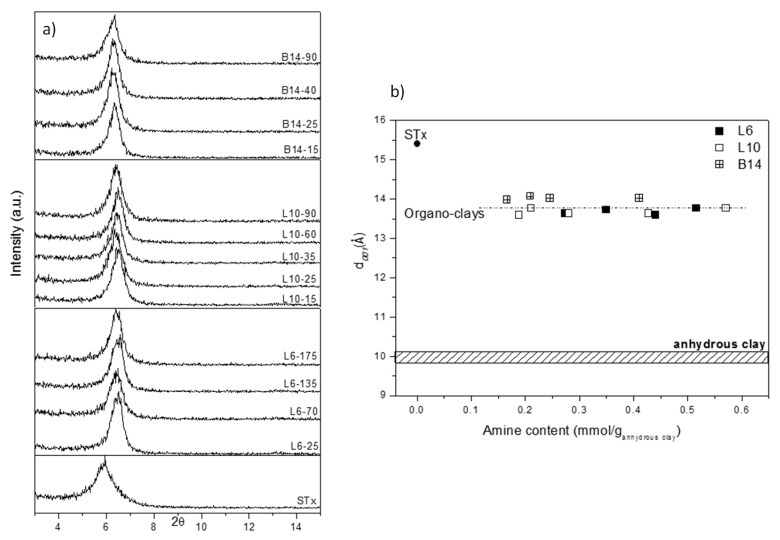
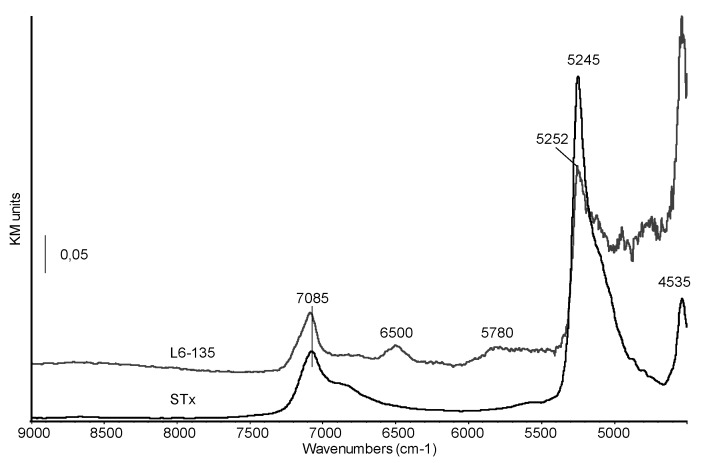
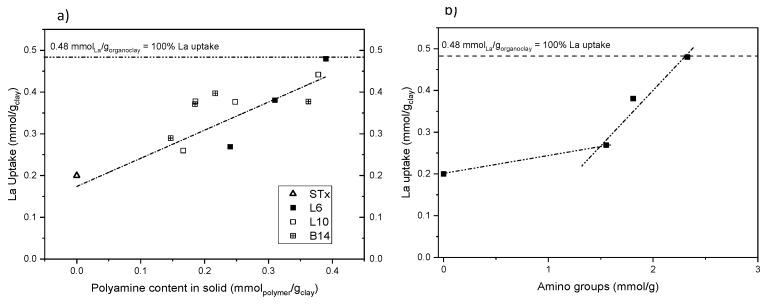
Hybrid materials based on clays and polyamines are supposed to be efficient heavy metals sorbents due to the well-known adsorption behaviour of the clay matrix and to the coordination properties of un-protonated amino groups. For this purpose, a montmorillonite clay was modified with three different aliphatic polyamines: L6 and L10 have a linear structure with six and ten amino groups, respectively, while B14 is a branched polyamine with fourteen amino groups. Initial amine concentration was the main parameter investigated and data were fitted with Langmuir and Freundlich models. Interaction mechanisms between clay and amines were deeply investigated by different experimental techniques such as X-ray powder diffraction (XRD), thermal analysis measurements (DTG), Fourier Transform Infrared Spectroscopy (FT-IR) and diffuse reflectance (NIR) spectroscopy. Experimental results showed that the amount of amines efficiently immobilized in the solid phase can be increased by increasing the initial concentration of polyamines in the clay modification process. These data were best fitted by Freundlich model, indicating a presence of surface sites of different nature. In the resulting hybrid materials, neither the accessibility of the NH/NH groups of the amines, nor the accessibility of the structural OH of the clay was hindered. Several preliminary tests in La ions' uptake and release from aqueous solution were also carried out. In the conditions used for this study, total metal ion removal was achieved at sufficiently low linear amine loadings (i.e., 0.45 mmol/g for the small L6 amine), suggesting that these hybrid materials are promising for the proposed application in environmental remediation.
基于粘土和多胺的杂化材料被认为是高效的重金属吸附剂,这归因于粘土基质众所周知的吸附行为以及未质子化氨基的配位特性。为此,用三种不同的脂肪族多胺对蒙脱石粘土进行了改性:L6和L10分别具有含六个和十个氨基的线性结构,而B14是具有十四个氨基的支化多胺。初始胺浓度是研究的主要参数,数据用朗缪尔模型和弗伦德利希模型进行拟合。通过不同的实验技术,如X射线粉末衍射(XRD)、热分析测量(DTG)、傅里叶变换红外光谱(FT-IR)和漫反射(NIR)光谱,深入研究了粘土与胺之间的相互作用机制。实验结果表明,在粘土改性过程中,通过提高多胺的初始浓度,可以有效增加固定在固相中胺的量。这些数据最适合用弗伦德利希模型拟合,表明存在不同性质的表面位点。在所得的杂化材料中,胺的NH/NH基团的可及性以及粘土结构OH的可及性均未受到阻碍。还进行了几项关于从水溶液中摄取和释放镧离子的初步试验。在本研究使用的条件下,在足够低的线性胺负载量(即,对于小的L6胺为0.45 mmol/g)下实现了总金属离子的去除,这表明这些杂化材料在环境修复中的应用前景广阔。