State key laboratory for molecular biology of special economic animals, Key laboratory of genetics, breeding and reproduction of special economic animals, Institute of special animal and plant sciences, Chinese academy of agricultural sciences, Changchun, China.
Animal Health Supervision Institute of Hainan Province, Haikou, China.
BMC Genomics. 2019 May 17;20(1):384. doi: 10.1186/s12864-019-5785-z.
Previous investigations of phylogeny in Cervus recovered many clades without whole genomic support.
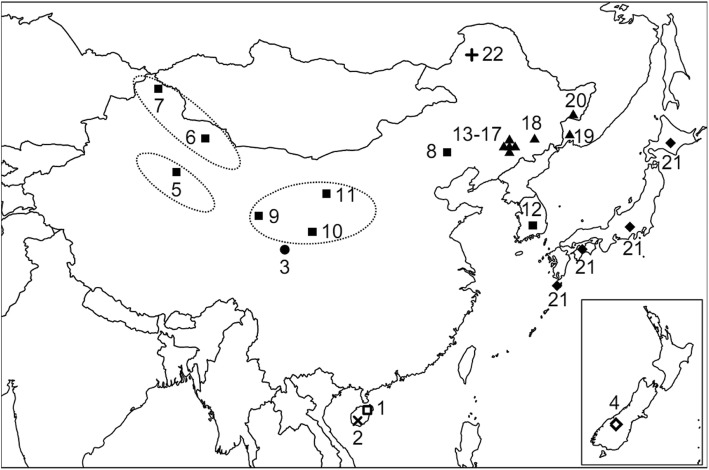
In this study, the genetic diversity and phylogeny of 5 species (21 subspecies/populations from C. unicolor, C. albirostris, C. nippon, C. elaphus and C. eldii) in the genus Cervus were analyzed using reduced-representation genome sequencing.
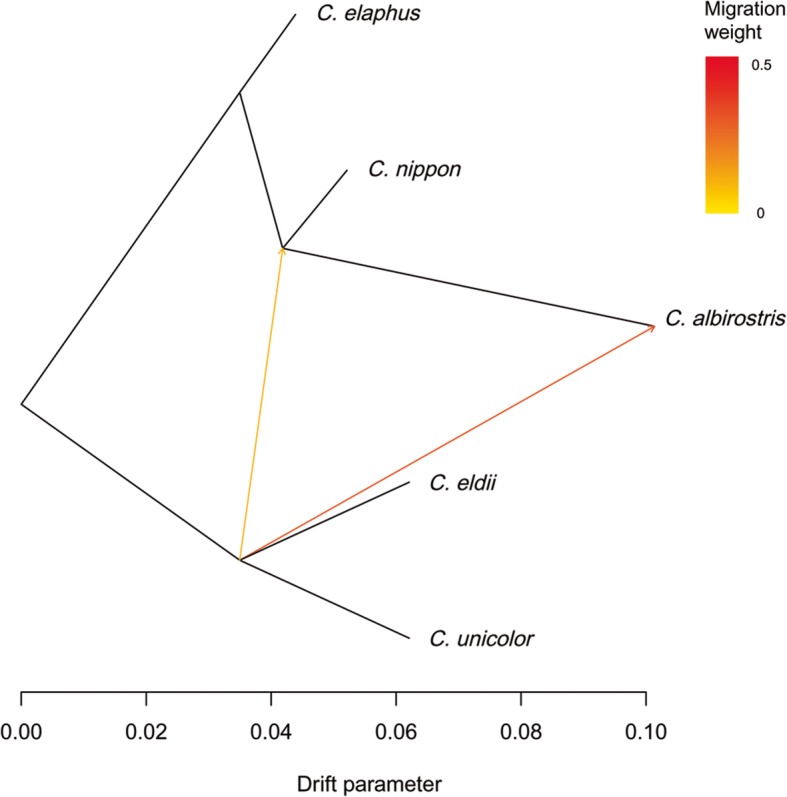
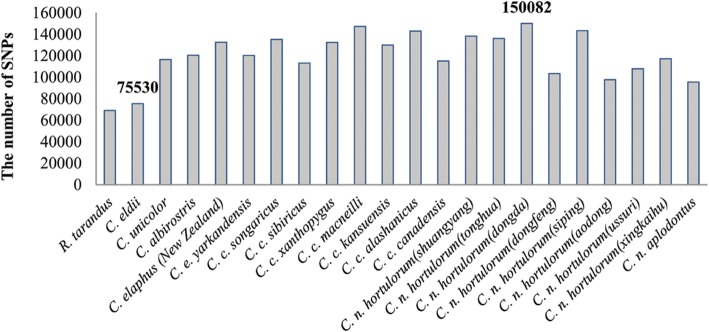
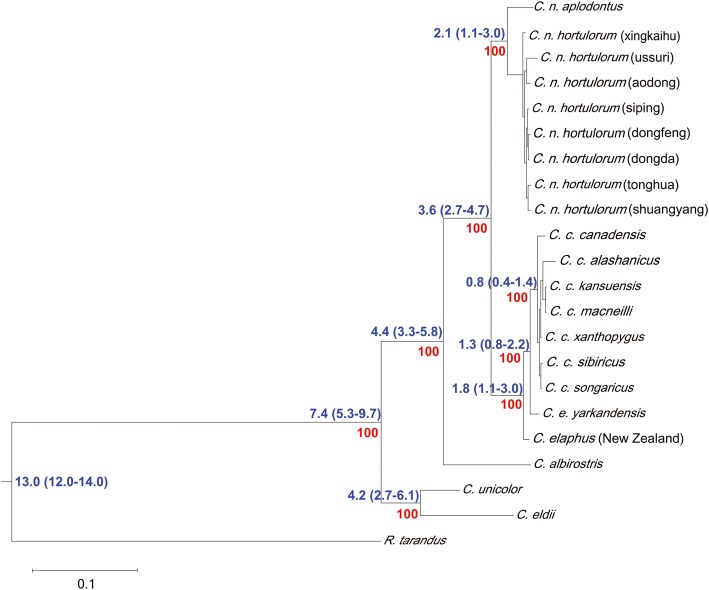
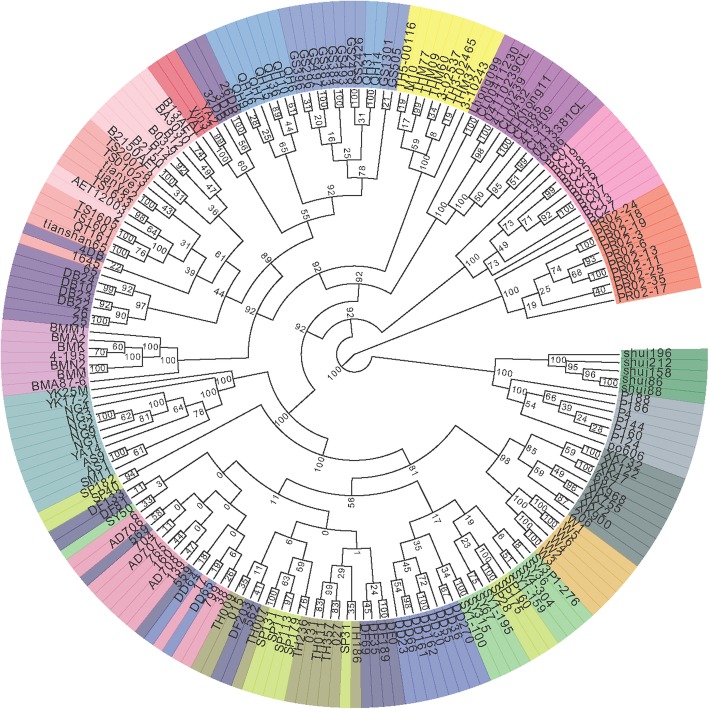
A total of 197,543 SNPs were identified with an average sequencing depth of 16 x. A total of 21 SNP matrices for each subspecies/population and 1 matrix for individual analysis were constructed, respectively. Nucleotide diversity and heterozygosity analysis showed that all 21 subspecies/populations had different degrees of genetic diversity. C. eldii, C. unicolor and C. albirostris showed relatively high expected and observed heterozygosity, while observed heterozygosity in C. nippon was the lowest, indicating there was a certain degree of inbreeding rate in these subspecies/populations. Phylogenetic ML tree of all Cervus based on the 21 SNP matrices showed 5 robustly supported clades that clearly separate C. eldii, C. unicolor, C. albirostris, C. elaphus and C. nippon. Within C. elaphus clade, 4 subclades were well differentiated and statistically highly supported: C. elaphus (New Zealand), C. e. yarkandensis, C. c. canadensis and the other grouping the rest of C. canadensis from China. In the C. nippon clade, 2 well-distinct subclades corresponding to C. n. aplodontus and other C. nippon populations were separated. Phylogenetic reconstruction indicated that the first evolutionary event of the genus Cervus occurred approximately 7.4 millions of years ago. The split between C. elaphus and C. nippon could be estimated at around 3.6 millions of years ago. Phylogenetic ML tree of all samples based on individual SNP matrices, together with geographic distribution, have shown that there were 3 major subclades of C. elaphus and C. canadensis in China, namely C. e. yarkandensis (distributed in Tarim Basin), C. c. macneilli/C. c. kansuensis/C. c. alashanicus (distributed in middle west of China), and C. c. songaricus/C. c. sibiricus (distributed in northwest of China). Among them, C. e. yarkandensis was molecularly the most primitive subclade, with a differentiation dating back to 0.8-2.2 Myr ago. D statistical analysis showed that there was high probability of interspecific gene exchange between C. albirostris and C. eldii, C. albirostris and C. unicolor, C. nippon and C. unicolor, and there might be 2 migration events among 5 species in the genus Cervus.
Our results provided new insight to the genetic diversity and phylogeny of Cervus deer. In view of the current status of these populations, their conservation category will need to be reassessed.
先前对鹿属的系统发育研究发现了许多没有全基因组支持的分支。
本研究利用简化基因组测序技术,对鹿属的 5 个物种(21 个亚种/种群,包括梅花鹿、白唇鹿、马鹿、麋鹿和坡鹿)的遗传多样性和系统发育进行了分析。
共鉴定出 197543 个 SNP,平均测序深度为 16x。分别构建了每个亚种/种群的 21 个 SNP 矩阵和 1 个个体分析矩阵。核苷酸多样性和杂合度分析表明,所有 21 个亚种/种群均具有不同程度的遗传多样性。坡鹿、梅花鹿和白唇鹿表现出相对较高的预期和观察杂合度,而马鹿的观察杂合度最低,表明这些亚种/种群存在一定程度的近交率。基于 21 个 SNP 矩阵的所有鹿属的系统发育 ML 树显示,有 5 个支持度较高的分支,清楚地将坡鹿、梅花鹿、白唇鹿、马鹿和麋鹿分开。在马鹿分支中,4 个亚分支得到了很好的区分,并在统计学上得到了高度支持:马鹿(新西兰)、马鹿指名亚种、马鹿加拿大亚种和中国其他地区的加拿大亚种。在麋鹿分支中,2 个明显不同的亚分支对应麋鹿指名亚种和其他麋鹿种群。系统发育重建表明,鹿属的第一个进化事件发生在大约 740 万年前。马鹿和麋鹿的分化可追溯到大约 360 万年前。基于个体 SNP 矩阵的所有样本的系统发育 ML 树,以及地理分布,表明中国有 3 个主要的马鹿和加拿大马鹿亚群,即塔克拉玛干鹿(分布在塔里木盆地)、天山马鹿(分布在中国中西部)和阿尔金山马鹿/戈壁马鹿/阿尔泰马鹿(分布在中国西北部)。其中,塔克拉玛干鹿是分子上最原始的亚群,分化时间可追溯到 0.8-2.2 百万年前。D 统计分析表明,白唇鹿和坡鹿、白唇鹿和梅花鹿、麋鹿和梅花鹿之间存在种间基因交流的高概率,鹿属 5 个物种之间可能有 2 次迁移事件。
本研究结果为鹿属的遗传多样性和系统发育提供了新的见解。鉴于这些种群的现状,需要重新评估它们的保护类别。