
基于双波纹金属脊的太赫兹传感超灵敏超材料共振传感器。
Enhanced Ultra-Sensitive Metamaterial Resonance Sensor based on Double Corrugated Metal stripe for Terahertz Sensing.
机构信息
Department of Computer Science & Engineering and Information Technology, Shiraz University, Shiraz, Iran.
Department of Communications & Electronics, School of Electrical and Computer Engineering, Shiraz University, Shiraz, Iran.
出版信息
Sci Rep. 2019 May 17;9(1):7516. doi: 10.1038/s41598-019-44026-4.
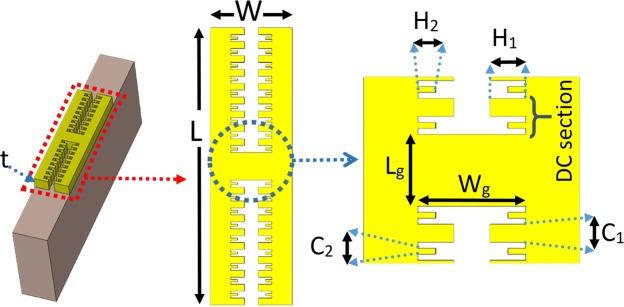
In this paper, an ultra-sensitive metamaterial terahertz sensor is proposed. The resonance sensor is designed based on a novel double corrugation form to enhance the ability of the sensor in the terms of sensitivity, Q-factor and the maximum sensible thickness of an analyte. The introduced structure can support the spoof surface plasmon and can resonate strongly at the tuned frequencies. Moreover, the structure of the terahertz sensor is investigated thoroughly from different points of view including frequency shifts due to variations in the thickness or refractive index of the analyte. In addition, the sensitivity of the sensor is approximated with a biharmonic fitting function for different combinations of refractive index and analyte thickness as "sensitivity surface". The sensor shows the maximum sensitivity of 1.75 THz/RIU for refractive index between 1-1.2 with a maximum thickness of 80 μm. Moreover, the simulation results approved that the double corrugation on the metal stripe improves the electromagnetic field interaction in the metal part greatly in comparison with the previously reported works. According to this work, the proposed structure can be applied for terahertz sensing with more abilities to sense even thicker biologic tissues.
本文提出了一种超灵敏的太赫兹超材料传感器。该共振传感器基于一种新颖的双波纹形状设计,以提高传感器在灵敏度、Q 因子和分析物最大敏感厚度方面的能力。所引入的结构可以支持赝表面等离激元,并在调谐频率处产生强烈共振。此外,还从不同角度研究了太赫兹传感器的结构,包括由于分析物厚度或折射率的变化引起的频率位移。此外,通过不同的折射率和分析物厚度组合,用双调和拟合函数来近似传感器的灵敏度,作为“灵敏度曲面”。该传感器在折射率为 1-1.2 时表现出 1.75 THz/RIU 的最大灵敏度,最大厚度为 80 μm。此外,模拟结果表明,与之前报道的工作相比,金属条上的双波纹大大提高了金属部分的电磁场相互作用。根据这项工作,所提出的结构可以应用于太赫兹传感,具有更高的能力来感应甚至更厚的生物组织。




 Zotero 插件