Department of Geriatrics and Expertise Centre Pharmacotherapy in Old Persons (EPHOR), UMC Utrecht, The Netherlands.
Department of Clinical Pharmacy, UMC Utrecht, The Netherlands.
Br J Clin Pharmacol. 2019 Sep;85(9):1974-1983. doi: 10.1111/bcp.13987. Epub 2019 Jul 3.
The Systematic Tool to Reduce Inappropriate Prescribing is a method to assess patient's medication and has been incorporated into a clinical decision support system: STRIP Assistant. Our aim was to evaluate the effect of recommendations generated using STRIP Assistant on appropriate prescribing and mortality in a preoperative setting.
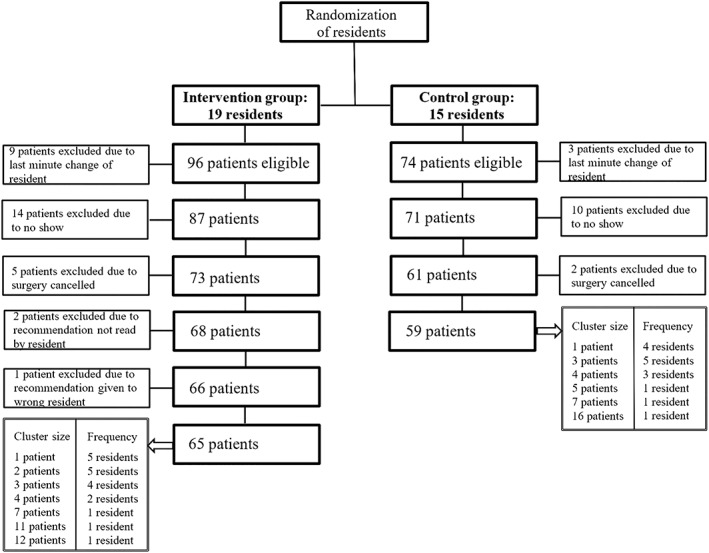
This cluster-randomized controlled trial was carried out at the preoperative geriatric outpatient clinic. Residents who performed a comprehensive geriatric assessment were randomized to the control group and intervention group in a 1:1 ratio. Visiting patients aged 70 years or older on 5 or more medications were included.
prescribing recommendations were generated by a physician using STRIP Assistant and given to the resident. Control group residents performed a medication review according to usual care.
number of medication changes made because of potential prescribing omissions (PPOs), potentially inappropriate medications (PIMs), and suboptimal dosages according to the prescribing recommendations. Secondary outcome: 3-month postoperative mortality.
65 intervention and 59 control patients were included, attended by 34 residents. Significantly more medication changes because of PPOs and PIMs were made in the intervention group than in the control group (PPOs 26.2% vs 3.4%, odds ratio 0.04 [95% confidence interval 0.003-0.46] P < .05; PIMS 46.2% vs 15.3% odds ratio 0.14 [95% confidence interval 0.07-0.57] P < .005). There were no differences in dose adjustments or in postoperative mortality.
Prescribing recommendations generated with the help of STRIP Assistant improved appropriate prescribing in a preoperative geriatric outpatient clinic but did not affect postoperative mortality.
系统减少不适当处方工具(Systematic Tool to Reduce Inappropriate Prescribing,简称 STRIP)是一种评估患者用药情况的方法,现已纳入临床决策支持系统:STRIP 助手。我们的目的是评估 STRIP 助手生成的推荐意见对术前患者适当处方和死亡率的影响。
这是一项在术前老年门诊进行的聚类随机对照试验。对进行全面老年评估的住院医师进行 1:1 随机分组,分为对照组和干预组。纳入年龄≥70 岁且服用≥5 种药物的就诊患者。
医生使用 STRIP 助手生成处方建议,并提供给住院医师。对照组住院医师按照常规进行药物审查。
根据处方建议,因潜在用药遗漏(potential prescribing omissions,PPO)、潜在不适当药物(potentially inappropriate medications,PIM)和剂量不足而进行的药物调整数量。次要结局:术后 3 个月死亡率。
共纳入 65 例干预组和 59 例对照组患者,由 34 名住院医师进行治疗。干预组因 PPO 和 PIM 而进行的药物调整明显多于对照组(PPO 26.2% vs. 3.4%,优势比 0.04 [95%置信区间 0.003-0.46],P<.05;PIM 46.2% vs. 15.3%,优势比 0.14 [95%置信区间 0.07-0.57],P<.005)。剂量调整或术后死亡率无差异。
在 STRIP 助手的帮助下生成的处方建议改善了术前老年门诊的适当处方,但对术后死亡率没有影响。