Dermatology Unit, Fondazione IRCCS Ca' Granda Ospedale Maggiore Policlinico, Via Pace, 9, 20122, Milan, Italy.
Department of Physiopathology and Transplantation, Università degli Studi di Milano, Milan, Italy.
Orphanet J Rare Dis. 2019 May 24;14(1):115. doi: 10.1186/s13023-019-1089-2.
Linear IgA bullous dermatosis (LABD) is a rare autoimmune subepithelial vesiculobullous disease due to IgA autoantibodies directed against different antigens of the basement membrane zone (BMZ) of the skin and/or mucosae. It affects mainly preschool-aged children and adults, with only few studies on large series. The aim of this study was to assess possible differences between adults and children regarding clinical presentation, immunopathologic features, management and course of the disease.
A retrospective review of 38 LABD patients, followed-up from November 2006 to September 2018, was performed.
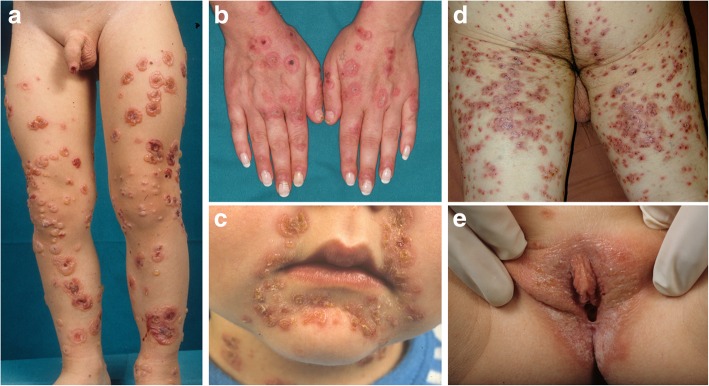
Of 38 patients, 27 were adults and 11 children. Mean age at diagnosis was 5.4 years and 60.6 years in the pediatric and adult group, respectively. Considering both groups, limbs were the most commonly involved site (73.7%), followed by trunk (55.3%), head (36.8%) and buttocks (13.2%). Interestingly, head (p = 0.008), particularly perioral (p = 0.001), involvement, as well as "string of pearls" arrangement (p = 0.03), were more prevalent in children. Mucosal involvement was seen in 9 (23.7%) patients and was more frequent in children than adults (45.5% vs 14.8%, respectively, p = 0.09). Linear IgA deposits along the BMZ were observed in 30 patients (78.9%), while linear/granular IgA deposits in 8 patients (21.1%). Dapsone was the most commonly used drug (78.9%) and complete remission was achieved in most cases (81.6%).
Our epidemiological and clinicopathological findings relative to a large cohort of LABD patients are mostly consistent with the literature data. Interestingly, head, notably perioral, involvement and "string of pearls" arrangement occurred more frequently in the paediatric than adult group. The above clinical parameters may be regarded as diagnostic tools for LABD in children.
线性 IgA 大疱性皮病(LABD)是一种罕见的自身免疫性表皮下水疱性疾病,由针对皮肤和/或黏膜基底膜带(BMZ)不同抗原的 IgA 自身抗体引起。它主要影响学龄前儿童和成年人,仅有少数关于大系列的研究。本研究旨在评估成人和儿童在临床表现、免疫病理特征、治疗和疾病过程方面是否存在差异。
对 2006 年 11 月至 2018 年 9 月期间随访的 38 例 LABD 患者进行回顾性分析。
38 例患者中,27 例为成人,11 例为儿童。儿童和成人组的平均诊断年龄分别为 5.4 岁和 60.6 岁。考虑到两组,四肢是最常见的受累部位(73.7%),其次是躯干(55.3%)、头部(36.8%)和臀部(13.2%)。有趣的是,头部(p=0.008),特别是口周(p=0.001)受累,以及“串珠状”排列(p=0.03)在儿童中更为常见。9 例(23.7%)患者存在黏膜受累,且儿童比成人更常见(分别为 45.5%和 14.8%,p=0.09)。30 例患者(78.9%)可见沿 BMZ 线性 IgA 沉积,8 例患者(21.1%)可见线性/颗粒状 IgA 沉积。最常使用的药物是氨苯砜(78.9%),大多数患者达到完全缓解(81.6%)。
我们对大量 LABD 患者的流行病学和临床病理发现与文献数据基本一致。有趣的是,头部,尤其是口周,受累和“串珠状”排列在儿童组比成人组更常见。上述临床参数可作为儿童 LABD 的诊断工具。