Poletto Edina, Pasqualim Gabriela, Giugliani Roberto, Matte Ursula, Baldo Guilherme
Gene Therapy Center, Hospital de Clínicas de Porto Alegre, Porto Alegre, RS, Brazil.
Postgraduate Program in Genetics and Molecular Biology, Universidade Federal do Rio Grande do Sul, Porto Alegre, RS, Brazil.
Genet Mol Biol. 2019;42(1 suppl 1):261-285. doi: 10.1590/1678-4685-GMB-2018-0100. Epub 2019 May 23.
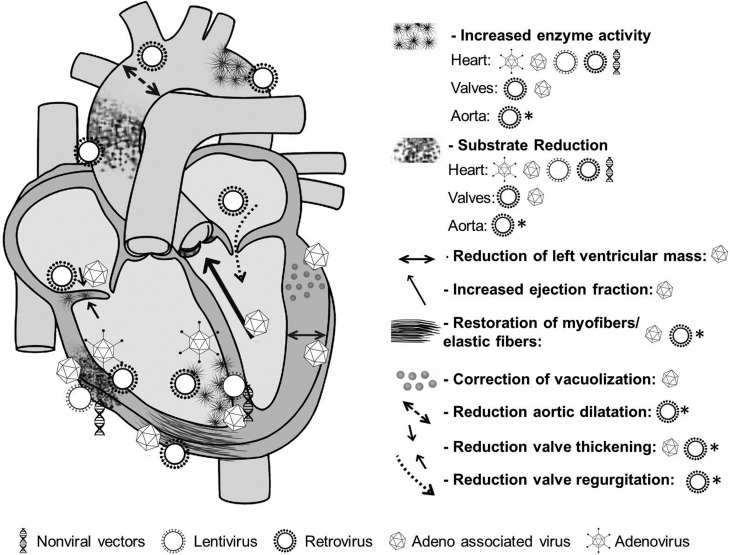
Lysosomal storage diseases (LSDs) are inherited conditions caused by impaired lysosomal function and consequent substrate storage, leading to a range of clinical manifestations, including cardiovascular disease. This may lead to significant symptoms and even cardiac failure, which is an important cause of death among patients. Currently available treatments do not completely correct cardiac involvement in the LSDs. Gene therapy has been tested as a therapeutic alternative with promising results for the heart disease. In this review, we present the results of different approaches of gene therapy for LSDs, mainly in animal models, and its effects in the heart, focusing on protocols with cardiac functional analysis.
溶酶体贮积症(LSDs)是由溶酶体功能受损及随后的底物蓄积引起的遗传性疾病,可导致一系列临床表现,包括心血管疾病。这可能会引发严重症状甚至心力衰竭,而心力衰竭是患者死亡的重要原因。目前可用的治疗方法并不能完全纠正LSDs患者的心脏受累情况。基因治疗已作为一种治疗选择进行了试验,对心脏病有很有前景的效果。在本综述中,我们介绍了LSDs基因治疗的不同方法的结果,主要是在动物模型中的结果,以及其对心脏的影响,重点关注具有心脏功能分析的方案。