Department of Orthopaedic Surgery, Catharina Hospital Eindhoven , Eindhoven.
Orthopaedic Center Máxima, Máxima Medical Center , Eindhoven.
Acta Orthop. 2019 Oct;90(5):455-459. doi: 10.1080/17453674.2019.1621595. Epub 2019 May 28.
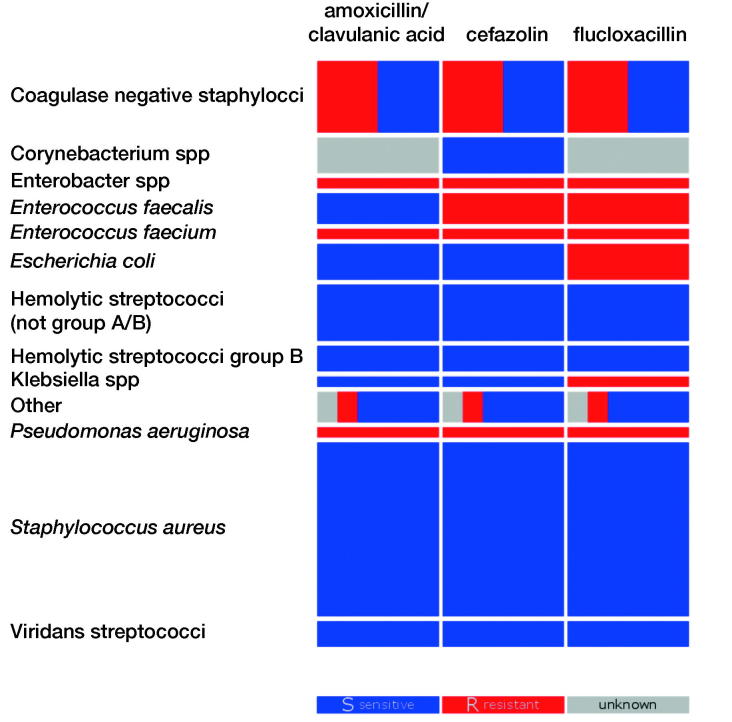
Background and purpose - The preferred treatment of an acute prosthetic joint infection (PJI) is debridement, antibiotics, irrigation and retention of the prosthesis (DAIR). The antibiotic treatment consists of an empirical and targeted phase. In the empirical phase, intravenous antibiotics are started after surgery before micro-organisms are determined in microbiological cultures. Which empirical antibiotic is used differs between hospitals, partly reflecting geographic differences in susceptibility spectrums. We investigated whether flucloxacillin should remain the antibiotic of choice in our hospital for empiric treatment of acute PJI with DAIR. Patients and methods - We retrospectively analyzed 91 patients treated for PJI with DAIR between 2012 and 2016. The susceptibility of micro-organisms was determined in multiple cultures of periprosthetic tissue and synovial fluid for 3 antibiotics: amoxicillin/clavulanic acid, cefazolin, and flucloxacillin. Results - Positive microbiological cultures from 68 patients were analyzed. was the predominant pathogen, cultured in half of the patients. In one-third of patients more than 1 micro-organism was found. On a patient level, the data showed that 65% were responsive to flucloxacillin, 76% to amoxicillin/clavulanic acid, and 79% to cefazolin. Interpretation - Flucloxacillin appeared to be a suboptimal choice in our patient population treated with DAIR. We therefore changed our practice to cefazolin as the preferred antibiotic in the empirical treatment of acute PJI with DAIR.
背景与目的-急性人工关节感染(PJI)的首选治疗方法是清创术、抗生素、灌洗和保留假体(DAIR)。抗生素治疗包括经验性和靶向性阶段。在经验性阶段,手术后在微生物培养确定微生物之前开始静脉内使用抗生素。使用哪种经验性抗生素在不同的医院有所不同,部分反映了抗生素敏感性谱的地理差异。我们研究了在我们医院使用氟氯西林作为 DAIR 治疗急性 PJI 的经验性治疗药物是否仍然是首选。
患者和方法-我们回顾性分析了 2012 年至 2016 年间接受 DAIR 治疗的 91 例 PJI 患者。对假体周围组织和滑膜的多种培养物中的微生物进行了 3 种抗生素的药敏试验:阿莫西林/克拉维酸、头孢唑林和氟氯西林。
结果-对 68 例阳性微生物培养物进行了分析。金黄色葡萄球菌是主要病原体,在一半的患者中培养出来。三分之一的患者发现了超过 1 种微生物。在患者水平上,数据显示 65%的患者对氟氯西林敏感,76%的患者对阿莫西林/克拉维酸敏感,79%的患者对头孢唑林敏感。
结论-在我们接受 DAIR 治疗的患者人群中,氟氯西林似乎不是一个理想的选择。因此,我们改变了实践,将头孢唑林作为 DAIR 治疗急性 PJI 的首选经验性抗生素。