Sagara Yoshimitsu, Karman Marc, Seki Atsushi, Pannipara Mehboobali, Tamaoki Nobuyuki, Weder Christoph
Research Institute for Electronic Science, Hokkaido University, N20, W10, Kita-Ku, Sapporo 001-0020, Japan.
JST-PRESTO, Honcho 4-1-8, Kawaguchi, Saitama 332-0012, Japan.
ACS Cent Sci. 2019 May 22;5(5):874-881. doi: 10.1021/acscentsci.9b00173. Epub 2019 Apr 24.
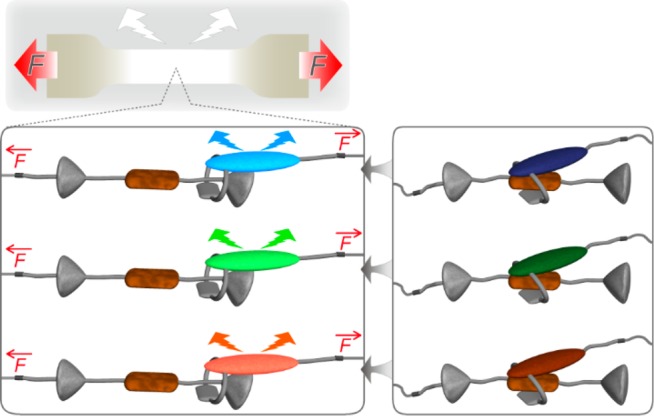
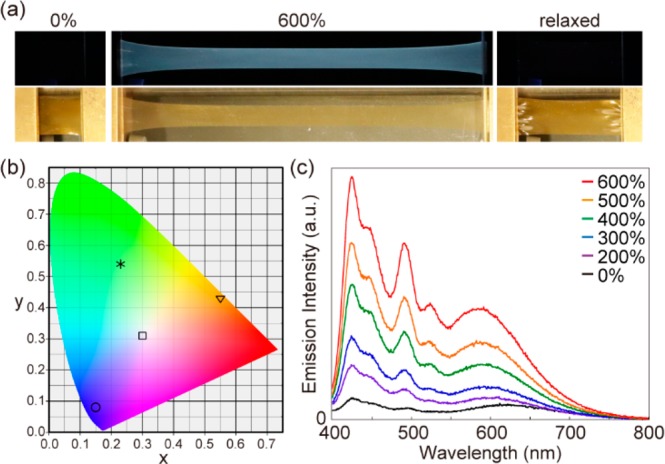
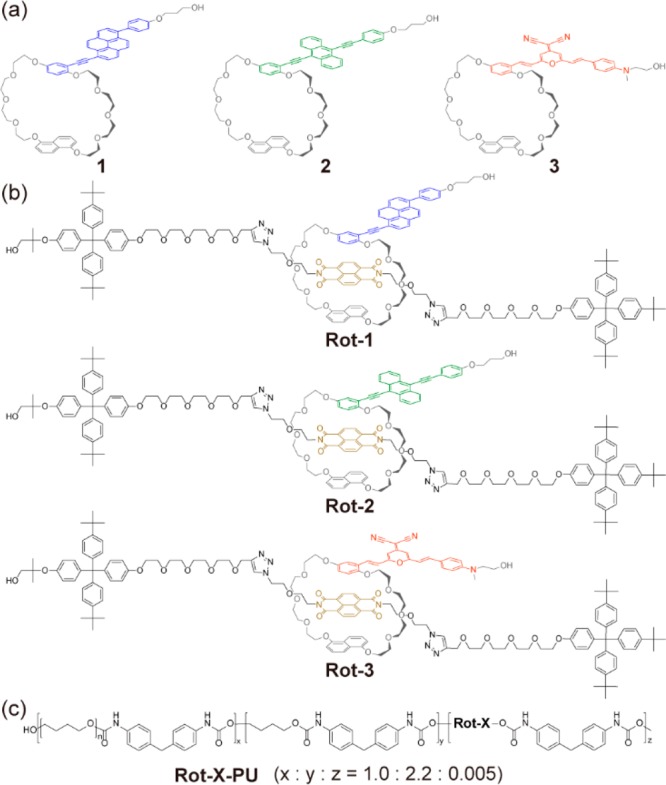
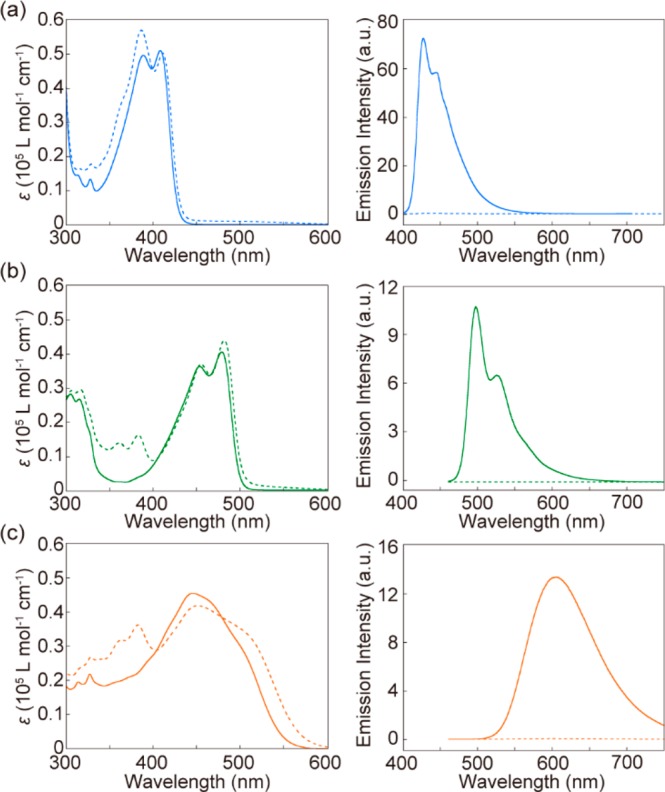
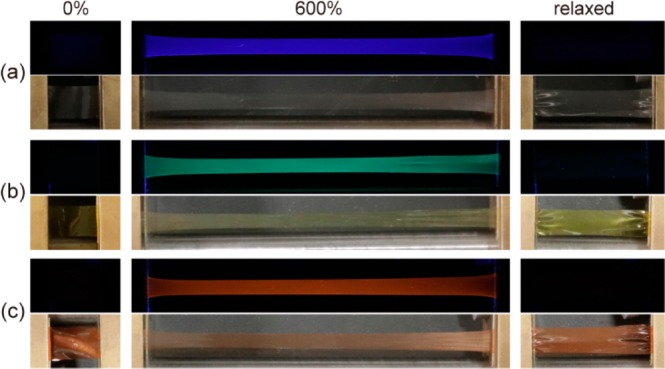
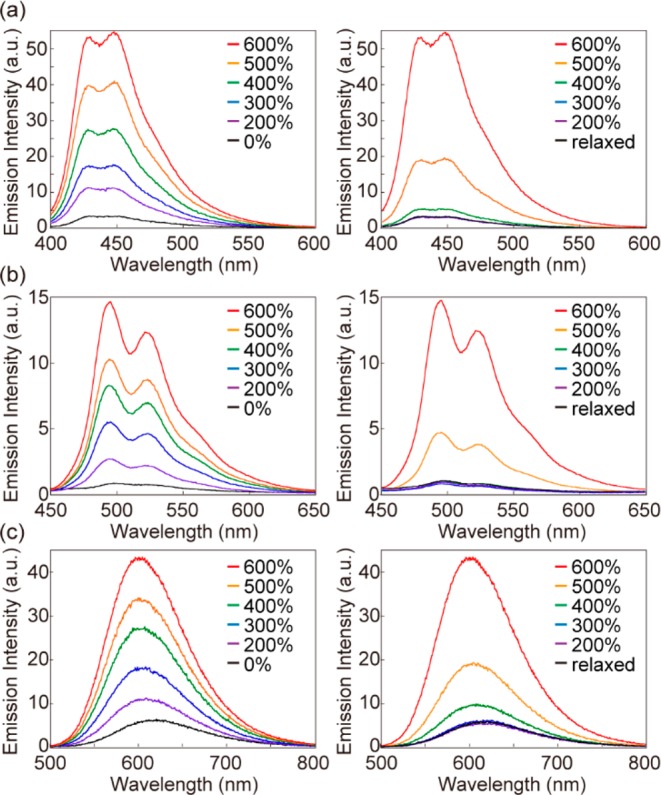
Three mechanoresponsive polyurethane elastomers whose blue, green, and orange photoluminescence can be reversibly turned on by mechanical force were prepared and combined to create a blend that exhibits deformation-induced white photoluminescence. The three polyurethanes contain rotaxane-based supramolecular mechanoluminophores based on π-extended pyrene, anthracene, or 4-(dicyanomethylene)-2-methyl-6-(4-dimethylaminostyryl)-4-pyran (DCM) luminophores, respectively, and 1,4,5,8-naphthalenetetracarboxylic diimide as an electronically matched quencher. Each polymer shows instantly reversible, strain-dependent switching of its photoluminescence intensity when stretched and relaxed, as deformation leads to a spatial separation of the luminophore and quencher. The present study shows that the photoluminescence color can easily be tailored by variation of the luminophore and also by combining several mechanophores in one material and demonstrates that adaptability is a key advantage of supramolecular approaches to create mechanoresponsive polymers.
制备了三种机械响应性聚氨酯弹性体,它们的蓝色、绿色和橙色光致发光可通过机械力可逆开启,并将它们混合以形成一种呈现形变诱导白色光致发光的共混物。这三种聚氨酯分别包含基于π-扩展芘、蒽或4-(二氰基亚甲基)-2-甲基-6-(4-二甲基氨基苯乙烯基)-4-吡喃(DCM)发光体的基于轮烷的超分子机械发光体,以及作为电子匹配猝灭剂的1,4,5,8-萘四羧酸二酰亚胺。当拉伸和松弛时,由于形变导致发光体和猝灭剂的空间分离,每种聚合物的光致发光强度都会立即发生可逆的、应变依赖性切换。本研究表明,通过改变发光体以及在一种材料中组合多种机械发光体,可以轻松调整光致发光颜色,并证明适应性是超分子方法制备机械响应性聚合物的关键优势。