Department of Hematology, CHU Lille, Lille, France.
Centre de Biologie et Pathologie, CHU, Lille, France.
Cancer Med. 2019 Jul;8(8):3822-3830. doi: 10.1002/cam4.2253. Epub 2019 May 30.
Streptococcus pneumoniae infection causes morbidity and mortality in multiple myeloma patients. Pneumococcal vaccination is commonly given to immunocompromised myeloma patients; however response data are sparse. Here, we present longitudinal response data to pneumococcal vaccination in multiple myeloma patients.
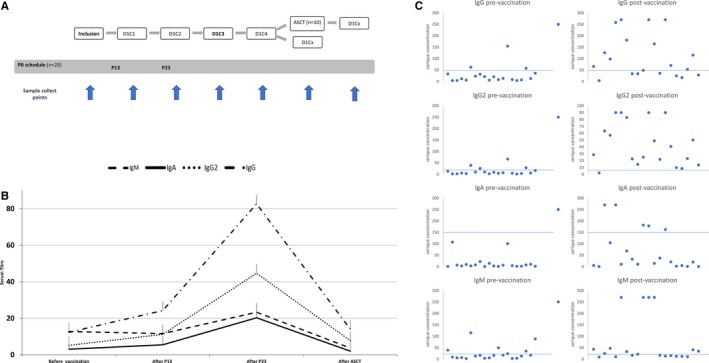
Twenty-eight multiple myeloma patients were included, 25 of whom were newly diagnosed. All the patients received two vaccines Prevnar13® and Pneumo23®. Serotype-specific IgG was measured by ELISA for all 23 vaccine serotypes at baseline, and then sequentially at different time points postvaccination until treatment ended. Response to vaccination is available for 20 patients. The primary endpoint was the incidence rate of patients who obtained an isotype response serum concentration after vaccination. Secondary endpoints included detailed isotype increase, time to first increase, further assessment of a decreased anti-pneumococcal serum concentrations following treatment including autologous stem cell transplantation (ASCT), rate of infection with a special attention to pneumococcal infection.
The median age was 66 years and the male to female ratio was 0.6. Anti-pneumococcal capsular polysaccharide (anti-PCP23) IgG, IgG2, IgA, and IgM responses were detected within 1 week postvaccination. Response to at least one subtype of antibody was obtained in 85% (n = 17) of patients, for at least two subtypes in 65% (n = 13), for at least three subtypes in 55% (n = 11), and 2 patients responded to all four subtypes. The median increase in the concentration of anti-PCP23 isotypes was threefold following vaccination, with the highest increase observed when Pneumo23® was given more than 30 days after Prevnar13®. The anti-pneumococcal geometric mean concentration decreased significantly for all subtypes over time independently of treatment approaches.
Myeloma has the ability to demonstrate a response to pneumococcal vaccine, independently of preexisting hypogammaglobulinemia and possibly of treatment-induced immunodepression. We also observed a drop in the serum response overtime and following autologous transplantation. Further studies in larger sample are needed to understand the benefit of vaccination strategies in these patients.
肺炎链球菌感染会导致多发性骨髓瘤患者发病和死亡。肺炎球菌疫苗常用于免疫功能低下的骨髓瘤患者;然而,反应数据很少。在这里,我们提供了多发性骨髓瘤患者接种肺炎球菌疫苗的纵向反应数据。
纳入了 28 例多发性骨髓瘤患者,其中 25 例为初诊患者。所有患者均接受了 2 种疫苗 Prevenar13®和 Pneumo23®。在基线时,通过 ELISA 测量了所有 23 种疫苗血清型的血清型特异性 IgG,然后在接种疫苗后的不同时间点进行连续测量,直到治疗结束。有 20 例患者可提供疫苗接种反应数据。主要终点是接种疫苗后获得血清型反应血清浓度的患者的发生率。次要终点包括详细的血清型增加、首次增加的时间、治疗后(包括自体干细胞移植[ASCT])抗肺炎球菌血清浓度下降的进一步评估、感染率,特别注意肺炎球菌感染。
中位年龄为 66 岁,男女比例为 0.6。接种疫苗后 1 周内可检测到肺炎球菌荚膜多糖(抗 PCP23)IgG、IgG2、IgA 和 IgM 反应。85%(n=17)的患者至少对一种亚型的抗体有反应,65%(n=13)的患者至少对两种亚型的抗体有反应,55%(n=11)的患者至少对三种亚型的抗体有反应,2 例患者对所有四种亚型的抗体均有反应。接种疫苗后,抗 PCP23 各血清型的浓度增加了三倍,当 Pneumo23®在 Prevenar13®后 30 天以上给予时,增加幅度最大。所有亚型的抗肺炎球菌几何平均浓度随时间显著下降,与治疗方法无关。
骨髓瘤有能力对肺炎球菌疫苗产生反应,这与预先存在的低丙种球蛋白血症无关,可能与治疗引起的免疫抑制无关。我们还观察到,随着时间的推移和自体移植后,血清反应会下降。需要进一步的研究来确定这些患者接种疫苗策略的获益。