Department of Chemistry, Georgia State University, Atlanta, GA 30303, USA.
Department of Chemistry and Research Institute for Natural Sciences, Hanyang University, Seoul 04763, Korea.
Int J Mol Sci. 2019 May 29;20(11):2641. doi: 10.3390/ijms20112641.
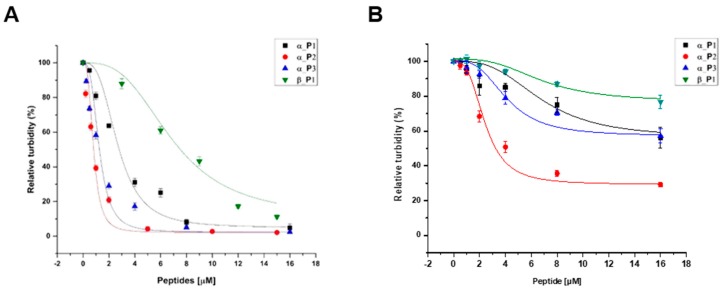
The plant disease Phytophthora blight, caused by the oomycete pathogen , is responsible for major economic losses in pepper production. Microtubules have been an attractive target for many antifungal agents as they are involved in key cellular events such as cell proliferation, signaling, and migration in eukaryotic cells. In order to design a novel biocompatible inhibitor, we screened and identified inhibitory peptides against alpha- and beta-tubulin of using a phage display method. The identified peptides displayed a higher binding affinity (nanomolar range) and improved specificity toward alpha- and beta-tubulin in comparison to tubulin as evaluated by fluorometric analysis. One peptide demonstrated the high inhibitory effect on microtubule formation with a nanomolar range of IC values, which were much lower than a well-known chemical inhibitor-benomyl (IC = 500 µM). Based on these results, this peptide can be employed to further develop promising candidates for novel antifungal agents against Phytophthora blight.
由卵菌病原体引起的植物病害辣椒疫病,是导致辣椒生产重大经济损失的原因。微管已成为许多抗真菌药物的一个有吸引力的靶标,因为它们参与真核细胞中的关键细胞事件,如细胞增殖、信号转导和迁移。为了设计一种新型的生物相容性抑制剂,我们使用噬菌体展示方法筛选和鉴定了针对 alpha 和 beta-微管蛋白的抑制肽。与微管蛋白相比,鉴定出的肽在荧光分析中显示出更高的结合亲和力(纳摩尔范围)和对 alpha 和 beta-微管蛋白的改善特异性。一种肽表现出对微管形成的高抑制作用,IC 值在纳摩尔范围内,远低于一种已知的化学抑制剂苯并咪唑(IC=500 µM)。基于这些结果,该肽可用于进一步开发针对辣椒疫病的新型抗真菌剂的有前途的候选物。