Gassen Nils C, Rein Theo
Department of Psychiatry, Bonn Clinical Center, Bonn, Germany.
Max Planck Institute of Psychiatry, Munich, Germany.
Front Psychiatry. 2019 May 15;10:337. doi: 10.3389/fpsyt.2019.00337. eCollection 2019.
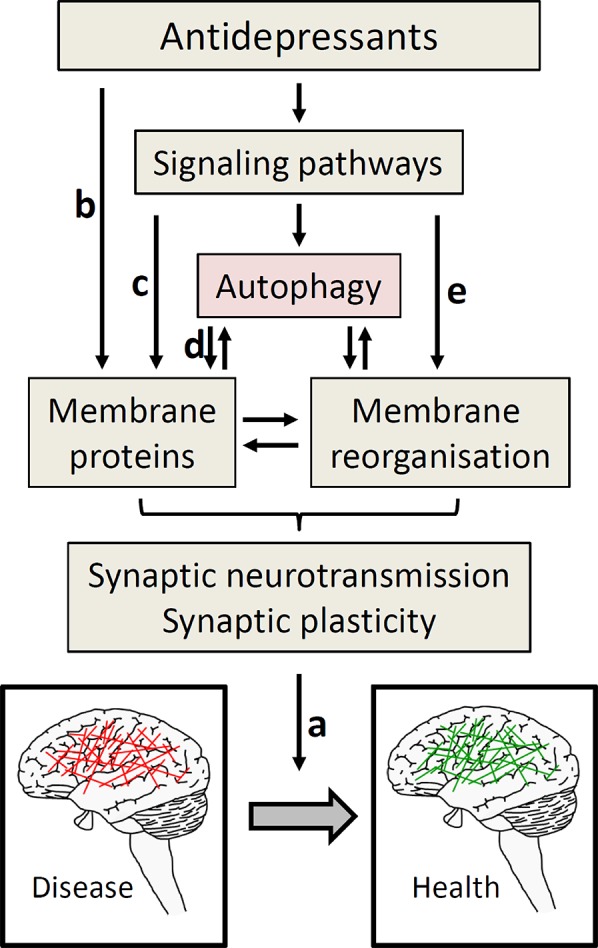
Autophagy has been recognized as evolutionary conserved intracellular pathway that ensures energy, organelle, and protein homeostasis through lysosomal degradation of damaged macromolecules and organelles. It is activated under various stress situations, e.g., food deprivation or proteotoxic conditions. Autophagy has been linked to several diseases, more recently also including stress-related diseases such as depression. A growing number of publications report on the role of autophagy in neurons, also referred to as "neuronal autophagy" on the one hand, and several studies describe effects of antidepressants-or of compounds that exert antidepressant-like actions-on autophagy on the other hand. This minireview highlights the emerging evidence for the involvement of autophagy in the pathology and treatment of depression and discusses current limitations as well as potential avenues for future research.
自噬已被公认为是一种进化上保守的细胞内途径,它通过溶酶体对受损大分子和细胞器的降解来确保能量、细胞器和蛋白质的稳态。在各种应激情况下,如食物缺乏或蛋白毒性条件下,自噬会被激活。自噬与多种疾病有关,最近还包括与应激相关的疾病,如抑郁症。越来越多的出版物报道了自噬在神经元中的作用,一方面也被称为“神经元自噬”,另一方面,一些研究描述了抗抑郁药或具有抗抑郁样作用的化合物对自噬的影响。这篇小型综述强调了自噬参与抑郁症病理和治疗的新证据,并讨论了当前的局限性以及未来研究的潜在途径。