Downing Karrie F, Riehle-Colarusso Tiffany, Gilboa Suzanne M, Lin Angela E, Oster Matthew E, Tinker Sarah C, Farr Sherry L
Division of Congenital and Developmental Disorders, National Center on Birth Defects and Developmental Disabilities, Centers for Disease Control and Prevention,Atlanta, GA,USA.
Medical Genetics Unit, MassGeneral Hospital for Children,Boston, MA,USA.
Cardiol Young. 2019 Jun;29(6):819-827. doi: 10.1017/S1047951119000970. Epub 2019 Jun 4.
Ebstein anomaly is a rare congenital heart defect (CHD) that, when severe, requires corrective surgery or other catheter-based intervention in the first year of life. Due to its rarity, risk factors for Ebstein anomaly remain largely unknown. Using national data, we examined 18 potential risk factors for Ebstein anomaly.
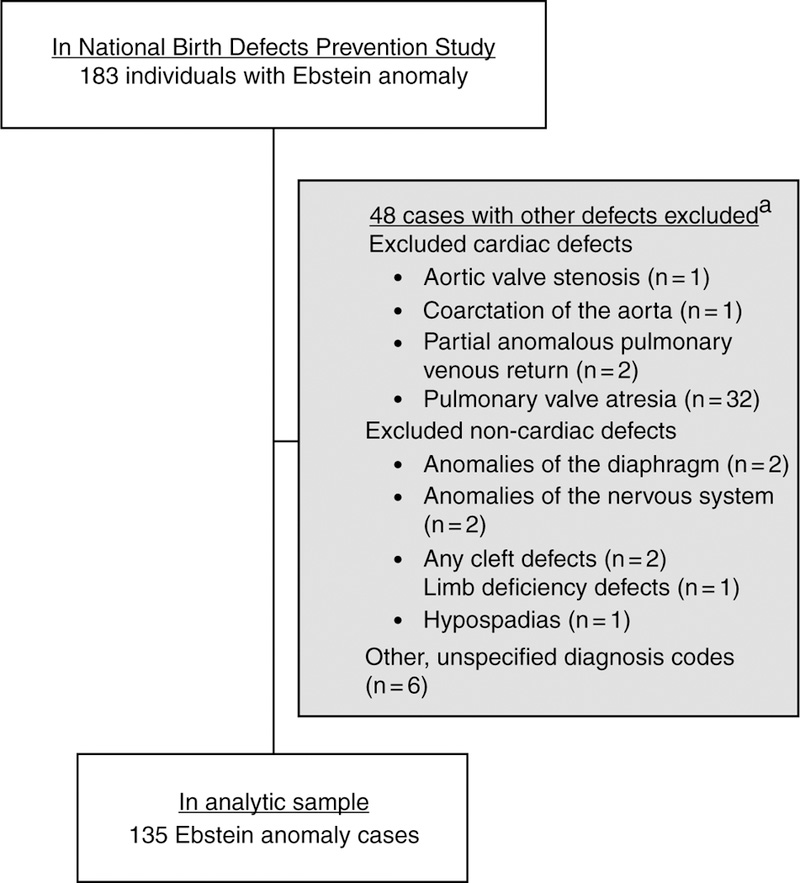
Using 1997-2011 data from the National Birth Defects Prevention Study, a population-based case-control study, we calculated crude and adjusted odds ratios and 95% confidence intervals for paternal age, maternal socio-demographics, reproductive history, and modifiable risk factors, and infant characteristics reported by mothers of 135 Ebstein anomaly cases and 11,829 controls.
Mothers of Ebstein anomaly cases had 4.1 (95% confidence interval: 1.8, 9.5) times the odds of reporting a family history of CHD compared with mothers of controls. Ebstein anomaly was associated with maternal second-hand cigarette smoke exposure at home (odds ratio = 2.2 [95% confidence interval: 1.1, 4.4]), but not maternal cigarette smoking (odds ratio = 1.3 [95% confidence interval: 0.8, 2.1]). Odds were elevated, but the 95% confidence interval included 1.0, for maternal marijuana use (odds ratio = 1.8 [95% confidence interval: 0.9, 3.8]) and paternal age ≥40 years at delivery (odds ratio = 1.9 [95% confidence interval: 1.0, 3.5]).
Maternal exposure to second-hand cigarette smoke at home and a family history of CHD were associated with elevated odds of Ebstein anomaly. Genetic analyses could clarify the potential heritability of Ebstein anomaly.
埃布斯坦畸形是一种罕见的先天性心脏病(CHD),病情严重时需要在出生后第一年进行矫正手术或其他基于导管的干预。由于其罕见性,埃布斯坦畸形的危险因素在很大程度上仍不为人知。我们利用全国性数据,对埃布斯坦畸形的18种潜在危险因素进行了研究。
利用全国出生缺陷预防研究(一项基于人群的病例对照研究)1997 - 2011年的数据,我们计算了135例埃布斯坦畸形病例和11,829例对照的母亲报告的父亲年龄、母亲社会人口统计学特征、生育史、可改变的危险因素以及婴儿特征的粗比值比和调整后的比值比及95%置信区间。
与对照组母亲相比,埃布斯坦畸形病例的母亲报告有CHD家族史的几率高出4.1倍(95%置信区间:1.8,9.5)。埃布斯坦畸形与母亲在家中接触二手烟有关(比值比 = 2.2 [95%置信区间:1.1,4.4]),但与母亲吸烟无关(比值比 = 1.3 [95%置信区间:0.8,2.1])。母亲使用大麻(比值比 = 1.8 [95%置信区间:0.9,3.8])和分娩时父亲年龄≥40岁(比值比 = 1.9 [95%置信区间:1.0,3.5])的几率有所升高,但95%置信区间包含1.0。
母亲在家中接触二手烟和CHD家族史与埃布斯坦畸形几率升高有关。基因分析可以阐明埃布斯坦畸形的潜在遗传可能性。