RAND Corporation, Santa Monica, California, United States of America.
Center for the Study of Healthcare Innovation, Implementation and Policy, VA Greater Los Angeles Healthcare System, Los Angeles, California, United States of America.
PLoS One. 2019 Jun 5;14(6):e0217831. doi: 10.1371/journal.pone.0217831. eCollection 2019.
To estimate the cost-effectiveness to the US Veterans Health Administration (VA) of the use of complementary and integrative health (CIH) approaches by younger Veterans with chronic musculoskeletal disorder (MSD) pain.
VA healthcare system.
We used a propensity score-adjusted hierarchical linear modeling (HLM), and 2010-2013 VA administrative data to estimate differences in VA healthcare costs, pain intensity (0-10 numerical rating scale), and opioid use between CIH users and nonusers. We identified CIH use in Veterans' medical records through Current Procedural Terminology, VA workload tracking, and provider-type codes.
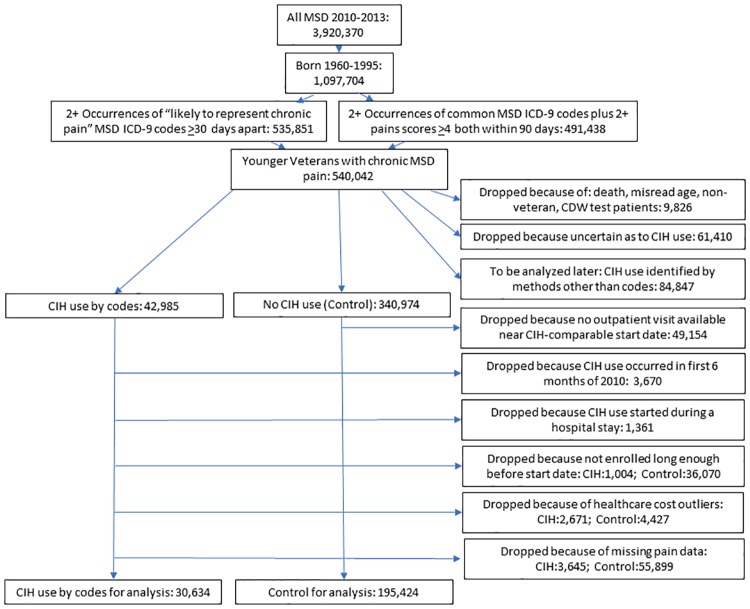
We identified 30,634 younger Veterans with chronic MSD pain as using CIH and 195,424 with no CIH use. CIH users differed from nonusers across all baseline covariates except the Charlson comorbidity index. They also differed on annual pre-CIH-start healthcare costs ($10,729 versus $5,818), pain (4.33 versus 3.76), and opioid use (66.6% versus 54.0%). The HLM results indicated lower annual healthcare costs (-$637; 95% CI: -$1,023, -$247), lower pain (-0.34; -0.40, -0.27), and slightly higher (less than a percentage point) opioid use (0.8; 0.6, 0.9) for CIH users in the year after CIH start. Sensitivity analyses indicated similar results for three most-used CIH approaches (acupuncture, chiropractic care, and massage), but higher costs for those with eight or more CIH visits.
On average CIH use appears associated with lower healthcare costs and pain and slightly higher opioid use in this population of younger Veterans with chronic musculoskeletal pain. Given the VA's growing interest in the use of CIH, further, more detailed analyses of its impacts are warranted.
评估美国退伍军人事务部(VA)采用补充和整合健康(CIH)方法治疗慢性肌肉骨骼疾病(MSD)疼痛的年轻退伍军人的成本效益。
VA 医疗保健系统。
我们使用倾向评分调整的分层线性模型(HLM)和 2010-2013 年 VA 管理数据,来估计 CIH 用户和非用户之间 VA 医疗保健成本、疼痛强度(0-10 数字评分量表)和阿片类药物使用的差异。我们通过当前程序术语、VA 工作量跟踪和提供者类型代码在退伍军人的医疗记录中确定 CIH 的使用。
我们确定了 30634 名患有慢性 MSD 疼痛的年轻退伍军人使用 CIH,195424 名退伍军人未使用 CIH。CIH 用户与非用户在所有基线协变量上存在差异,除了 Charlson 合并症指数。他们在年度预 CIH 启动医疗保健费用($10729 与 $5818)、疼痛(4.33 与 3.76)和阿片类药物使用(66.6% 与 54.0%)方面也存在差异。HLM 结果表明,CIH 用户在 CIH 启动后的第一年,年度医疗保健成本降低了(-$637;95%CI:-$1023,-$247),疼痛减轻了(-0.34;-0.40,-0.27),阿片类药物使用略有增加(不到一个百分点)(0.8;0.6,0.9)。敏感性分析表明,三种最常用的 CIH 方法(针灸、整脊疗法和按摩)的结果类似,但对于接受 8 次或更多 CIH 治疗的患者,成本更高。
在患有慢性肌肉骨骼疼痛的年轻退伍军人中,CIH 的使用平均来看与较低的医疗保健成本和疼痛以及略高的阿片类药物使用相关。鉴于 VA 对 CIH 使用的兴趣不断增加,有必要对其影响进行进一步、更详细的分析。