Tamborrini Davide, Piatti Simonetta
Centre de Recherche en Biologie Cellulaire de Montpellier 1919 Route de Mende, 34293 Montpellier, France.
Microb Cell. 2019 May 22;6(6):295-298. doi: 10.15698/mic2019.06.681.
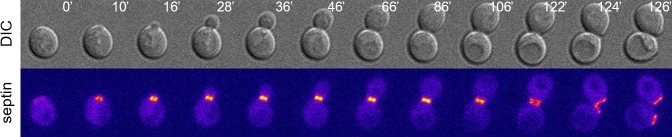
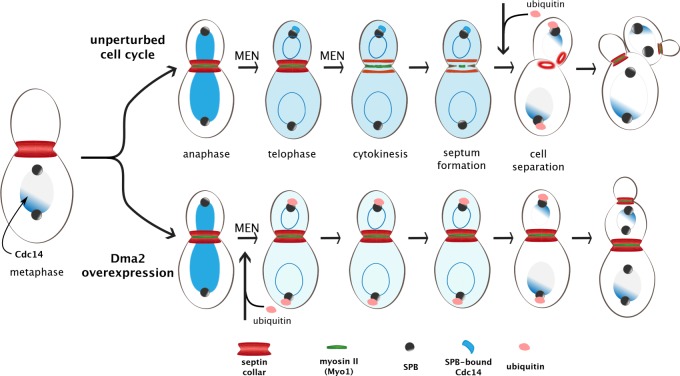
In many eukaryotic cells cytokinesis involves a contractile actomyosin ring (CAR) that drives cleavage furrow ingression. What triggers CAR constriction at a precise time of the cell cycle and how constriction is coupled to chromosome segregation are fundamental questions. In the budding yeast , CAR assembly strictly requires a rigid septin collar that forms at the bud neck early during the cell cycle. At the time of cytokinesis, a sudden remodelling of the septin collar occurs, leading to its splitting into two separate rings that sandwich the CAR. We have shown that septin displacement during splitting is an essential prerequisite for CAR constriction [Tamborrini ., Nat Commun. 9(1):4308]. Thus, cytokinesis in budding yeast is a two-step mechanism: during the first step, the septin collar organizes the assembly of the cytokinetic machinery at the right place while restraining CAR-driven membrane ingression; during the second step, a confined eviction of septins from the division site during septin ring splitting triggers CAR constriction. Our data further indicate that septin ring splitting is prompted by the Mitotic Exit Network (MEN), and in particular by its downstream phosphatase Cdc14, independently of its mitotic exit function. Surprisingly, MEN signalling at spindle pole bodies (SPBs) is critical for septin ring splitting and cytokinesis. Ubiquitination of the MEN anchor at SPBs by the Dma1/2 ubiquitin ligase attenuates MEN signalling and could have a decisive role in coupling cytokinesis to chromosome and organelle segregation. Altogether, our data emphasize the importance of septin ring splitting, which has been mysterious so far, and highlight a novel mechanism to prevent CAR constriction and cytokinesis in unpropitious conditions.
在许多真核细胞中,胞质分裂涉及一个收缩性肌动球蛋白环(CAR),它驱动分裂沟内陷。在细胞周期的精确时间触发CAR收缩以及收缩如何与染色体分离偶联是基本问题。在芽殖酵母中,CAR组装严格需要在细胞周期早期于芽颈处形成的刚性隔膜蛋白环。在胞质分裂时,隔膜蛋白环会突然重塑,导致其分裂成两个夹着CAR的独立环。我们已经表明,分裂过程中隔膜蛋白的移位是CAR收缩的必要前提[Tamborrini等人,《自然通讯》9(1):4308]。因此,芽殖酵母中的胞质分裂是一个两步机制:在第一步中,隔膜蛋白环在正确位置组织胞质分裂机制的组装,同时抑制CAR驱动的膜内陷;在第二步中,隔膜蛋白环分裂期间隔膜蛋白从分裂位点的受限排出触发CAR收缩。我们的数据进一步表明,隔膜蛋白环分裂是由有丝分裂退出网络(MEN)引发的,特别是由其下游磷酸酶Cdc14引发,与它的有丝分裂退出功能无关。令人惊讶的是,纺锤极体(SPB)处的MEN信号对于隔膜蛋白环分裂和胞质分裂至关重要。Dma1/2泛素连接酶对SPB处MEN锚定蛋白的泛素化会减弱MEN信号,并且可能在将胞质分裂与染色体和细胞器分离偶联中起决定性作用。总之,我们的数据强调了迄今为止一直很神秘的隔膜蛋白环分裂的重要性,并突出了一种在不利条件下防止CAR收缩和胞质分裂的新机制。