Morrison Filomene G, Logue Mark W, Guetta Rachel, Maniates Hannah, Stone Annjanette, Schichman Steven A, McGlinchey Regina E, Milberg William P, Miller Mark W, Wolf Erika J
National Center for PTSD at VA Boston Healthcare System, Boston, MA 02130, USA.
Department of Psychiatry, Boston University School of Medicine, Boston, MA 02118, USA.
Aging (Albany NY). 2019 Jun 7;11(11):3487-3504. doi: 10.18632/aging.101992.
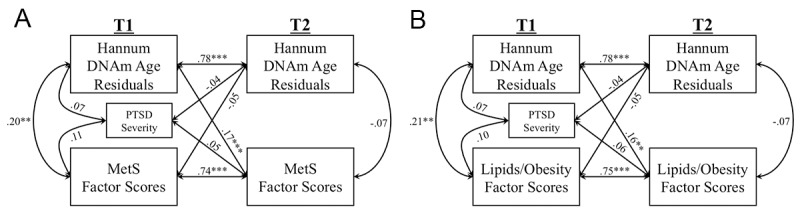
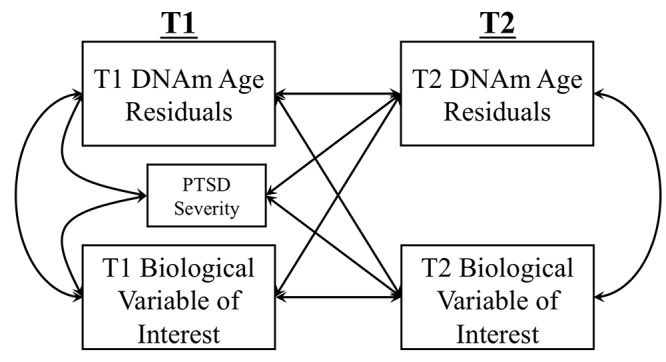
Epigenetic age estimations based on DNA methylation (DNAm) can predict human chronological age with a high level of accuracy. These DNAm age algorithms can also be used to index advanced cellular age, when estimated DNAm age exceeds chronological age. Advanced DNAm age has been associated with several diseases and metabolic and inflammatory pathology, but the causal direction of this association is unclear. The goal of this study was to examine potential bidirectional associations between advanced epigenetic age and metabolic and inflammatory markers over time in a longitudinal cohort of 179 veterans with a high prevalence of posttraumatic stress disorder (PTSD) who were assessed over the course of two years. Analyses focused on two commonly investigated metrics of advanced DNAm age derived from the Horvath (developed across multiple tissue types) and Hannum (developed in whole blood) DNAm age algorithms. Results of cross-lagged panel models revealed that advanced Hannum DNAm age at Time 1 (T1) was associated with increased (i.e., accounting for T1 levels) metabolic syndrome (MetS) severity at Time 2 (T2; = < 0.001). This association was specific to worsening lipid panels and indicators of abdominal obesity ( = 0.001). In contrast, no baseline measures of inflammation or metabolic pathology were associated with changes in advanced epigenetic age over time. No associations emerged between advanced Horvath DNAm age and any of the examined biological parameters. Results suggest that advanced epigenetic age, when measured using an algorithm developed in whole blood, may be a prognostic marker of pathological metabolic processes. This carries implications for understanding pathways linking advanced epigenetic age to morbidity and mortality.
基于DNA甲基化(DNAm)的表观遗传年龄估计能够高精度地预测人类实际年龄。当估计的DNAm年龄超过实际年龄时,这些DNAm年龄算法还可用于衡量细胞衰老程度。DNAm年龄超前与多种疾病以及代谢和炎症病理相关,但这种关联的因果方向尚不清楚。本研究的目的是在一个有179名创伤后应激障碍(PTSD)患病率较高的退伍军人的纵向队列中,考察两年期间DNAm年龄超前与代谢和炎症标志物之间潜在的双向关联。分析聚焦于从Horvath(基于多种组织类型开发)和Hannum(基于全血开发)DNAm年龄算法得出的两种常用的DNAm年龄超前指标。交叉滞后面板模型的结果显示,第1时间点(T1)的Hannum DNAm年龄超前与第2时间点(T2)代谢综合征(MetS)严重程度增加(即考虑T1水平)相关(P = < 0.001)。这种关联具体表现为血脂指标恶化和腹部肥胖指标变化(P = 0.001)。相比之下,炎症或代谢病理的基线测量指标与DNAm年龄超前随时间的变化无关。Horvath DNAm年龄超前与任何所检测的生物学参数之间均未出现关联。结果表明,使用基于全血开发的算法测量的DNAm年龄超前可能是病理代谢过程的一个预后标志物。这对于理解将DNAm年龄超前与发病和死亡联系起来的途径具有重要意义。