Peking-Tsinghua Center for Life Sciences (CLS), Academy for Advanced Interdisciplinary Studies, Peking University, Beijing, 100871, China.
Biomedical Pioneering Innovation Center (BIOPIC), School of Life Sciences, Peking University, Beijing, 100871, China.
J Assist Reprod Genet. 2019 Jun;36(6):1263-1271. doi: 10.1007/s10815-019-01451-8. Epub 2019 Jun 11.
This study is aimed at increasing the accuracy of preimplantation genetic test for monogenic defects (PGT-M).
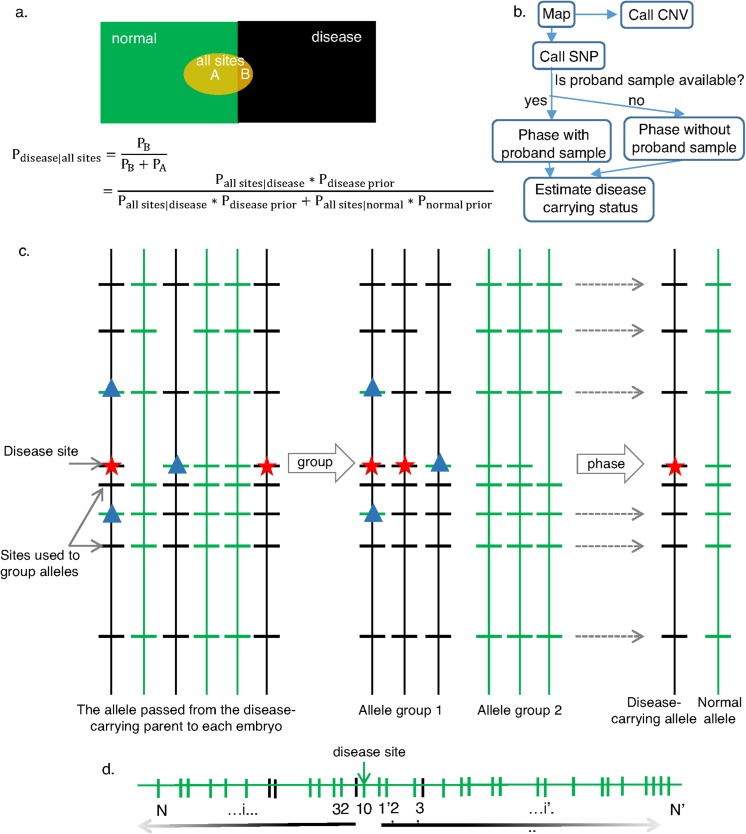
We applied Bayesian statistics to optimize data analyses of the mutated allele revealed by sequencing with aneuploidy and linkage analyses (MARSALA) method for PGT-M. In doing so, we developed a Bayesian algorithm for linkage analyses incorporating PCR SNV detection with genome sequencing around the known mutation sites in order to determine quantitatively the probabilities of having the disease-carrying alleles from parents with monogenic diseases. Both recombination events and sequencing errors were taken into account in calculating the probability.
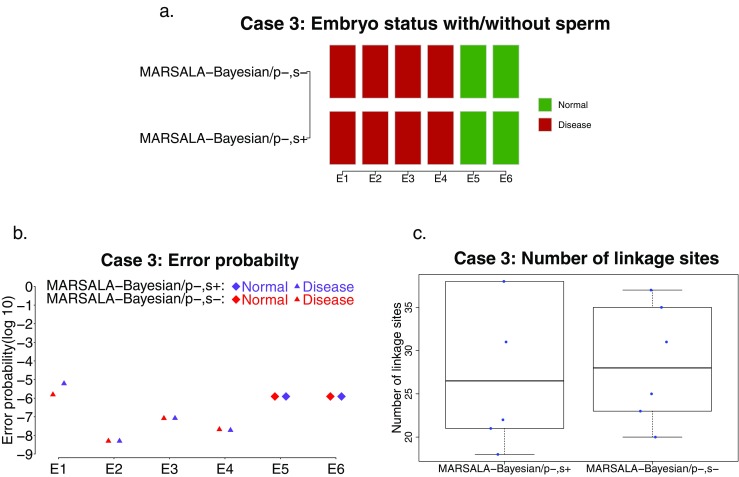
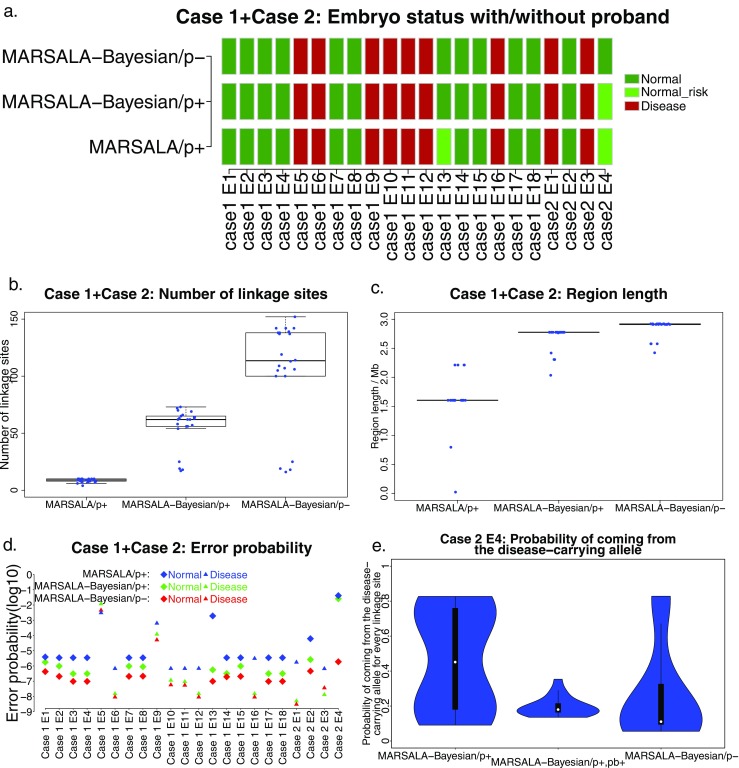
Data of 28 in vitro fertilized embryos from three couples were retrieved from two published research articles by Yan et al. (Proc Natl Acad Sci. 112:15964-9, 2015) and Wilton et al. (Hum Reprod. 24:1221-8, 2009). We found the embryos deemed "normal" and selected for transfer in the previous publications were actually different in error probability of 10-4%. Notably, our Bayesian model reduced the error probability to 10-10%. Furthermore, a proband sample is no longer required by our new method, given a minimum of four embryos or sperm cells.
The error probability of PGT-M can be significantly reduced by using the Bayesian statistics approach, increasing the accuracy of selecting healthy embryos for transfer with or without a proband sample.
本研究旨在提高单基因缺陷植入前遗传学检测(PGT-M)的准确性。
我们应用贝叶斯统计学来优化测序的非整倍体和连锁分析(MARSALA)方法揭示的突变等位基因的数据分析,用于 PGT-M。为此,我们开发了一种贝叶斯连锁分析算法,将 PCR SNV 检测与基因组测序结合起来,以确定来自携带单基因疾病的父母的致病等位基因的概率。在计算概率时,考虑了重组事件和测序错误。
从 Yan 等人发表的两篇研究文章中检索到来自三对夫妇的 28 个体外受精胚胎的数据。(Proc Natl Acad Sci. 112:15964-9, 2015)和 Wilton 等人。(Hum Reprod. 24:1221-8, 2009)。我们发现以前的出版物中被认为“正常”并选择转移的胚胎实际上在 10-4%的错误概率上有所不同。值得注意的是,我们的贝叶斯模型将错误概率降低到 10-10%。此外,我们的新方法不再需要先证者样本,只需至少四个胚胎或精子细胞。
通过使用贝叶斯统计学方法,PGT-M 的错误概率可以显著降低,从而提高了在有无先证者样本的情况下选择健康胚胎进行转移的准确性。