Department of Inflammation and Immunity, Lerner Research Institute, Cleveland Clinic, Cleveland, OH.
Transgenic Animal Model Core and.
Blood Adv. 2019 Jun 25;3(12):1808-1814. doi: 10.1182/bloodadvances.2019031591.
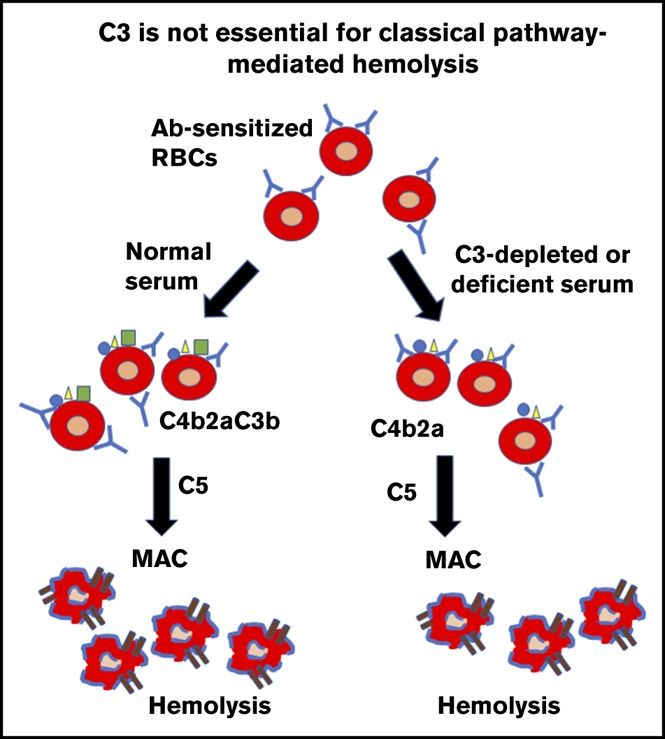
Complement component 3 (C3) is emerging as a potential therapeutic target. We studied complement-mediated hemolysis using normal and C3-depleted human sera, wild-type (WT) and C3-deficient rat sera, and WT and C3 knockout rat models. In all of the in vitro and in vivo experiments, we found that the loss of C3 did not prevent classical pathway-mediated hemolysis, but it did almost abolish alternative pathway-mediated hemolysis. Experiments using preassembled classical pathway C3 convertases confirmed that C4b2a directly activated complement component 5 (C5), leading to membrane attack complex formation and hemolysis. Our results suggest that targeting C3 should effectively inhibit hemolysis and tissue damage mediated by the alternative pathway of complement activation, but this approach might have limited efficacy in treating classical pathway-mediated pathological conditions.
补体成分 3(C3)正成为一个有潜力的治疗靶点。我们使用正常和 C3 耗尽的人血清、野生型(WT)和 C3 缺乏的大鼠血清以及 WT 和 C3 基因敲除大鼠模型研究了补体介导的溶血。在所有的体外和体内实验中,我们发现 C3 的缺失并没有阻止经典途径介导的溶血,但它几乎完全抑制了替代途径介导的溶血。使用预组装的经典途径 C3 转化酶的实验证实 C4b2a 可直接激活补体成分 5(C5),导致膜攻击复合物的形成和溶血。我们的结果表明,靶向 C3 应该可以有效地抑制补体激活替代途径介导的溶血和组织损伤,但这种方法在治疗经典途径介导的病理状况方面可能效果有限。