School of Biological Sciences, Queen's University Belfast, Belfast, UK.
School of Biological, Earth and Environmental Sciences, University College Cork, Cork, Ireland.
J Fish Biol. 2019 Sep;95(3):692-718. doi: 10.1111/jfb.14005. Epub 2019 Jun 13.
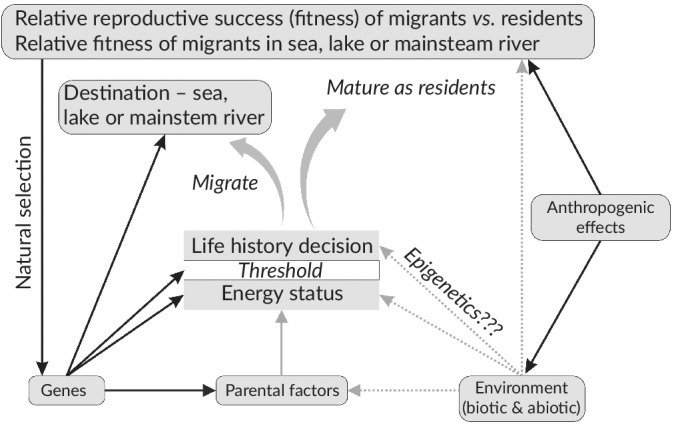
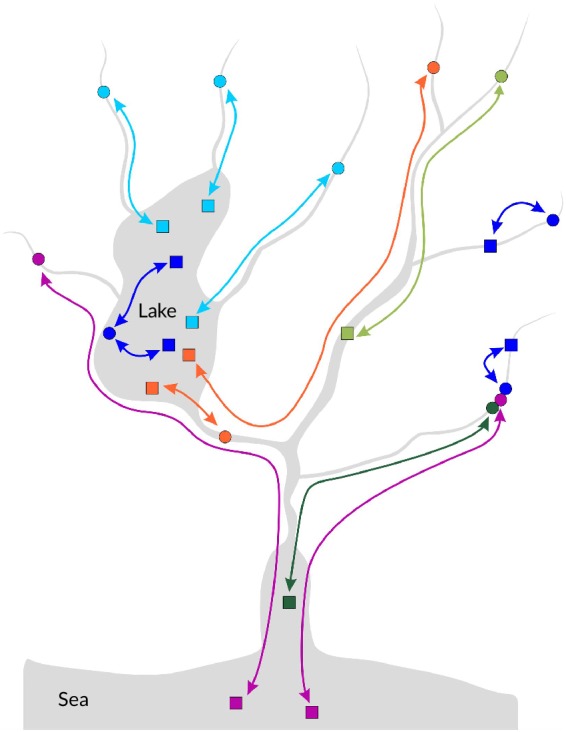
Brown trout Salmo trutta is endemic to Europe, western Asia and north-western Africa; it is a prominent member of freshwater and coastal marine fish faunas. The species shows two resident (river-resident, lake-resident) and three main facultative migratory life histories (downstream-upstream within a river system, fluvial-adfluvial potamodromous; to and from a lake, lacustrine-adfluvial (inlet) or allacustrine (outlet) potamodromous; to and from the sea, anadromous). River-residency v. migration is a balance between enhanced feeding and thus growth advantages of migration to a particular habitat v. the costs of potentially greater mortality and energy expenditure. Fluvial-adfluvial migration usually has less feeding improvement, but less mortality risk, than lacustrine-adfluvial or allacustrine and anadromous, but the latter vary among catchments as to which is favoured. Indirect evidence suggests that around 50% of the variability in S. trutta migration v. residency, among individuals within a population, is due to genetic variance. This dichotomous decision can best be explained by the threshold-trait model of quantitative genetics. Thus, an individual's physiological condition (e.g., energy status) as regulated by environmental factors, genes and non-genetic parental effects, acts as the cue. The magnitude of this cue relative to a genetically predetermined individual threshold, governs whether it will migrate or sexually mature as a river-resident. This decision threshold occurs early in life and, if the choice is to migrate, a second threshold probably follows determining the age and timing of migration. Migration destination (mainstem river, lake, or sea) also appears to be genetically programmed. Decisions to migrate and ultimate destination result in a number of subsequent consequential changes such as parr-smolt transformation, sexual maturity and return migration. Strong associations with one or a few genes have been found for most aspects of the migratory syndrome and indirect evidence supports genetic involvement in all parts. Thus, migratory and resident life histories potentially evolve as a result of natural and anthropogenic environmental changes, which alter relative survival and reproduction. Knowledge of genetic determinants of the various components of migration in S. trutta lags substantially behind that of Oncorhynchus mykiss and other salmonines. Identification of genetic markers linked to migration components and especially to the migration-residency decision, is a prerequisite for facilitating detailed empirical studies. In order to predict effectively, through modelling, the effects of environmental changes, quantification of the relative fitness of different migratory traits and of their heritabilities, across a range of environmental conditions, is also urgently required in the face of the increasing pace of such changes.
虹鳟 Salmo trutta 是欧洲、西亚和西北非的特有种;它是淡水和沿海海洋鱼类区系的重要成员。该物种具有两种定居(河栖、湖栖)和三种主要的兼性洄游生活史(在河流系统内上下游迁徙、河流-入海口洄游;往返湖泊、入湖-出湖洄游;往返海洋、溯河洄游)。河栖与洄游的平衡取决于迁移到特定栖息地的摄食和生长优势与潜在更大死亡率和能量消耗的成本之间的平衡。与溯河洄游和湖泊-入湖洄游或全湖洄游相比,河流-入海口洄游的摄食改善通常较少,但死亡率风险较低,但不同流域之间的后两者有所偏好。间接证据表明,在一个种群内个体之间,鲑鱼迁徙与定居的约 50%的变异性归因于遗传方差。这种二分决策可以通过数量遗传学的阈值性状模型得到最好的解释。因此,个体的生理状况(例如,能量状态)由环境因素、基因和非遗传亲本效应调节,作为线索。相对于个体遗传决定的阈值,线索的大小决定它是迁移还是作为河栖个体性成熟。这个决策阈值在生命早期发生,如果选择迁移,可能会遵循第二个阈值来确定迁移的年龄和时间。洄游目的地(干流、湖泊或海洋)似乎也是遗传编程的。迁移和最终目的地的决定导致许多随后的 consequential 变化,如幼鱼-成鱼转变、性成熟和返回洄游。大多数洄游综合征的方面都发现与一个或几个基因有很强的关联,间接证据支持遗传参与所有部分。因此,洄游和定居的生活史可能会随着自然和人为环境变化而进化,这些变化会改变相对存活率和繁殖率。与虹鳟 Oncorhynchus mykiss 和其他鲑鱼相比,虹鳟各种洄游成分的遗传决定因素的知识明显滞后。识别与洄游成分相关的遗传标记,特别是与洄游-定居决策相关的遗传标记,是在面对环境变化加速的情况下,促进详细实证研究的前提。为了通过建模有效地预测环境变化的影响,还需要在一系列环境条件下量化不同洄游特征的相对适应性及其遗传力。