
入院时和出院时心力衰竭患者的血尿素氮变化。
Blood urea nitrogen variation upon admission and at discharge in patients with heart failure.
机构信息
Pulmonology Division, Lady Davis Carmel Medical Center, Haifa, Israel.
Internal Medicine Department B, Rambam Health Care Campus, PO Box 9602, Haifa, 31096, Israel.
出版信息
ESC Heart Fail. 2019 Aug;6(4):809-816. doi: 10.1002/ehf2.12471. Epub 2019 Jun 14.
AIMS
Heart failure (HF) is one of the leading causes for hospitalization and mortality. After first admission with acute decompensated HF, some patients are in high risk for short-term and long-term mortality. These patients should be identified, closely followed up, and treated. It has been observed that blood urea nitrogen (BUN) on admission is a predictive marker for short-term mortality. Recently, it has been shown that higher BUN levels on discharge are also a bad prognostic predictor. However, the prognostic value of BUN alteration during hospital stay was not investigated; therefore, we aimed to investigate the effect of BUN variation during hospitalization on mortality.
METHODS AND RESULTS
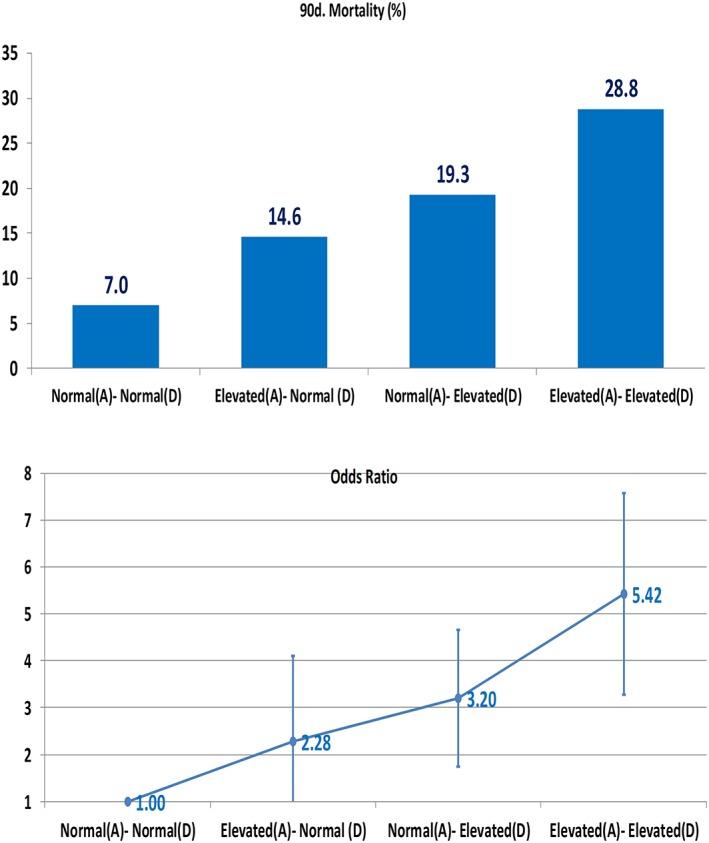
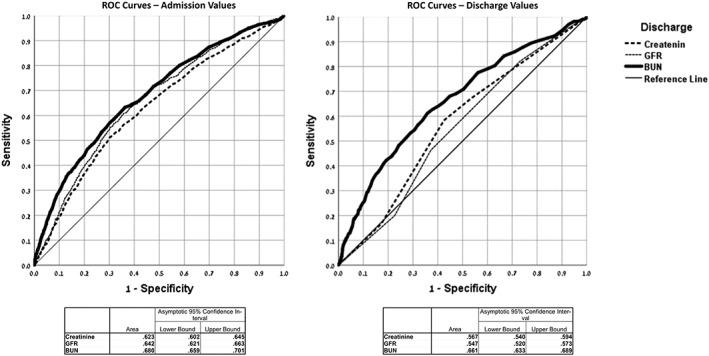
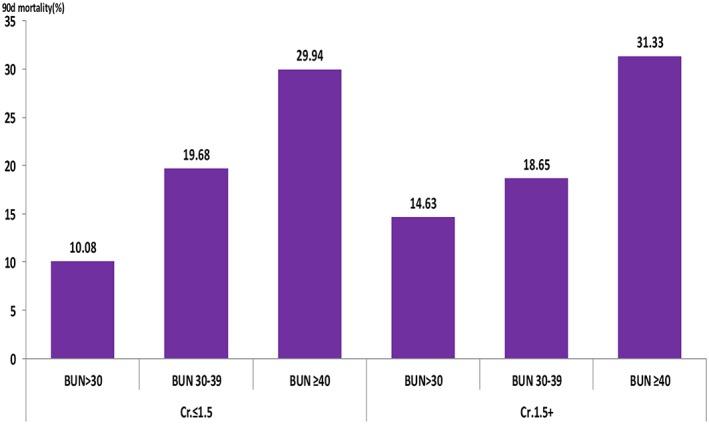
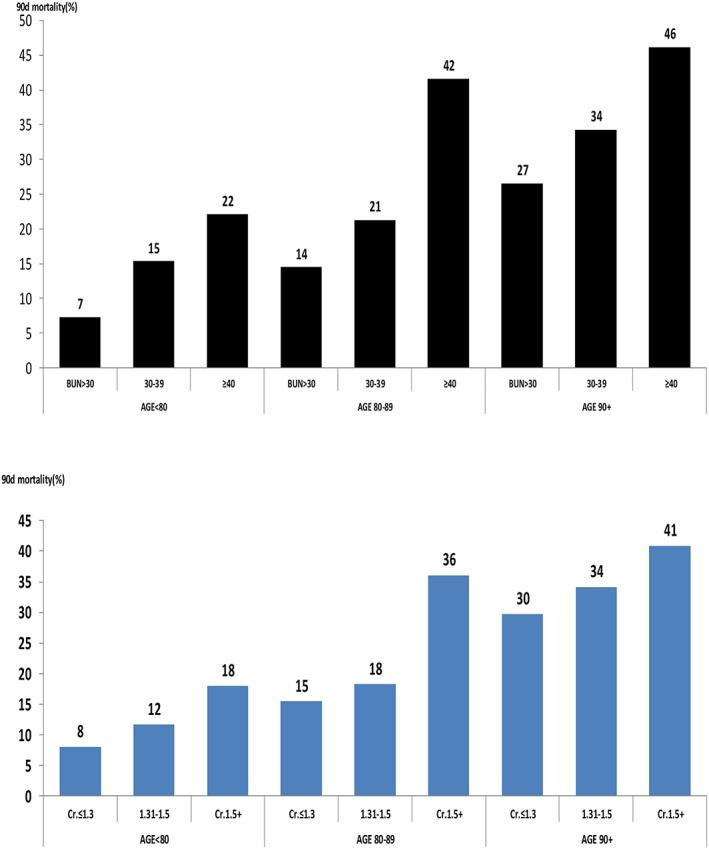
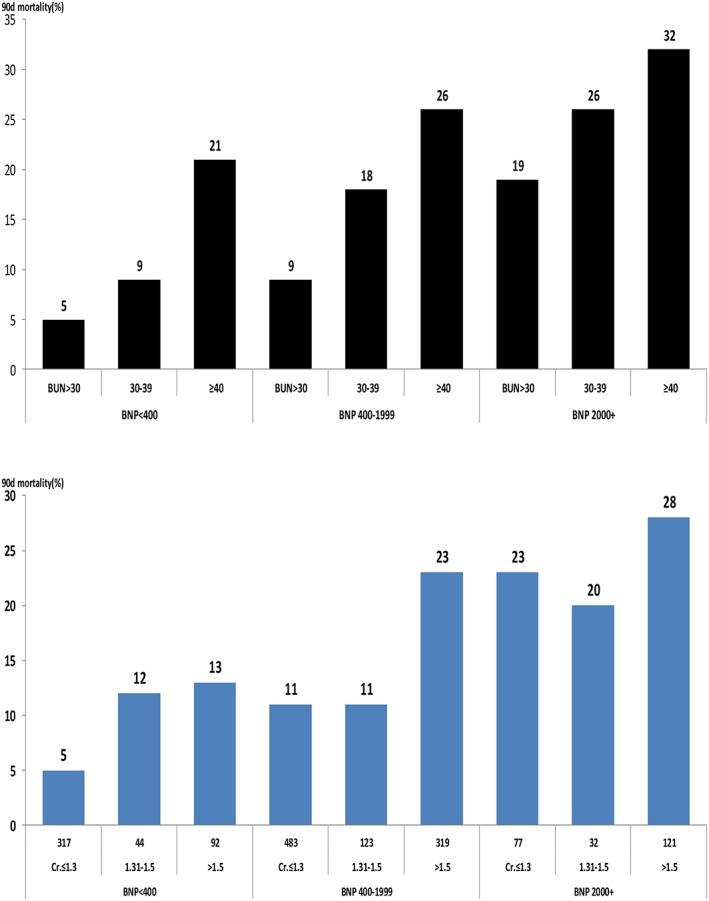
A retrospective study included patients with first hospitalization with the primary diagnosis of HF. The patients were divided into four groups on the basis of the values of BUN on admission and discharge, respectively: normal-normal, elevated-normal, normal-elevated, and elevated-elevated. Four thousand seven hundred sixty-eight patients were included; 2567 were male (53.8%); the mean age was 74.7 ± 12.7 years. The 90 day mortality rate in the normal-normal group was 7% lower than that in the elevated-normal (14.6%) and normal-elevated (19.3%) groups; P value < 0.01. The 90 day mortality in the elevated-elevated group (28.8%) was significantly higher than that in the other groups; P < 0.001. During the 36 month follow-up, these results are maintained. While sub-dividing BUN levels into <30, 30-39, and >40 mg/dL, higher BUN levels correlated with higher 90 day mortality rate regardless of creatinine levels, brain natriuretic peptide, or age. Moreover, BUN on admission and on discharge correlated better with mortality than did creatinine and glomerular filtration rate at the same points.
CONCLUSIONS
The BUN both on admission and on discharge is a prognostic predictor in patients with HF; however, patients with elevated levels both on admission and on discharge have the worst prognosis. Moreover, worsening or lack of improvement in BUN during hospitalization is a worse prognostic predictor. To the best of our knowledge, this is the first trial to discuss the BUN change during hospitalization in HF.
目的
心力衰竭(HF)是住院和死亡的主要原因之一。在首次因急性失代偿性 HF 入院后,一些患者存在短期和长期死亡的高风险。这些患者应被识别出来,密切随访,并进行治疗。已经观察到入院时的血尿素氮(BUN)是短期死亡率的预测指标。最近,已经表明出院时更高的 BUN 水平也是预后不良的预测指标。然而,住院期间 BUN 变化的预后价值尚未得到研究;因此,我们旨在研究住院期间 BUN 变化对死亡率的影响。
方法和结果
一项回顾性研究纳入了首次因 HF 住院的患者。根据入院和出院时的 BUN 值,患者分为四组:正常-正常、升高-正常、正常-升高和升高-升高。共纳入 4768 例患者,其中 2567 例为男性(53.8%);平均年龄为 74.7±12.7 岁。正常-正常组的 90 天死亡率比升高-正常组(14.6%)和正常-升高组(19.3%)低 7%,P 值<0.01。升高-升高组(28.8%)的 90 天死亡率明显高于其他组,P<0.001。在 36 个月的随访中,这些结果得以维持。将 BUN 水平进一步细分为<30、30-39 和>40mg/dL 时,无论肌酐水平、脑钠肽或年龄如何,较高的 BUN 水平与较高的 90 天死亡率相关。此外,入院时和出院时的 BUN 与死亡率的相关性优于同一时间点的肌酐和肾小球滤过率。
结论
入院和出院时的 BUN 都是 HF 患者的预后预测指标;然而,入院和出院时 BUN 水平升高的患者预后最差。此外,住院期间 BUN 恶化或无改善是预后更差的预测指标。据我们所知,这是第一项讨论 HF 住院期间 BUN 变化的试验。

 Zotero 插件