Huang Dan, Hou Mengshu, Lu Weidang
School of Computer Science and Engineering, University of Electronic Science and Technology of China, Chengdu 610054, China.
College of Information Engineering, Zhejiang University of Technology, Hangzhou 310014, China.
Sensors (Basel). 2019 Jun 13;19(12):2663. doi: 10.3390/s19122663.
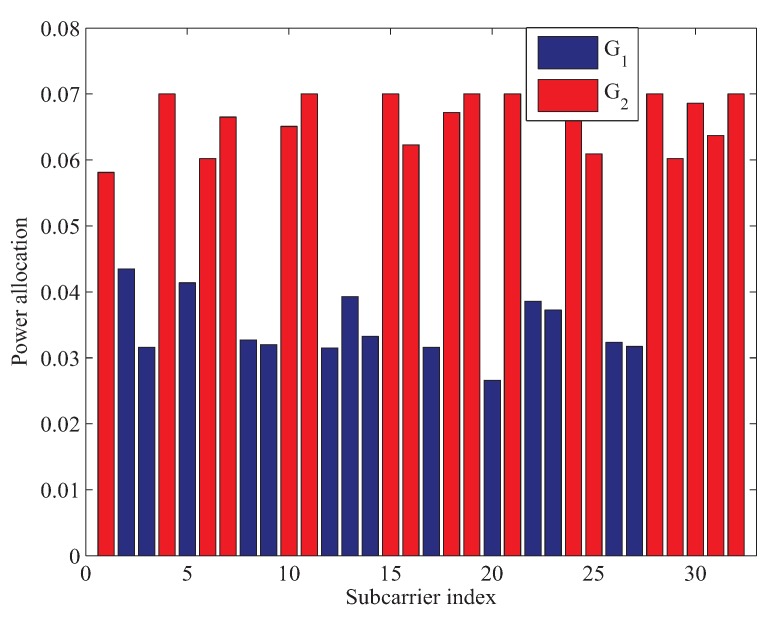
In this paper, we propose subcarrier allocation based cooperative spectrum sharing protocol for OFDM relaying networks with wireless energy harvesting. In the proposed protocol, the cognitive relay node utilizes different subcarriers to forward the primary information to obtain the spectrum access for the cognitive system transmission. The primary system consists of two parts, a primary transmitter (PT) and primary receiver (PR), and cognitive system includes a cognitive source node (CSN), cognitive destination node (CDN) and cognitive relay node (CRN). In the first phase, CRN splits a fraction of the power received from the PT and CSN transmission to decode information, while the remaining power is used for energy harvesting. Then CRN uses disjoint subcarriers to forward the signals of PT and CSN by utilizing the harvested energy in the second phase. Three parameters which consist of power splitting ratio, power allocation and subcarriers allocation are optimized in our algorithm to maximize the cognitive transmission rate with the constraint of primary target transmission rate. Numerical and simulation results are shown to give useful insights into the proposed cooperative spectrum sharing protocol, and we also found that various system parameters have a great effect for the simulation results.
在本文中,我们为具有无线能量收集功能的正交频分复用(OFDM)中继网络提出了基于子载波分配的协作频谱共享协议。在所提出的协议中,认知中继节点利用不同的子载波转发主信息,以获取认知系统传输的频谱接入。主系统由两部分组成,即主发射机(PT)和主接收机(PR),而认知系统包括认知源节点(CSN)、认知目的节点(CDN)和认知中继节点(CRN)。在第一阶段,认知中继节点将从主发射机和认知源节点传输中接收到的一部分功率用于解码信息,而其余功率则用于能量收集。然后,认知中继节点在第二阶段利用收集到的能量,使用不相交的子载波转发主发射机和认知源节点的信号。在我们的算法中,对功率分配比、功率分配和子载波分配这三个参数进行了优化,以在主目标传输速率的约束下最大化认知传输速率。数值和仿真结果展示了所提出的协作频谱共享协议的有用见解,并且我们还发现各种系统参数对仿真结果有很大影响。