
雌三醇对长期雌激素剥夺的乳腺癌细胞及低剂量对激素敏感细胞的促凋亡作用。
Pro-Apoptotic Effects of Estetrol on Long-Term Estrogen-Deprived Breast Cancer Cells and at Low Doses on Hormone-Sensitive Cells.
作者信息
Yue Wei, Verhoeven Carole, Bernnink Herjan Coelingh, Wang Ji-Ping, Santen Richard J
机构信息
Department of Medicine, Division of Endocrinology & Metabolism, University of Virginia Health Systems, Charlottesville, VA, USA.
Pantarhei Oncology, Zeist, The Netherlands.
出版信息
Breast Cancer (Auckl). 2019 May 15;13:1178223419844198. doi: 10.1177/1178223419844198. eCollection 2019.
PURPOSE
Postmenopausal women with estrogen receptor-positive breast cancers often respond initially to tamoxifen or aromatase inhibitor therapy. Resistance to these treatments usually develops within 12 to 18 months. Clinical studies have demonstrated that high-dose estrogen can induce regression of these endocrine-resistant tumors. However, side-effects of high-dose estradiol (E) or diethylstilbestrol (DES) limit their usage. Estetrol (E) is the most abundant estrogen during pregnancy and has a long half-life and a low potential for side-effects. Estetrol might then provide benefits similar to DES on tumor regression but with lesser toxicity.
METHODS
In this study, we systematically evaluated the effects of E on cell proliferation and apoptosis in wild-type MCF-7 and long-term estrogen-deprived (LTED) MCF-7 cells and compared its effects with E and estriol (E).
RESULTS
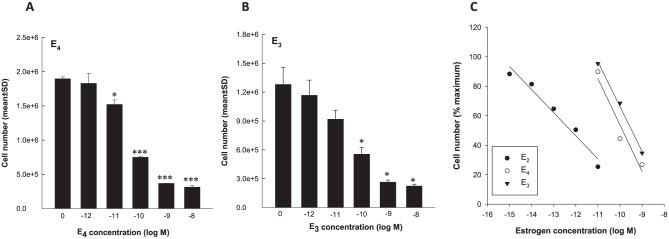
Estetrol induced apoptosis in LTED cells but stimulated growth of MCF-7 cells at concentrations from 10 to 10 M. These effects of E are similar to those of E but require much higher doses. Differing from E, E at 10 M induced apoptosis in MCF-7 cells and another pregnancy estrogen, E, acted similarly. No antagonistic effect of E or E against E occurred when they were combined.
CONCLUSIONS
The pro-apoptotic effects of E and E on LTED cells and at low doses on MCF-7 cells indicate that these steroids could be used as therapeutic agents for endocrine-resistant or sensitive breast cancer.
目的
雌激素受体阳性乳腺癌的绝经后女性通常最初对他莫昔芬或芳香化酶抑制剂治疗有反应。对这些治疗的耐药性通常在12至18个月内出现。临床研究表明,高剂量雌激素可诱导这些内分泌耐药肿瘤的消退。然而,高剂量雌二醇(E)或己烯雌酚(DES)的副作用限制了它们的使用。雌三醇(E)是孕期最丰富的雌激素,半衰期长且副作用可能性低。雌三醇可能在肿瘤消退方面提供与己烯雌酚相似的益处,但毒性较小。
方法
在本研究中,我们系统评估了E对野生型MCF-7和长期雌激素剥夺(LTED)的MCF-7细胞中细胞增殖和凋亡的影响,并将其与E和雌三醇(E)的作用进行比较。
结果
雌三醇在LTED细胞中诱导凋亡,但在10至10 M浓度下刺激MCF-7细胞生长。E的这些作用与E相似,但需要更高剂量。与E不同,10 M的E在MCF-7细胞中诱导凋亡,另一种孕期雌激素E的作用相似。E或E与E联合使用时未出现拮抗作用。
结论
E和E对LTED细胞以及低剂量对MCF-7细胞的促凋亡作用表明,这些类固醇可作为内分泌耐药或敏感乳腺癌的治疗药物。




 Zotero 插件